
Free Safe Operating Procedure (Waste Stream Sorting) Template
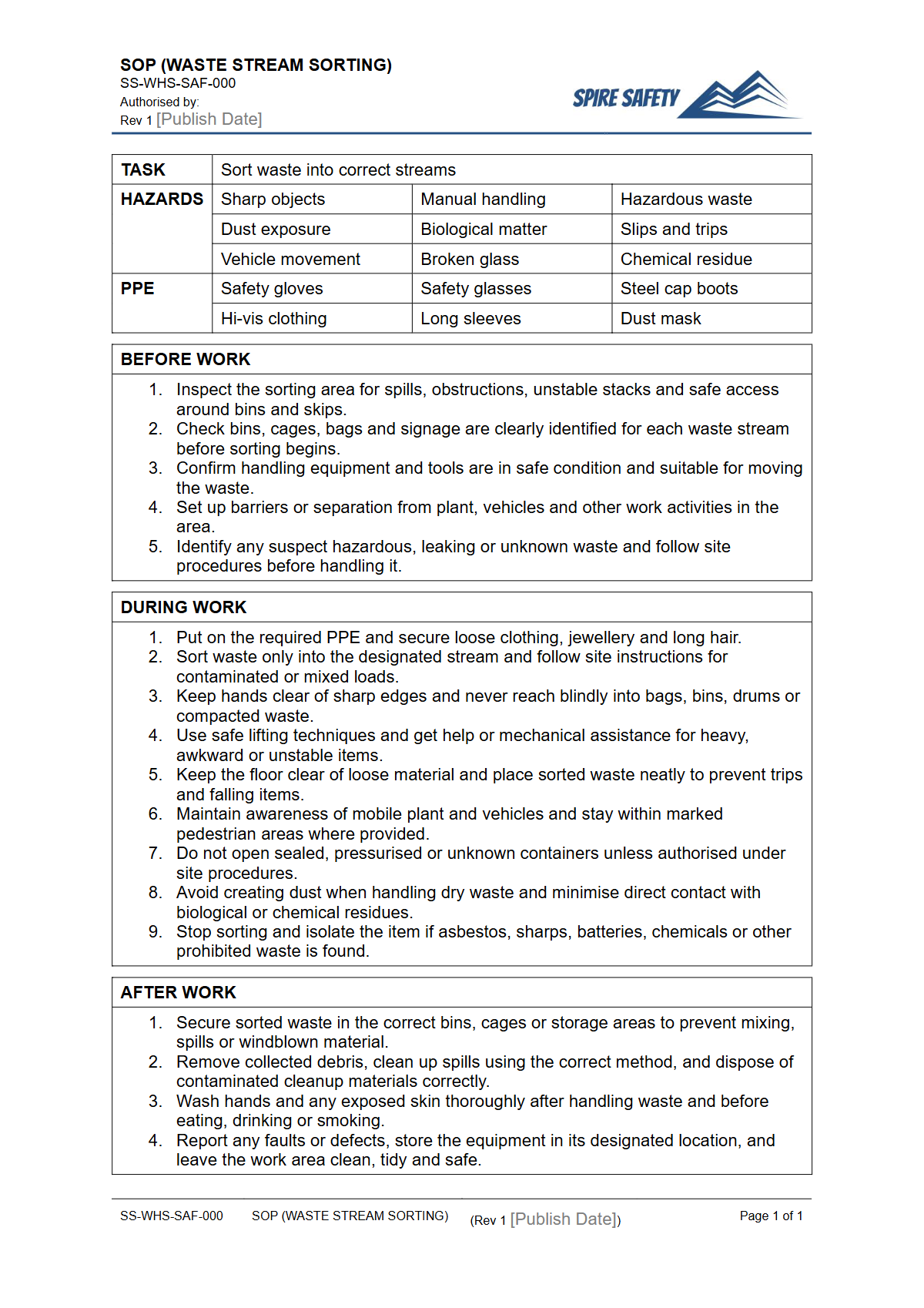
Download our free Safe Operating Procedure (Waste Stream Sorting) Template. This user-friendly DOCX and PDF helps you define safe work methods.
Free Safe Operating Procedure (Waste Stream Sorting) Template
DOCX • 126 KB + PDF
Updated Oct 2026
No signup required
Purpose of the Free Safe Operating Procedure (Waste Stream Sorting) Template
Properly managing waste streams is more than an environmental responsibility; it's a critical component of workplace health and safety. The process of sorting waste can expose workers to numerous hazards, including manual handling injuries, cuts from sharp objects, exposure to hazardous chemicals, and biological contaminants.
This free Safe Operating Procedure (Waste Stream Sorting) Template provides a structured starting point for your organisation to document and formalise the safe methods required for this common but often overlooked task.
Implementing a clear SOP helps in systematically identifying these hazards and outlining robust control measures. It serves as a key training tool for workers, ensuring everyone understands the expected safe work practices, required personal protective equipment (PPE), and emergency procedures.
Using this template helps embed safe waste handling into your broader WHS management systems, demonstrating a proactive approach to risk management and promoting a consistent safety culture across your operations.
Video walkthrough
How to use the Free Safe Operating Procedure (Waste Stream Sorting) Template
This document is a template designed to be adapted to the specific context of your workplace. Download the DOCX file and customise it to reflect your site's unique waste streams, equipment, layout, and risks.
A PDF version is also available for easy distribution once finalised. It is crucial to conduct a site-specific risk assessment for waste sorting activities to inform the content of your SOP.
Important: This is a template and not a complete document. To be effective, you must customise it with your specific operational details.
We recommend involving the workers who perform the task in the drafting and review process. Their direct experience is invaluable for creating a practical and effective procedure.
Once customised, ensure the final SOP is communicated to all relevant personnel and that they are trained in its contents. A periodic review by your team or through a WHS compliance audit can verify its ongoing effectiveness and relevance.
When to use it
A Safe Operating Procedure for waste stream sorting should be an active document within your safety management system. It is essential when inducting new employees or contractors who will be involved in waste handling.
It should also be used as a basis for refresher training to prevent complacency and reinforce correct procedures. This SOP is particularly valuable when introducing new types of waste into your facility or changing the sorting process or equipment.
Following any incident, near miss, or the identification of a new hazard related to waste sorting, this procedure should be reviewed and updated accordingly. Regularly scheduled reviews, typically on an annual basis, ensure the document remains current with operational practices and legislative requirements.
For associated tasks, such as moving large containers, you may also need procedures like a body truck SOP to cover vehicle-related risks.
Who should use it
This template is designed for use by Persons Conducting a Business or Undertaking (PCBUs), WHS managers, supervisors, and team leaders. It is their responsibility to ensure safe systems of work are developed, implemented, and maintained.
These leaders will use the template to create a workplace-specific document that gives workers clear, unambiguous instructions for safely performing their duties.
Frontline workers are the ultimate end-users of the finalised SOP. They will refer to it during training and as a daily reference for correct procedures.
The SOP should be readily accessible in the work area where waste sorting occurs. For activities that might require working at height, such as accessing large industrial bins, it's vital to have separate procedures, like a step ladder SOP, to address those specific risks.
If you need assistance adapting this template or developing comprehensive safety procedures, consider seeking expert WHS consulting services. You can also explore our free WHS resources library for other useful templates and guides.
Common mistakes
Common mistakes to avoid
- Failing to conduct a specific risk assessment for all waste streams present.
- Providing generic, non-puncture-resistant gloves that offer inadequate protection.
- Neglecting to train workers on how to identify and segregate potentially hazardous waste.
- Storing the finalised SOP in an office, making it inaccessible to workers at the point of work.
Legal references
Legal considerations
The following legal requirements may be relevant to this type of work.
- Work Health and Safety Act (Harmonised) — Provides the primary duties for protecting workers and other people from work health and safety risks.
- Work Health and Safety Regulations (Harmonised) — Sets out requirements supporting the management of workplace hazards and risks.
The following codes may be relevant to this type of work.
- Managing WHS Risks Code of Practice — Provides practical guidance on identifying hazards, assessing risks and applying effective controls.
- Work Health and Safety Consultation, Cooperation and Coordination Code of Practice — Provides practical guidance on consulting workers and coordinating with other duty holders.
- Managing the Work Environment and Facilities Code of Practice — Provides practical guidance on safe work environments, workplace facilities and related controls.
Did you know
Manual Handling Risk
According to Safe Work Australia, injuries resulting from manual handling are the most common type of workplace injury in the country, making SOPs for tasks like waste sorting especially important.
The Waste Hierarchy
The universally recognised waste hierarchy prioritises actions to reduce waste: Avoid, Reduce, Reuse, Recycle, Recover, and lastly, Dispose. Your sorting procedure is a key part of the 'Recycle' and 'Recover' steps.
FAQ
Frequently asked questions
01What are the primary hazards associated with waste stream sorting?
02How often should a Waste Stream Sorting SOP be reviewed?
03What kind of PPE is needed for waste sorting?
04What is the difference between an SOP and a SWMS for waste sorting?
Share this resource
Free Safe Operating Procedure (Waste Stream Sorting) Template
Browse Categories
How To Use It
- 1Download and open in Word or PDF.
- 2Replace the placeholders with your business details.
- 3Get it reviewed by a WHS specialist before rollout.
Need it customised?
Our WHS consultants can adapt this template to your site, run a gap analysis, or audit what you already have in place.
Book a Free Consultation WHS consulting servicesor call 1300 156 382
Related templates
- Free Safe Operating Procedure (Waste Transfer Handover) Template
- Free Safe Operating Procedure (Wastewater Sampling) Template
- Free Safe Operating Procedure (Water Bath) Template
- Free Safe Operating Procedure (Water Leak Response) Template
- Free Safe Operating Procedure (Water Level Meter) Template
- Free Safe Operating Procedure (Water Main Burst Response) Template