
Free Safe Operating Procedure (Waste Load Inspection) Template
Effectively manage hazards associated with waste load inspections with our structured SOP template. Download your free DOCX and PDF to get started today.
Free Safe Operating Procedure (Waste Load Inspection) Template
DOCX • 126 KB + PDF
Updated Oct 2026
No signup required
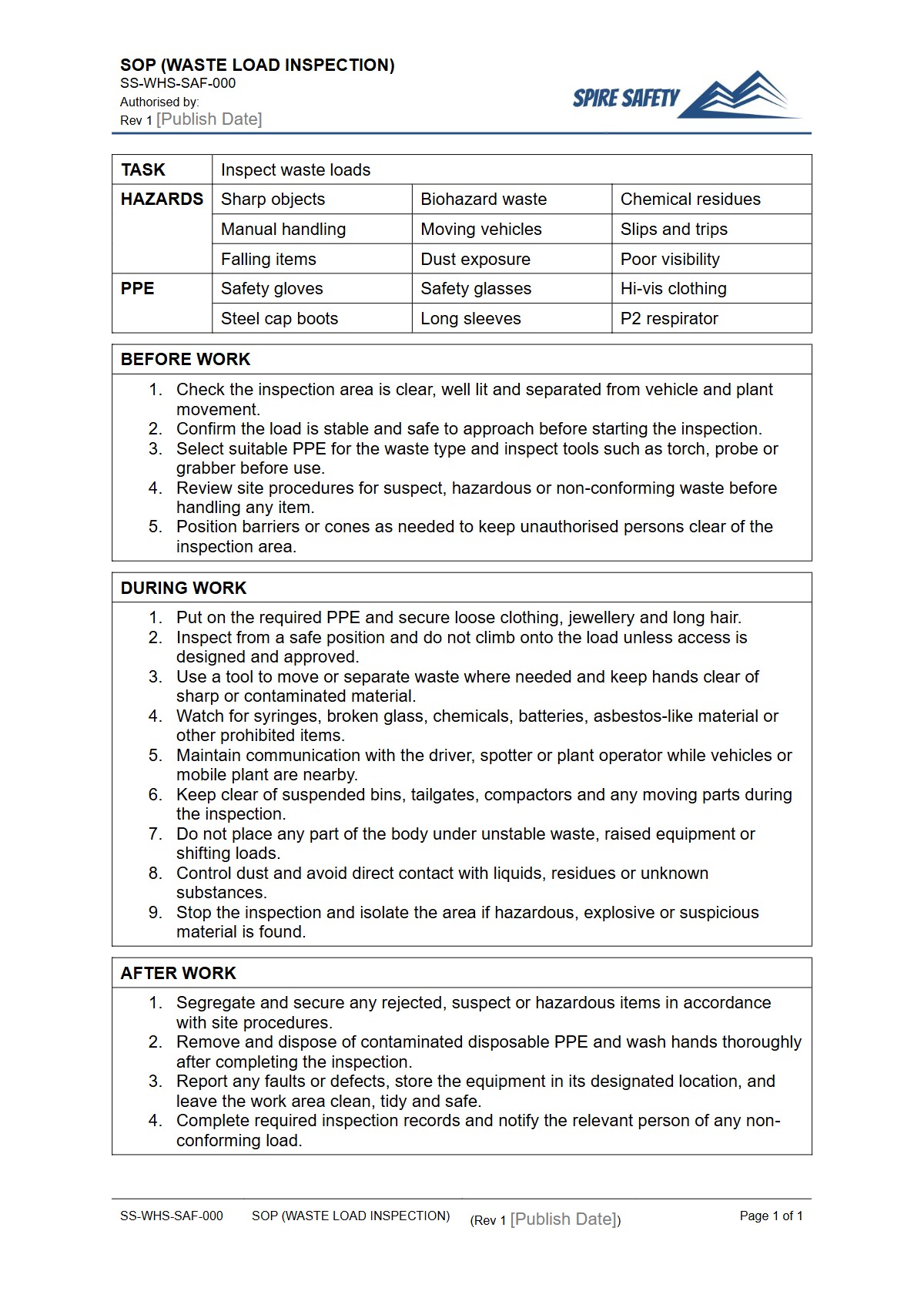
Purpose of the Free Safe Operating Procedure (Waste Load Inspection) Template
Inspecting incoming waste loads is a critical control point for any facility that processes, recycles, or disposes of waste. This task carries significant risks, including exposure to hazardous materials, physical hazards like sharps or unstable items, and ergonomic injuries.
Our Free Safe Operating Procedure (Waste Load Inspection) Template provides a structured framework for documenting the required steps to perform these inspections safely and consistently. Using a formal SOP helps your organisation meet its duty of care by identifying hazards, implementing controls, and defining clear, repeatable instructions for workers.
This procedure is designed to be a key component of your broader safety framework. A well-drafted SOP demonstrates a commitment to proactive risk management and can be integrated into your existing WHS management systems to ensure a cohesive approach to workplace health and safety.
It establishes a benchmark for expected safe work behaviour, assists in training new employees, and provides a clear reference for all personnel involved in waste receival.
Video walkthrough
How to use the Free Safe Operating Procedure (Waste Load Inspection) Template
This Safe Operating Procedure is available as a fully editable DOCX file and a print-ready PDF. After downloading, you can begin tailoring it to your specific operational context.
The template is structured with key sections including required PPE, pre-operational checks, step-by-step inspection instructions, and emergency procedures. Your task is to populate these sections with details relevant to your site.
IMPORTANT: This is a template only. We have provided a structured starting point, but you must customise this document to reflect the specific equipment, substances, processes, and risks in your workplace.
A competent person with a thorough understanding of your waste streams and operational hazards should oversee the customisation process before the SOP is approved for use.
Waste management often involves heavy machinery to move and process materials post-inspection. If your processes involve using specific plant for this task, ensure operators are trained and competent.
For example, if a telehandler is used to sort or relocate inspected loads, a specific procedure like our FREE Telehandler SOP Template should be referenced and followed.
When to use this Safe Operating Procedure
This SOP should be implemented at any workplace where waste is received from external sources and requires inspection before acceptance or processing. This includes, but is not limited to, waste transfer stations, material recovery facilities (MRFs), scrap metal yards, landfills, and manufacturing sites that accept waste for recycling or energy generation.
The procedure should be followed for every designated load, forming part of the standard receival process. It is a live document that should be used daily by operators and reviewed regularly to ensure it remains current.
Regular verification that the SOP is being followed correctly is also a vital part of maintaining a safe system of work. This can be achieved through direct supervision, toolbox talks, and formal reviews as part of your WHS compliance auditing schedule.
These audits help identify any gaps between the documented procedure and actual work practices.
Who should use this Safe Operating Procedure
This procedure is primarily intended for workers directly responsible for inspecting waste loads, often referred to as waste sorters, spotters, or receival officers. Supervisors and managers should also be thoroughly familiar with the SOP to effectively oversee operations and enforce safe work practices.
Additionally, plant operators who handle the waste after inspection must understand the procedure to be aware of how prohibited or hazardous items are identified and segregated.
For instance, an operator using heavy equipment to manage stockpiles needs to be aware of the inspection outcomes. If your site uses specific machinery for this, it's essential to have documented procedures, such as our FREE Scraper SOP Template, to guide their safe use.
Training on this SOP should be included in the induction for all new employees in relevant roles and as part of ongoing refresher training for existing staff.
In facilities where inspected waste is moved along a sorting line, personnel operating that equipment must also understand the upstream controls. Safe operation of such equipment is paramount, which is why a specific document like our FREE Conveyer System SOP (Safe Operating Procedure) Template can be a crucial addition to your safety documentation. For a wide range of other safety documents, you can browse our complete free WHS resources library.
Common mistakes
Common mistakes to avoid
- Failing to wear the correct task-specific Personal Protective Equipment (PPE).
- Conducting only a superficial visual check instead of a thorough inspection.
- Not following the documented procedure for quarantining and reporting prohibited waste.
- Becoming complacent and rushing the inspection process, especially during peak periods.
Legal references
Legal considerations
The following legal requirements may be relevant to this type of work.
- Work Health and Safety Act (Harmonised) — Provides the primary duties for protecting workers and other people from work health and safety risks.
- Work Health and Safety Regulations (Harmonised) — Sets out requirements supporting the management of workplace hazards and risks.
The following codes may be relevant to this type of work.
- Managing WHS Risks Code of Practice — Provides practical guidance on identifying hazards, assessing risks and applying effective controls.
- Work Health and Safety Consultation, Cooperation and Coordination Code of Practice — Provides practical guidance on consulting workers and coordinating with other duty holders.
- Managing the Work Environment and Facilities Code of Practice — Provides practical guidance on safe work environments, workplace facilities and related controls.
Did you know
Hazardous Waste Generation
According to the National Waste Report 2022, Australia generated an estimated 7.4 million tonnes of hazardous waste in 2020-21. Proper inspection procedures are the first line of defence in identifying and segregating these materials correctly.
FAQ
Frequently asked questions
01What is the main purpose of a waste load inspection SOP?
02Can this template be used for all types of waste facilities?
03How often should waste load inspection procedures be reviewed?
04What are the key hazards during a waste load inspection?
Share this resource
Free Safe Operating Procedure (Waste Load Inspection) Template
Browse Categories
How To Use It
- 1Download and open in Word or PDF.
- 2Replace the placeholders with your business details.
- 3Get it reviewed by a WHS specialist before rollout.
Need it customised?
Our WHS consultants can adapt this template to your site, run a gap analysis, or audit what you already have in place.
Book a Free Consultation WHS consulting servicesor call 1300 156 382
Related templates
- Free Safe Operating Procedure (Waste Load Rejection) Template
- Free Safe Operating Procedure (Waste Load Segregation) Template
- Free Safe Operating Procedure (Waste Oil Collection) Template
- Free Safe Operating Procedure (Waste Stream Sorting) Template
- Free Safe Operating Procedure (Waste Transfer Handover) Template
- Free Safe Operating Procedure (Wastewater Sampling) Template