
Free Safe Operating Procedure (Waste Load Segregation) Template
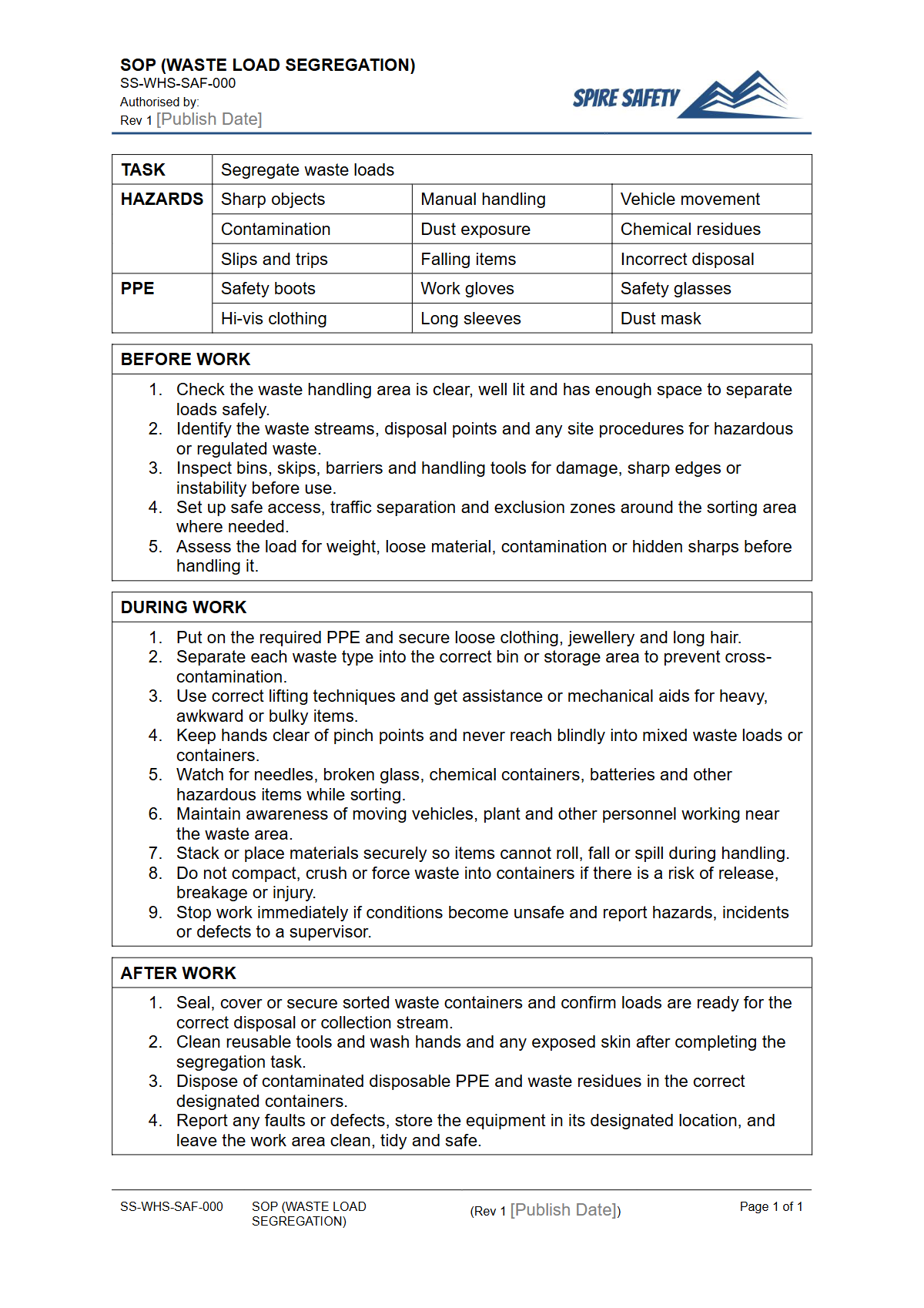
Download our free Safe Operating Procedure (Waste Load Segregation) Template to formalise safe waste handling. Get your customisable DOCX and PDF now.
Free Safe Operating Procedure (Waste Load Segregation) Template
DOCX • 126 KB + PDF
Updated Oct 2026
No signup required
Purpose of the Free Safe Operating Procedure (Waste Load Segregation) Template
Properly segregating waste is a critical control measure in many Australian workplaces, from construction sites and manufacturing facilities to waste management centres. This free Safe Operating Procedure (Waste Load Segregation) Template provides a structured framework for documenting the specific steps required to safely separate different waste streams.
The primary purpose is to prevent hazardous incidents that can occur when incompatible materials are mixed, such as chemical reactions, fires, or the release of toxic gases. It also addresses manual handling risks, required Personal Protective Equipment (PPE), and emergency procedures associated with waste handling tasks.
By implementing a clear SOP, organisations can ensure a consistent and safe approach to waste management, helping to meet their duties under WHS legislation. Formalising this process helps train workers effectively, reduces the likelihood of errors, and provides clear instructions for handling both general and potentially hazardous waste types.
This document serves as a key part of a broader WHS management system, demonstrating a commitment to proactive risk management.
Video walkthrough
How to use the Free Safe Operating Procedure (Waste Load Segregation) Template
This downloadable Safe Operating Procedure template is provided in both DOCX and PDF formats. The DOCX file is fully editable, allowing you to tailor it to the unique requirements of your worksite.
It is crucial to customise this document; it is not a complete, off-the-shelf solution. We have populated it with common headings and prompts, but you must consult with your workers and review your specific site conditions, waste types, machinery, and legal obligations to make it relevant and effective.
When customising, ensure you detail the specific types of waste handled at your facility, the dedicated storage areas, and the correct bins or containers for each. Clearly define the segregation rules—what can and cannot be mixed.
It's also vital to integrate procedures for any machinery used in the process, such as balers or compactors. For related equipment, you might find our FREE Conveyer System SOP template useful for documenting safe transfer processes.
When to use this Safe Operating Procedure
A Waste Load Segregation SOP should be used in any environment where multiple waste streams are generated and need to be managed separately to control risks. This includes, but is not limited to:
- Waste Transfer and Recycling Facilities: Where loads from various sources are received, sorted, and processed.
- Construction and Demolition Sites: For separating materials like concrete, timber, metals, and hazardous substances like asbestos.
- Manufacturing Plants: To manage production offcuts, chemical wastes, packaging, and general refuse.
- Healthcare and Laboratory Settings: For segregating clinical, cytotoxic, chemical, and general waste.
- Warehousing and Logistics Centres: To handle damaged goods, packaging materials, and returned products which may be hazardous.
- Agricultural Operations: For managing chemical containers, organic waste, and other farm-related refuse. You may also need procedures for specific equipment, like our FREE Spreader SOP Template.
Who should use this Safe Operating Procedure
This SOP is intended for all personnel involved in the lifecycle of waste management within an organisation. Key users include:
- Workers and Operators: The primary users who perform the day-to-day tasks of collecting, sorting, and moving waste. They need to understand the procedures to perform their job safely.
- Site Supervisors and Managers: Responsible for implementing the SOP, providing training, monitoring compliance, and ensuring resources (like correct bins and PPE) are available.
- WHS/HSE Officers: Use the SOP as a tool for risk assessments, incident investigations, and workplace inspections. They are often responsible for developing, reviewing, and updating the procedure.
- Plant and Equipment Operators: Individuals operating machinery for waste handling, such as forklifts, excavators, or telehandlers, must be aware of the segregation requirements. Our FREE Telehandler SOP template outlines controls for this type of equipment.
Ultimately, a robust SOP ensures everyone understands their role in the waste management process. Regular reviews of site procedures are essential for maintaining safety standards, a process which can be formalised through WHS compliance auditing to identify any gaps or areas for improvement. For more templates and safety resources, feel free to browse our full free WHS resources library.
Common mistakes
Common mistakes to avoid
- Assuming all workers automatically know which waste materials are incompatible.
- Using inconsistent or poorly labelled bins, leading to accidental mixing.
- Failing to provide specific PPE required for handling different chemical or biological waste types.
- Not updating the SOP to include new waste streams introduced to the worksite.
Legal references
Legal considerations
The following legal requirements may be relevant to this type of work.
- Work Health and Safety Act (Harmonised) — Provides the primary duties for protecting workers and other people from work health and safety risks.
- Work Health and Safety Regulations (Harmonised) — Sets out requirements supporting the management of workplace hazards and risks.
The following codes may be relevant to this type of work.
- Managing WHS Risks Code of Practice — Provides practical guidance on identifying hazards, assessing risks and applying effective controls.
- Work Health and Safety Consultation, Cooperation and Coordination Code of Practice — Provides practical guidance on consulting workers and coordinating with other duty holders.
- Managing the Work Environment and Facilities Code of Practice — Provides practical guidance on safe work environments, workplace facilities and related controls.
Did you know
Chemical Cocktails
Mixing common incompatible waste streams, such as acid-based cleaners and chlorine bleach, can release highly toxic chlorine gas. This poses an immediate and severe respiratory hazard to anyone in the vicinity.
Spontaneous Combustion
Spontaneous combustion is a significant fire risk in mixed waste. Materials like oily rags, sawdust, or certain chemicals can self-heat to the point of ignition when piled together, especially in poorly ventilated areas.
FAQ
Frequently asked questions
01What are the biggest risks of not segregating waste loads properly?
02Does this SOP cover hazardous waste disposal?
03Who is responsible for training workers on this Safe Operating Procedure?
04How often should a Waste Load Segregation SOP be reviewed?
Share this resource
Free Safe Operating Procedure (Waste Load Segregation) Template
Browse Categories
How To Use It
- 1Download and open in Word or PDF.
- 2Replace the placeholders with your business details.
- 3Get it reviewed by a WHS specialist before rollout.
Need it customised?
Our WHS consultants can adapt this template to your site, run a gap analysis, or audit what you already have in place.
Book a Free Consultation WHS consulting servicesor call 1300 156 382
Related templates
- Free Safe Operating Procedure (Waste Oil Collection) Template
- Free Safe Operating Procedure (Waste Stream Sorting) Template
- Free Safe Operating Procedure (Waste Transfer Handover) Template
- Free Safe Operating Procedure (Wastewater Sampling) Template
- Free Safe Operating Procedure (Water Bath) Template
- Free Safe Operating Procedure (Water Leak Response) Template