
Free Safe Operating Procedure (Waste Dropoff Check) Template
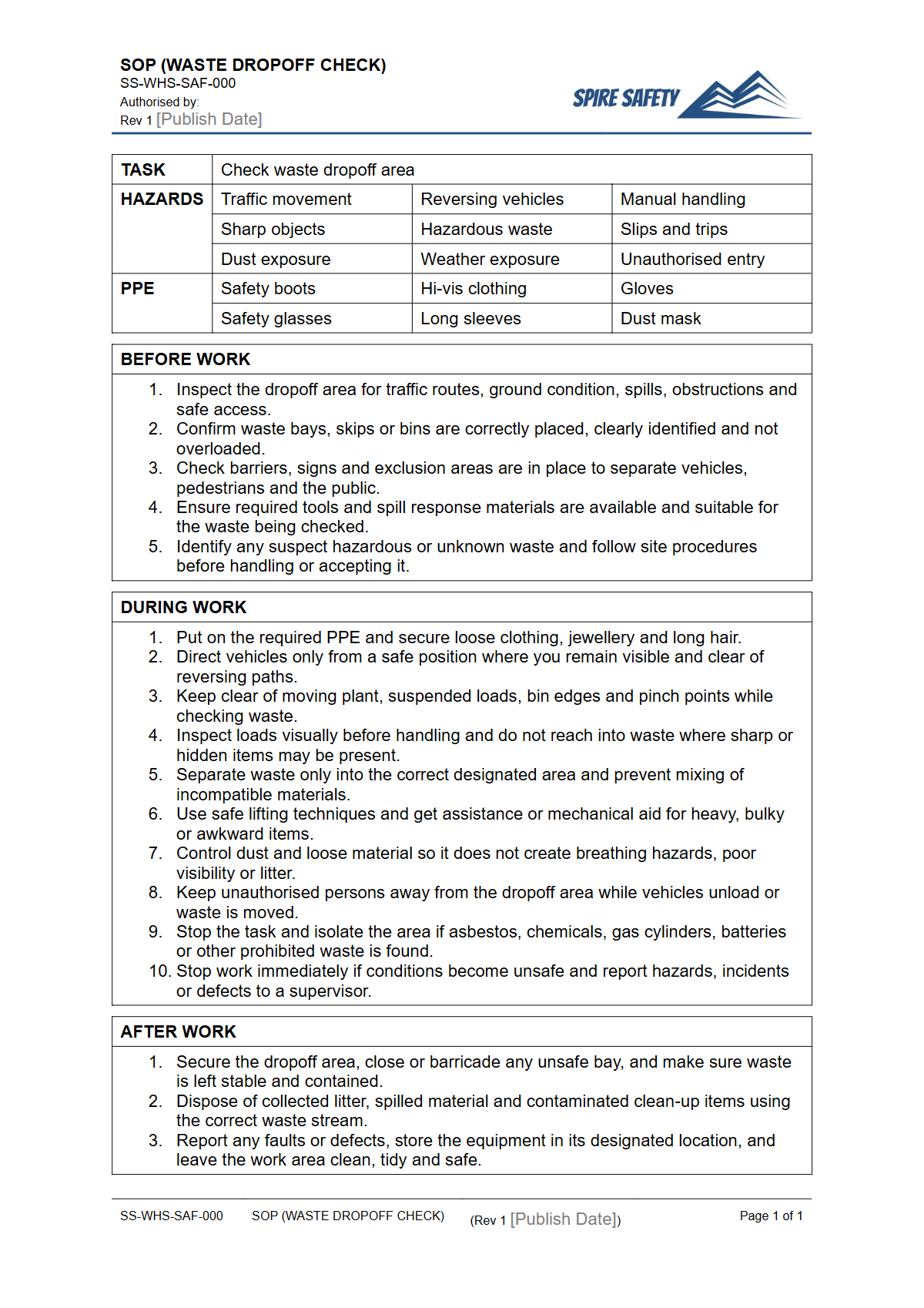
Download our free Safe Operating Procedure (Waste Dropoff Check) Template to formalise safety steps for receiving waste. Customise this structured DOCX or PDF.
Free Safe Operating Procedure (Waste Dropoff Check) Template
DOCX • 126 KB + PDF
Updated Oct 2026
No signup required
Purpose of the Free Safe Operating Procedure (Waste Dropoff Check) Template
Managing the receival of waste is a high-risk activity common in construction, demolition, manufacturing, and waste processing industries. Our Free Safe Operating Procedure (Waste Dropoff Check) Template provides a structured starting point for documenting the required safety steps.
This SOP helps control hazards associated with vehicle movements, manual handling, unexpected hazardous materials, and pedestrian interaction in busy yard environments. By implementing a clear procedure, organisations can significantly reduce the risk of incidents, injuries, and property damage.
A well-defined SOP is a critical component of any site's safety framework. It ensures all personnel, from gatekeepers to yard supervisors, follow a consistent, safe process for every dropoff.
This document helps you meet your primary duty of care under WHS legislation by formalising risk controls. Integrating this procedure into your daily operations is a key step in developing robust WHS management systems that protect your workers and your business.
Video walkthrough
How to use the Free Safe Operating Procedure (Waste Dropoff Check) Template
This resource is available for immediate download in both DOCX and PDF formats. The DOCX version is fully editable, allowing you to adapt the content to your specific operational needs.
The procedure outlines key steps from vehicle arrival and communication protocols to final checks and departure, but it requires site-specific information to be effective and aligned with your risk profile.
IMPORTANT: This is a template, not a finished document. We have drafted it to be a strong starting point based on Australian WHS principles, but you must customise it to reflect the specific hazards, equipment, site layout, and control measures unique to your workplace.
A generic procedure cannot account for your unique operational risks.
Key Sections to Customise
- Site-Specific Traffic Management: Detail your site's vehicle and pedestrian routes, exclusion zones, and communication signals (e.g., hand signals, two-way radio channels).
- PPE Requirements: List all mandatory Personal Protective Equipment for personnel involved in the dropoff, such as high-visibility clothing, safety footwear, hard hats, and gloves.
- Waste Types: Clearly define the types of waste accepted and any prohibited materials. Include steps for managing unexpected or non-conforming waste.
- Equipment Used: If machinery like forklifts or excavators are used to move or inspect waste, reference the relevant SOPs for that plant, such as our FREE Telehandler SOP Template.
- Emergency Procedures: Outline specific actions for incidents like spills, fires, or medical emergencies during the dropoff process.
When to use it
This Safe Operating Procedure should be actively used every time a vehicle enters the site to deliver waste. It is a live document that forms the basis for worker training, inductions, and competency assessments for the task.
It should be readily accessible in the work area where waste dropoffs occur. Furthermore, the SOP serves as a critical reference during incident investigations and should be reviewed as part of any regular WHS compliance auditing to ensure its ongoing effectiveness and relevance.
Who should use it
This SOP is intended for all personnel involved in the waste receival process. This includes, but is not limited to:
- Site Supervisors and Managers: Responsible for implementing the SOP, ensuring workers are trained, and monitoring compliance.
- Gatekeepers and Weighbridge Operators: The first point of contact, responsible for driver communication, documentation checks, and directing vehicles.
- Yard Hands and Plant Operators: The workers who directly oversee the unloading process, manage the waste pile, and operate machinery. Their input during the development of the SOP is invaluable.
- WHS Officers and Managers: Responsible for developing, reviewing, and updating the SOP in consultation with workers and management.
Effective implementation relies on consultation. Ensure you involve your Health and Safety Representatives and the workers performing the task when you customise this procedure.
If the waste handling process involves specific equipment like conveyor belts, you may also need a FREE Conveyer System SOP to manage those associated risks. For complex sites or processes, seeking specialist WHS consulting advice can help ensure all risks are identified and adequately controlled. To find other useful templates and checklists, browse our complete free WHS resources library.
Common mistakes
Common mistakes to avoid
- Failing to adequately customise the template with site-specific traffic management plans.
- Poor or non-existent communication protocols between vehicle drivers and site personnel.
- Neglecting to train workers on the specific steps and hazards outlined in the finalised SOP.
- Not having a clear procedure for dealing with non-conforming or unexpected hazardous waste.
Legal references
Legal considerations
The following legal requirements may be relevant to this type of work.
- Work Health and Safety Act (Harmonised) — Provides the primary duties for protecting workers and other people from work health and safety risks.
- Work Health and Safety Regulations (Harmonised) — Sets out requirements supporting the management of workplace hazards and risks.
The following codes may be relevant to this type of work.
- Managing WHS Risks Code of Practice — Provides practical guidance on identifying hazards, assessing risks and applying effective controls.
- Work Health and Safety Consultation, Cooperation and Coordination Code of Practice — Provides practical guidance on consulting workers and coordinating with other duty holders.
- Managing the Work Environment and Facilities Code of Practice — Provides practical guidance on safe work environments, workplace facilities and related controls.
Did you know
Vehicle Interaction Risks
According to Safe Work Australia, being hit by a moving vehicle is a leading cause of workplace fatalities. Two-thirds of these incidents occur in industries like construction and transport, highlighting the need for strict traffic management during tasks like waste dropoffs.
Construction Waste Volume
Australia generates millions of tonnes of construction and demolition waste each year. Safely and efficiently managing the receival of this material at recycling and disposal facilities is a critical logistical and safety challenge for the industry.
FAQ
Frequently asked questions
01What should be included in a Waste Dropoff Check SOP?
02Is a Safe Operating Procedure a legal requirement in Australia for waste dropoffs?
03How often should we review our Waste Dropoff Check SOP?
04Can this template be used for hazardous waste?
Share this resource
Free Safe Operating Procedure (Waste Dropoff Check) Template
Browse Categories
How To Use It
- 1Download and open in Word or PDF.
- 2Replace the placeholders with your business details.
- 3Get it reviewed by a WHS specialist before rollout.
Need it customised?
Our WHS consultants can adapt this template to your site, run a gap analysis, or audit what you already have in place.
Book a Free Consultation WHS consulting servicesor call 1300 156 382
Related templates
- Free Safe Operating Procedure (Waste Drum Handling) Template
- Free Safe Operating Procedure (Waste Load Inspection) Template
- Free Safe Operating Procedure (Waste Load Rejection) Template
- Free Safe Operating Procedure (Waste Load Segregation) Template
- Free Safe Operating Procedure (Waste Oil Collection) Template
- Free Safe Operating Procedure (Waste Stream Sorting) Template