
Free Safe Operating Procedure (Waste Drum Handling) Template
Handling waste drums presents significant manual handling and chemical exposure risks. Download our free Safe Operating Procedure template to get started.
Free Safe Operating Procedure (Waste Drum Handling) Template
DOCX • 126 KB + PDF
Updated Oct 2026
No signup required
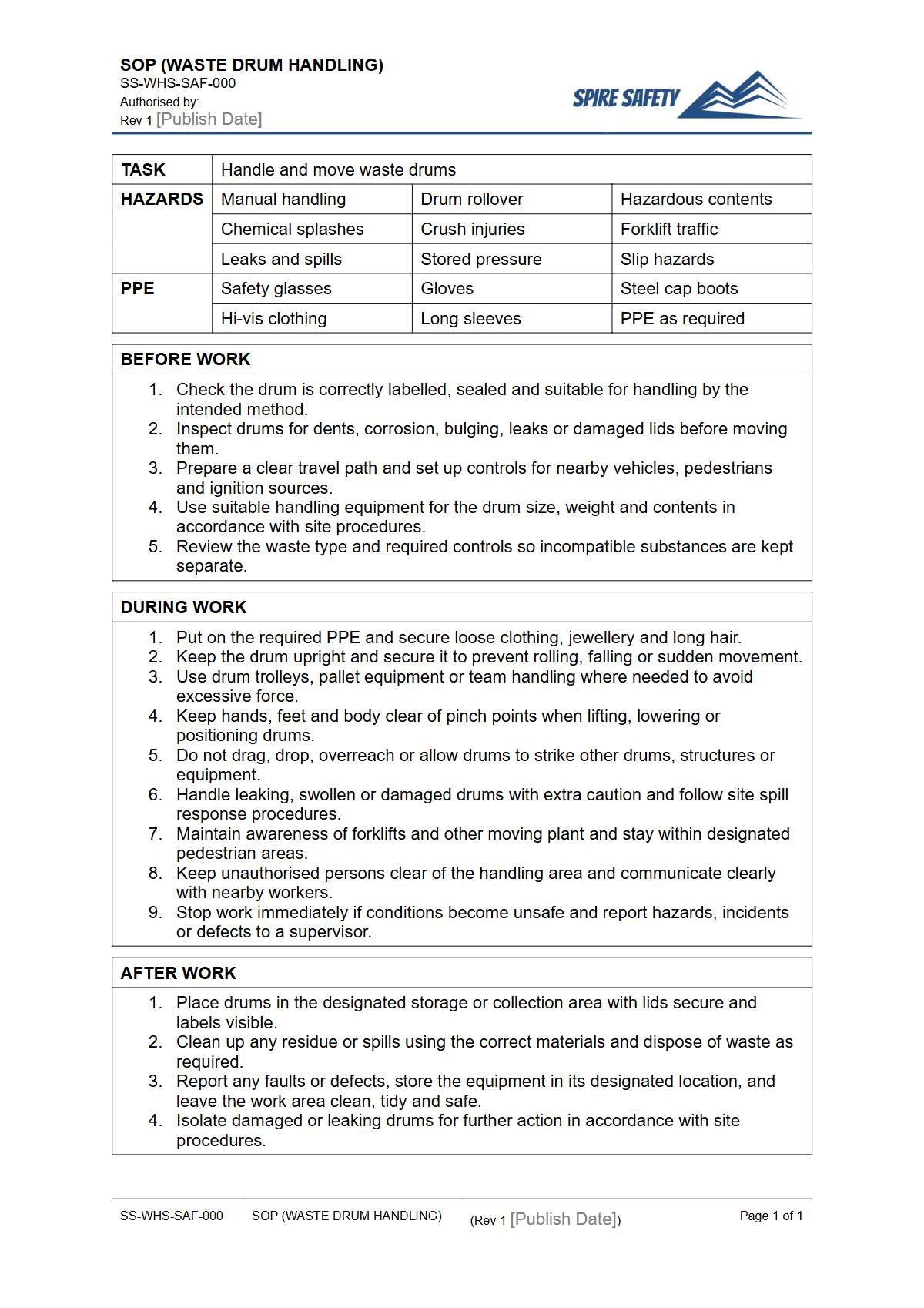
Purpose of the Free Safe Operating Procedure (Waste Drum Handling) Template
Effectively managing the risks associated with moving and storing waste drums is a critical part of workplace safety. This Free Safe Operating Procedure (Waste Drum Handling) Template provides a structured starting point for documenting the required steps to perform this task safely.
Using this SOP helps your organisation meet its duty of care by clearly outlining hazards, control measures, and emergency responses related to drum handling.
A well-drafted Safe Operating Procedure is a key administrative control that formalises safe work practices. This template guides you in identifying risks such as musculoskeletal injuries from manual handling, exposure to hazardous chemicals, and potential spills.
It serves as a practical tool within your overall WHS management systems, ensuring that all workers follow a consistent, pre-approved method for handling drums.
Video walkthrough
How to use the Free Safe Operating Procedure (Waste Drum Handling) Template
This document is a template and must be customised to suit the specific requirements of your workplace. Download the DOCX or PDF and adapt it by incorporating your site-specific details, including the types of drums used, the substances they contain, the equipment available (e.g., drum lifters, trolleys, forklifts), and your emergency procedures.
A generic procedure is not sufficient; it must reflect the practical realities of your operations.
We recommend a competent person, such as a WHS manager or a supervisor with extensive experience in the task, completes the customisation. After customisation, the SOP should be reviewed and approved by management before being issued to workers.
For guidance on implementing robust safety documents and control measures, consider our expert WHS consulting services.
Integrating the SOP into your Safety System
A Safe Operating Procedure is most effective when it is integrated into your daily operations and training programs. Use the completed document as a basis for:
- Conducting toolbox talks and safety meetings.
- Inducting new workers and contractors who will be handling waste drums.
- Performing periodic risk assessments and procedure reviews.
- Verifying worker competency for the task.
Like many hazardous tasks in an industrial setting, drum handling requires clear, documented instructions. For other activities involving hazardous substances, you might also require a FREE Oxy Acetylene SOP Template to ensure all risks are managed.
When to use a Waste Drum Handling SOP
This Safe Operating Procedure should be used whenever a worker is required to manually or mechanically handle, move, store, or decant substances from drums. It is particularly important for tasks involving heavy 205-litre (44-gallon) drums, which pose significant ergonomic risks.
The SOP should be readily accessible in any area where drum handling occurs, serving as a quick reference guide for workers before they begin the task.
If mechanical aids are used for moving drums, such as forklifts or telehandlers, those machines require their own specific procedures. You can use our FREE Telehandler SOP Template as a starting point for developing procedures for such plant.
The drum handling SOP should reference these related procedures to ensure a comprehensive approach to safety.
Who should use this Safe Operating Procedure
This SOP is designed for several key roles within an organisation:
- Workers: To understand and follow the approved, safe method for handling waste drums.
- Supervisors: To train workers, monitor adherence to the procedure, and ensure control measures are in place and effective.
- WHS Managers/Coordinators: To use as a foundational document for risk assessments, training development, and incident investigations related to drum handling.
Documenting safe procedures is a fundamental aspect of managing workplace safety, not just for drum handling but for all equipment and processes. For instance, many industrial sites will also need a Free Air Compressor SOP (Safe Operating Procedure) Template to control the risks associated with pressurised air systems. Ensuring all key tasks have a documented SOP helps create a consistent safety culture across your entire operation, and you can find many more templates in our free WHS resources library.
Common mistakes
Common mistakes to avoid
- Using incorrect manual lifting techniques (e.g., 'rolling' a heavy drum on its bottom edge) instead of using mechanical aids.
- Failing to read labels or Safety Data Sheets (SDS) to understand the drum's contents and associated hazards before handling.
- Not wearing the correct personal protective equipment (PPE), particularly chemical-resistant gloves and safety eyewear.
- Storing drums improperly, such as stacking them unsafely, blocking emergency exits, or not using spill containment pallets.
Legal references
Legal considerations
The following legal requirements may be relevant to this type of work.
- Work Health and Safety Act (Harmonised) — Provides the primary duties for protecting workers and other people from work health and safety risks.
- Work Health and Safety Regulations (Harmonised) — Sets out requirements supporting the management of workplace hazards and risks.
The following codes may be relevant to this type of work.
- Managing WHS Risks Code of Practice — Provides practical guidance on identifying hazards, assessing risks and applying effective controls.
- Work Health and Safety Consultation, Cooperation and Coordination Code of Practice — Provides practical guidance on consulting workers and coordinating with other duty holders.
- Managing the Work Environment and Facilities Code of Practice — Provides practical guidance on safe work environments, workplace facilities and related controls.
Did you know
Manual Handling Risks
Injuries from hazardous manual tasks, including lifting heavy drums, are a leading cause of serious workers' compensation claims in Australia. A full 205-litre drum can weigh over 250kg, making mechanical aids essential for safe handling.
Drum Materials
Drums are commonly made from steel, high-density polyethylene (HDPE), or fibreboard. The material choice depends on the chemical compatibility of the contents, with HDPE drums often used for corrosive substances that would react with steel.
FAQ
Frequently asked questions
01What should be included in a SOP for waste drum handling?
02How often should a Safe Operating Procedure for waste drums be reviewed?
03Are there specific PPE requirements for handling waste drums?
04Can a generic SOP be used for all types of waste drums?
Share this resource
Free Safe Operating Procedure (Waste Drum Handling) Template
Browse Categories
How To Use It
- 1Download and open in Word or PDF.
- 2Replace the placeholders with your business details.
- 3Get it reviewed by a WHS specialist before rollout.
Need it customised?
Our WHS consultants can adapt this template to your site, run a gap analysis, or audit what you already have in place.
Book a Free Consultation WHS consulting servicesor call 1300 156 382
Related templates
- Free Safe Operating Procedure (Waste Load Inspection) Template
- Free Safe Operating Procedure (Waste Load Rejection) Template
- Free Safe Operating Procedure (Waste Load Segregation) Template
- Free Safe Operating Procedure (Waste Oil Collection) Template
- Free Safe Operating Procedure (Waste Stream Sorting) Template
- Free Safe Operating Procedure (Waste Transfer Handover) Template