
Free Safe Operating Procedure (Waste Bin Tagging) Template
Standardise your waste management processes with our free Safe Operating Procedure for waste bin tagging. Download this customisable template to improve safety.
Free Safe Operating Procedure (Waste Bin Tagging) Template
DOCX • 126 KB + PDF
Updated Oct 2026
No signup required
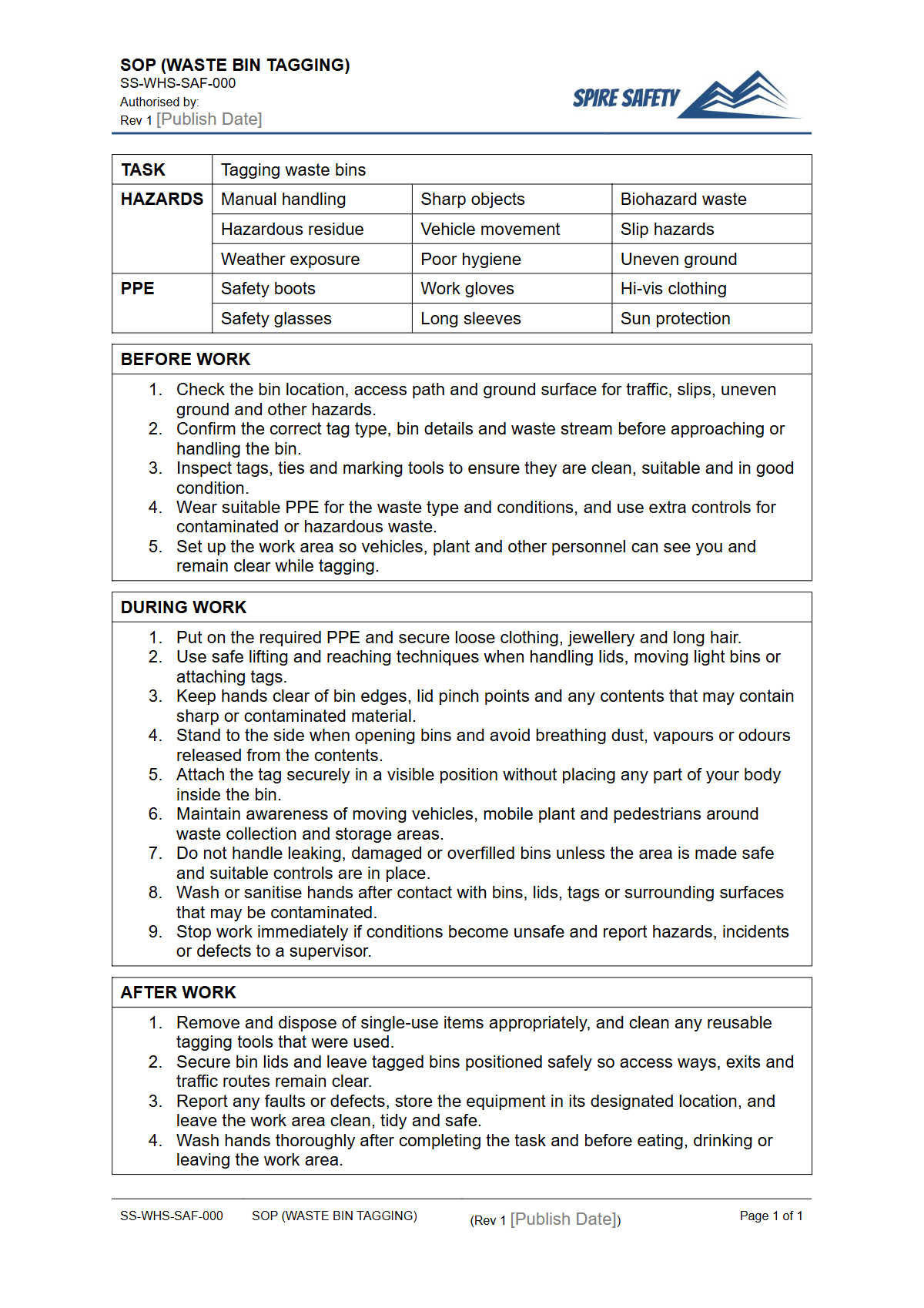
Purpose of the Free Safe Operating Procedure (Waste Bin Tagging) Template
Effective waste management is a critical component of workplace safety and environmental responsibility. This free Safe Operating Procedure (Waste Bin Tagging) template provides a structured framework for identifying, segregating, and managing different waste streams within your organisation.
Proper tagging ensures that general waste, recyclables, organic matter, and hazardous materials are handled correctly from point of generation to final disposal. Implementing a clear procedure helps prevent cross-contamination, reduces the risk of exposure to hazardous substances, and supports your compliance efforts with environmental regulations.
By standardising the process, you minimise confusion and reduce the likelihood of incidents, such as placing sharp objects in general waste or mixing reactive chemicals. A documented SOP is also an essential training tool for new and existing employees, reinforcing safe work practices.
This procedure should form one part of a broader WHS management system that holistically addresses all workplace risks.
Video walkthrough
How to use the Free Safe Operating Procedure (Waste Bin Tagging) Template
This document is a template and must be customised to suit the specific requirements of your workplace. Before implementation, conduct a thorough review and adapt the content to reflect your site's unique waste streams, bin types, facility layout, and local council or state-based disposal requirements.
We have included prompts and sections that you must fill in with your operational details.
Key customisation steps include:
- Defining Waste Streams: Clearly list all types of waste generated at your site (e.g., general, mixed recycling, cardboard, e-waste, hazardous solvents, clinical waste).
- Establishing a Tagging System: Specify the exact colour codes, tag designs, and wording for each waste stream. Ensure the system is logical and easy for all workers to understand.
- Detailing Procedures: Add step-by-step instructions for attaching tags, moving bins, and procedures for dealing with full, damaged, or incorrectly tagged bins.
- Assigning Responsibilities: Clearly nominate the roles responsible for monitoring the system, training staff, and arranging waste collection.
- Adding Emergency Information: Include contact details and procedures for spills or accidental exposure related to specific waste types.
Once tailored, the SOP should be formally approved, and all relevant personnel must be trained on its contents. Regular reviews are essential to ensure the procedure remains current, a process often incorporated as part of a regular WHS compliance audit.
When to use it
A Safe Operating Procedure for waste bin tagging should be used consistently as the standard for all waste handling activities. It is particularly crucial in several scenarios.
It should be a core document for employee inductions to establish correct habits from day one. The SOP serves as the primary reference material during refresher training sessions on waste management or environmental safety.
It should also be consulted whenever a new waste stream is introduced to the workplace, ensuring it is immediately integrated into the existing system correctly.
Furthermore, this SOP is an important tool during safety inspections and audits, providing a benchmark against which actual practices can be measured. It should be readily accessible in work areas where waste is generated or handled, acting as a quick reference guide for employees.
Whether operating a telehandler to move large skips or cleaning up after using a circular saw in a workshop, clear waste segregation is vital for safety and efficiency.
Who should use it
This SOP is intended for a wide range of personnel within an organisation. WHS Managers and Environmental Officers will use it to develop, implement, and oversee the waste management program.
Supervisors and Team Leaders are responsible for enforcing the procedure within their teams and ensuring compliance on a daily basis. They use the SOP to conduct spot checks and deliver on-the-job training.
All employees and contractors who generate or handle waste must be trained on and follow the procedure. This ensures everyone understands their responsibilities, from correctly segregating coffee cups to safely managing hazardous material containers.
Just as a conveyer system SOP outlines steps for safe material movement, this document details the process for safe material disposal. For organisations needing assistance in tailoring and implementing such procedures, it can be beneficial to seek expert WHS consulting advice to ensure all risks are appropriately managed.
If this template isn't quite right, you can explore our free WHS resources library for more options.
Common mistakes
Common mistakes to avoid
- Using generic tags that fail to specify the exact type of waste (e.g., 'Recycling' instead of 'Mixed Paper & Cardboard').
- Failing to train all employees, including temporary staff and contractors, on the tagging system and what each colour means.
- Inconsistent placement of tags on bins, making them difficult for waste collectors or staff to see and identify quickly.
- Forgetting to update the SOP and retrain staff after introducing a new waste stream or changing waste contractors.
Legal references
Legal considerations
The following legal requirements may be relevant to this type of work.
- Work Health and Safety Act (Harmonised) — Provides the primary duties for protecting workers and other people from work health and safety risks.
- Work Health and Safety Regulations (Harmonised) — Sets out requirements supporting the management of workplace hazards and risks.
The following codes may be relevant to this type of work.
- Managing WHS Risks Code of Practice — Provides practical guidance on identifying hazards, assessing risks and applying effective controls.
- Work Health and Safety Consultation, Cooperation and Coordination Code of Practice — Provides practical guidance on consulting workers and coordinating with other duty holders.
- Managing the Work Environment and Facilities Code of Practice — Provides practical guidance on safe work environments, workplace facilities and related controls.
Did you know
The Waste Hierarchy
The internationally recognised waste management hierarchy prioritises actions from most to least preferable: Avoidance, Reuse, Recycling, Recovery (including energy from waste), and finally, Disposal.
Australian Packaging Covenant
The Australian Packaging Covenant Organisation (APCO) is a co-regulatory body that works with government and industry to reduce the environmental impact of packaging and improve recycling outcomes in Australia.
FAQ
Frequently asked questions
01What key information should be included in a waste bin tagging SOP?
02Why is a colour-coding system important for waste bin tags?
03How often should our waste bin tagging procedure be reviewed?
04Can this template be used for tagging hazardous waste bins?
Share this resource
Free Safe Operating Procedure (Waste Bin Tagging) Template
Browse Categories
How To Use It
- 1Download and open in Word or PDF.
- 2Replace the placeholders with your business details.
- 3Get it reviewed by a WHS specialist before rollout.
Need it customised?
Our WHS consultants can adapt this template to your site, run a gap analysis, or audit what you already have in place.
Book a Free Consultation WHS consulting servicesor call 1300 156 382
Related templates
- Free Safe Operating Procedure (Waste Compactor) Template
- Free Safe Operating Procedure (Waste Dropoff Check) Template
- Free Safe Operating Procedure (Waste Drum Handling) Template
- Free Safe Operating Procedure (Waste Load Inspection) Template
- Free Safe Operating Procedure (Waste Load Rejection) Template
- Free Safe Operating Procedure (Waste Load Segregation) Template