
Free Safe Operating Procedure (Waste Bin Inspection) Template
Formalise your waste management safety with our free Safe Operating Procedure for waste bin inspections. Download our customisable template to get started.
Free Safe Operating Procedure (Waste Bin Inspection) Template
DOCX • 126 KB + PDF
Updated Oct 2026
No signup required
Purpose of the Free Safe Operating Procedure (Waste Bin Inspection) Template
Managing workplace waste is more than just emptying bins. It involves a systematic process to ensure the safety of workers and the integrity of your waste management system.
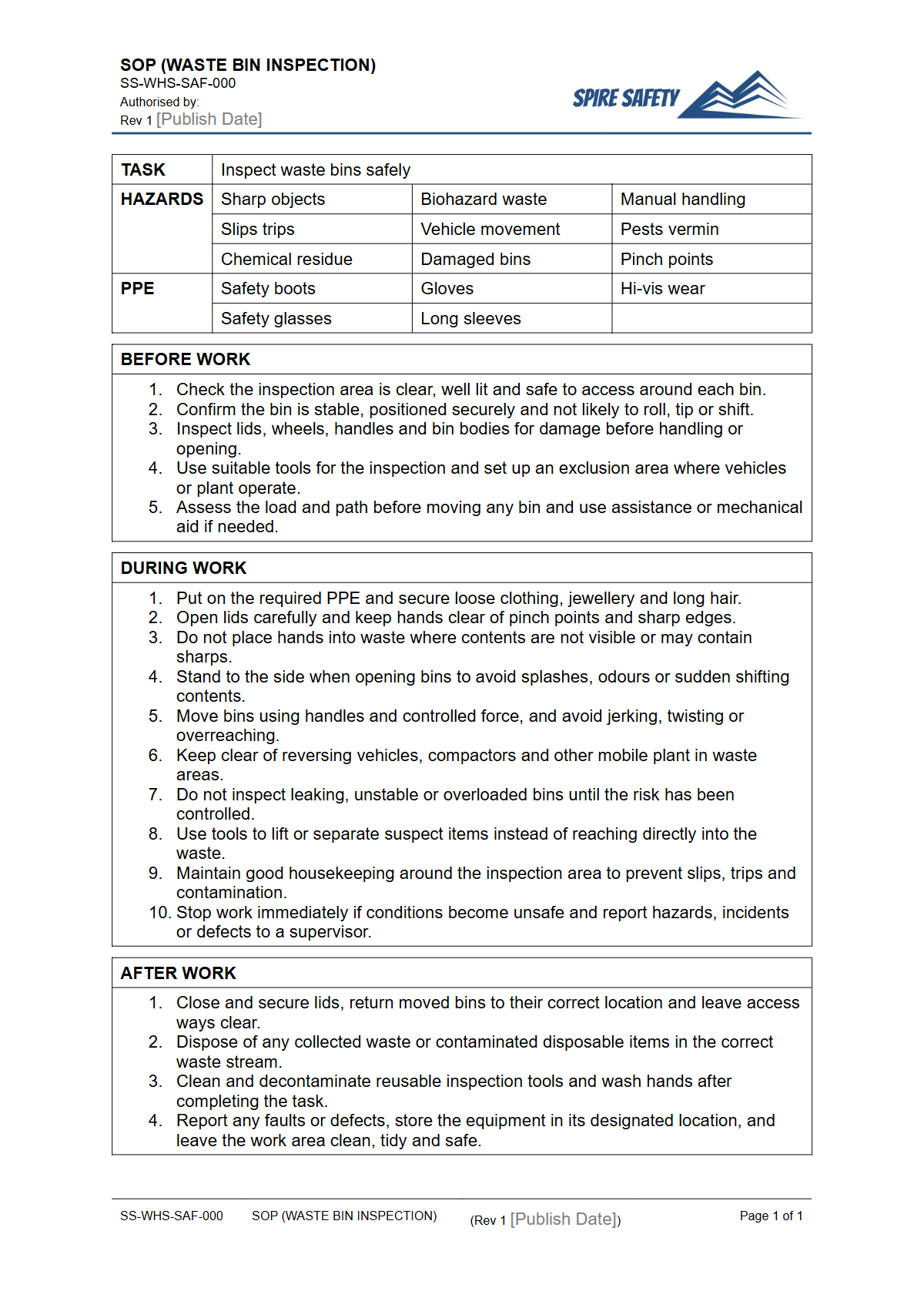
Our Free Safe Operating Procedure (Waste Bin Inspection) Template provides a structured framework for this crucial task. It helps your organisation document the required steps for safely inspecting various types of waste bins, from office paper bins to large industrial skips.
A documented SOP ensures consistency, aids in training new staff, and demonstrates a commitment to proactive risk management.
Implementing formal procedures like this is a fundamental part of maintaining effective WHS management systems. This template helps you identify and control common hazards associated with waste bins, such as manual handling injuries, cuts from sharps, exposure to biological or chemical substances, and ergonomic strains. By standardising the inspection process, you reduce the likelihood of incidents and create a safer environment for everyone.
Video walkthrough
How to use the Free Safe Operating Procedure (Waste Bin Inspection) Template
This resource is available for immediate download in both DOCX and PDF formats. The DOCX file is fully editable, allowing you to tailor the procedure to your specific operational needs.
The PDF version serves as a ready-to-print reference for your team. It's crucial to adapt this document to your unique workplace environment, as a generic procedure is insufficient for managing specific risks.
Important: This document is a template, not a finished product. We have provided a solid foundation based on Australian WHS principles, but you must customise it.
Your final SOP should reflect the specific types of bins used, the waste streams they handle, the personal protective equipment (PPE) required, and the unique hazards present at your site. For instance, the procedure for inspecting a kitchen bin near a deep fryer will differ from that for an external construction waste skip.
You can review our Safe Operating Procedure for a Deep Fryer for another example of a task-specific safety document.
When to Conduct Waste Bin Inspections
Regular inspections are key to preventing equipment failure and managing hazards before they cause harm. This SOP should be used as part of a regular, scheduled maintenance and safety program.
The frequency of inspections will depend on the type of bin, its location, and its usage rate. For example:
- Daily or per-shift checks: For high-use bins in areas like commercial kitchens, manufacturing floors, or public spaces.
- Weekly inspections: For general office bins or those in lower-traffic areas.
- Before and after emptying: Especially for large mobile bins (skip bins, wheelie bins) to check for damage to wheels, lids, or lifting points.
- Following a report: Whenever a worker reports damage, overflow, or a potential hazard associated with a bin.
Integrating these checks into your operational workflow ensures that safety standards are consistently met. This is similar to the routine checks required for complex machinery, where a Conveyer System SOP would mandate pre-start inspections.
Who Should Use This SOP
This Safe Operating Procedure is designed for any personnel responsible for handling, inspecting, or managing waste bins. This includes a wide range of roles:
- Cleaning and janitorial staff
- Maintenance workers
- Waste management contractors
- Facility managers
- Supervisors and team leaders responsible for operational areas
- WHS officers and representatives
Before any worker is assigned to inspect waste bins, they must be trained on the finalised SOP. This training should cover hazard identification, correct use of PPE, proper lifting and handling techniques, and the procedure for reporting faults or incidents.
Ensuring all relevant personnel are competent is a cornerstone of workplace safety. If you need assistance developing and implementing procedures like this, our WHS consulting services can provide expert guidance.
This template is just one of many resources designed to help you build a comprehensive safety system. You can explore our complete free WHS resources library for more templates, checklists, and guides to support your safety goals.
For other equipment-specific procedures, consider downloading our Free Air Compressor SOP Template to see how procedures can be adapted for different workplace assets.
Common mistakes
Common mistakes to avoid
- Using a generic template without customising it for specific bin types and waste streams.
- Failing to provide staff with the correct Personal Protective Equipment (PPE) for the task.
- Not training employees on the finalised SOP, assuming the task is 'common sense'.
- Forgetting to document inspections, leaving no record for audits or incident investigations.
Legal references
Legal considerations
The following legal requirements may be relevant to this type of work.
- Work Health and Safety Act (Harmonised) — Provides the primary duties for protecting workers and other people from work health and safety risks.
- Work Health and Safety Regulations (Harmonised) — Sets out requirements supporting the management of workplace hazards and risks.
The following codes may be relevant to this type of work.
- Managing WHS Risks Code of Practice — Provides practical guidance on identifying hazards, assessing risks and applying effective controls.
- Work Health and Safety Consultation, Cooperation and Coordination Code of Practice — Provides practical guidance on consulting workers and coordinating with other duty holders.
- Managing the Work Environment and Facilities Code of Practice — Provides practical guidance on safe work environments, workplace facilities and related controls.
Did you know
Manual Handling Risk
According to Safe Work Australia, manual handling injuries account for a significant portion of all serious workers' compensation claims, making structured procedures for tasks like moving heavy bins critical.
Hidden Dangers
Improperly disposed of items, such as lithium-ion batteries or aerosol cans, can create serious fire or explosion risks within waste bins, highlighting the importance of visual inspections and proper waste segregation.
FAQ
Frequently asked questions
01What should be included in a waste bin inspection checklist?
02How often should commercial waste bins be inspected?
03Is a Safe Operating Procedure a legal requirement for waste bin inspection in Australia?
04What are the main hazards of inspecting and handling waste bins?
Share this resource
Free Safe Operating Procedure (Waste Bin Inspection) Template
Browse Categories
How To Use It
- 1Download and open in Word or PDF.
- 2Replace the placeholders with your business details.
- 3Get it reviewed by a WHS specialist before rollout.
Need it customised?
Our WHS consultants can adapt this template to your site, run a gap analysis, or audit what you already have in place.
Book a Free Consultation WHS consulting servicesor call 1300 156 382
Related templates
- Free Safe Operating Procedure (Waste Bin Placement) Template
- Free Safe Operating Procedure (Waste Bin Tagging) Template
- Free Safe Operating Procedure (Waste Compactor) Template
- Free Safe Operating Procedure (Waste Dropoff Check) Template
- Free Safe Operating Procedure (Waste Drum Handling) Template
- Free Safe Operating Procedure (Waste Load Inspection) Template