
Free Safe Operating Procedure (Waste Bay Cleanup) Template
Clearly define the steps for safely cleaning and maintaining waste bay areas in your workplace.
Free Safe Operating Procedure (Waste Bay Cleanup) Template
DOCX • 126 KB + PDF
Updated Oct 2026
No signup required
Purpose of the Free Safe Operating Procedure (Waste Bay Cleanup) Template
This Free Safe Operating Procedure (Waste Bay Cleanup) Template provides a structured starting point for organisations to document a safe system of work for cleaning and maintaining waste disposal areas. A messy or poorly managed waste bay introduces significant risks, including slips, trips, and falls from wet or cluttered floors, manual handling injuries from moving heavy bins, and exposure to hazardous substances.
By establishing a clear, step-by-step procedure, you formalise expectations and control measures, helping to meet your WHS duties.
Implementing a documented SOP is a practical way to manage identified risks and is a fundamental component of all effective safety frameworks. It serves as a critical control measure within your broader safety program, demonstrating a commitment to proactive risk management.
These procedures form the building blocks of comprehensive WHS management systems that protect workers and ensure operational consistency.
Video walkthrough
How to use the Free Safe Operating Procedure (Waste Bay Cleanup) Template
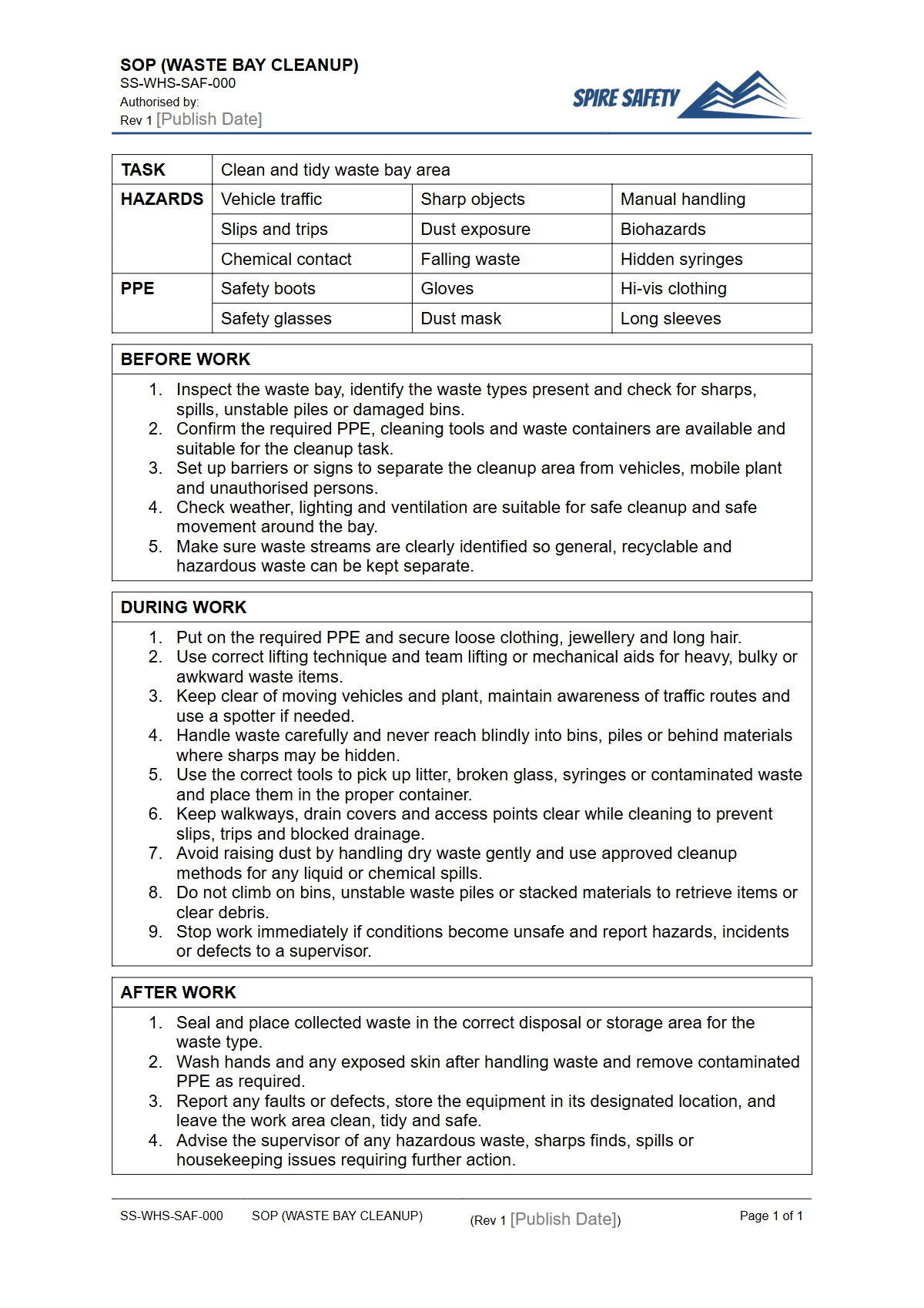
The template is available as a DOCX file for easy editing and customisation, and a PDF for simple distribution and printing. The document outlines the key sections required in a robust Safe Operating Procedure, including required PPE, pre-operational checks, the sequential task steps, and emergency response actions.
It guides you in creating a procedure that is both logical and easy for workers to follow.
Important: This document is a template, not a finished product. It is aligned with Australian WHS practice but must be adapted to your specific site conditions.
We strongly advise that you consult with the workers who actually perform the waste bay cleanup task to ensure the final SOP is practical and reflects the real-world hazards and controls in your workplace. Your procedure should detail the exact equipment, chemicals, and waste types relevant to your operations.
What to Include in Your Waste Bay Cleanup SOP
When customising this template, ensure you provide specific details to make it relevant and effective. Your final SOP should clearly outline:
- Task Details: The specific area covered by the procedure and the frequency of the cleanup task.
- Hazard Identification: A list of all potential hazards, such as slippery surfaces, hazardous chemicals, biological waste, sharp objects, heavy lifting, and noise from compactors.
- Control Measures: Specific controls for each hazard. This includes mandatory Personal Protective Equipment (PPE) like chemical-resistant gloves, non-slip enclosed footwear, safety glasses, and potentially respiratory protection.
- Equipment: A list of all tools and equipment required, such as pressure washers, hoses, brooms, shovels, and wheelie bins. If your cleanup involves using compressed air, a separate Air Compressor SOP should be referenced.
- Chemicals: The names of all cleaning agents used, with a reference to their location and the need to review the Safety Data Sheet (SDS) before use.
- Emergency Procedures: Clear steps to take in case of a chemical spill, personal injury, or exposure incident, including emergency contact numbers.
When to Use This Safe Operating Procedure
A formal Waste Bay Cleanup SOP should be integrated into your daily operations and safety management activities. It is not a document to be filed away and forgotten. It should be actively used for:
- Training and inducting new employees tasked with cleaning duties.
- Conducting refresher training for existing workers to reinforce safe work practices.
- Guiding supervisors in monitoring work and ensuring procedures are followed correctly.
- A reference point during incident investigations or near-miss reporting.
The effectiveness of your SOPs should be confirmed through observation and discussion with workers. This can be formalised through regular WHS compliance auditing to ensure the documented procedure aligns with on-the-ground practice and remains effective at controlling risks.
Who Should Use It
This template is designed for use by anyone with responsibility for workplace health and safety. This includes:
- PCBUs (Persons Conducting a Business or Undertaking): To help fulfil their primary duty of care to provide a safe work environment and safe systems of work.
- Managers and Supervisors: To draft, implement, and enforce the procedure within their teams.
- Health and Safety Representatives (HSRs): To participate in the consultation process and review control measures.
- Workers: As a training tool and a clear guide on how to perform the cleanup task safely.
The processes documented in an SOP can also cover tasks that lead into or out of the primary activity. For instance, if waste is transported to the bay via automated machinery, it may be useful to also reference your conveyer system SOP to ensure end-to-end safety.
A well-drafted SOP ensures everyone understands their responsibilities and the accepted safe method for completing a task. To find more templates for other common workplace tasks, you can browse our complete free WHS resources library.
Common mistakes
Common mistakes to avoid
- Using a generic template without customising it for specific site hazards, equipment, and chemicals.
- Failing to consult with workers who actually perform the cleanup task, resulting in an impractical procedure.
- Neglecting to provide the specific Personal Protective Equipment (PPE) listed in the SOP.
- Not training workers on the finalised SOP or failing to enforce its use during work activities.
Legal references
Legal considerations
The following legal requirements may be relevant to this type of work.
- Work Health and Safety Act (Harmonised) — Provides the primary duties for protecting workers and other people from work health and safety risks.
- Work Health and Safety Regulations (Harmonised) — Sets out requirements supporting the management of workplace hazards and risks.
The following codes may be relevant to this type of work.
- Managing WHS Risks Code of Practice — Provides practical guidance on identifying hazards, assessing risks and applying effective controls.
- Work Health and Safety Consultation, Cooperation and Coordination Code of Practice — Provides practical guidance on consulting workers and coordinating with other duty holders.
- Managing the Work Environment and Facilities Code of Practice — Provides practical guidance on safe work environments, workplace facilities and related controls.
Did you know
Slips, Trips, and Falls
Slips, trips, and falls are a leading cause of serious workplace injuries in Australia. Maintaining clean, dry, and unobstructed floors in areas like waste bays is a critical preventative measure.
Hierarchy of Control
A Safe Operating Procedure is an 'administrative control' in the hierarchy of control. It should be used in conjunction with higher-level controls like eliminating hazards or substituting them with safer alternatives wherever possible.
FAQ
Frequently asked questions
01What is a Safe Operating Procedure for waste bay cleanup?
02Who is responsible for writing a waste bay cleanup SOP?
03How often should a waste bay cleanup SOP be reviewed?
04Does this template cover chemical handling for waste bay cleaning?
Share this resource
Free Safe Operating Procedure (Waste Bay Cleanup) Template
Browse Categories
How To Use It
- 1Download and open in Word or PDF.
- 2Replace the placeholders with your business details.
- 3Get it reviewed by a WHS specialist before rollout.
Need it customised?
Our WHS consultants can adapt this template to your site, run a gap analysis, or audit what you already have in place.
Book a Free Consultation WHS consulting servicesor call 1300 156 382
Related templates
- Free Safe Operating Procedure (Waste Bin Inspection) Template
- Free Safe Operating Procedure (Waste Bin Placement) Template
- Free Safe Operating Procedure (Waste Bin Tagging) Template
- Free Safe Operating Procedure (Waste Compactor) Template
- Free Safe Operating Procedure (Waste Dropoff Check) Template
- Free Safe Operating Procedure (Waste Drum Handling) Template