
Free Safe Operating Procedure (Wash Plant) Template
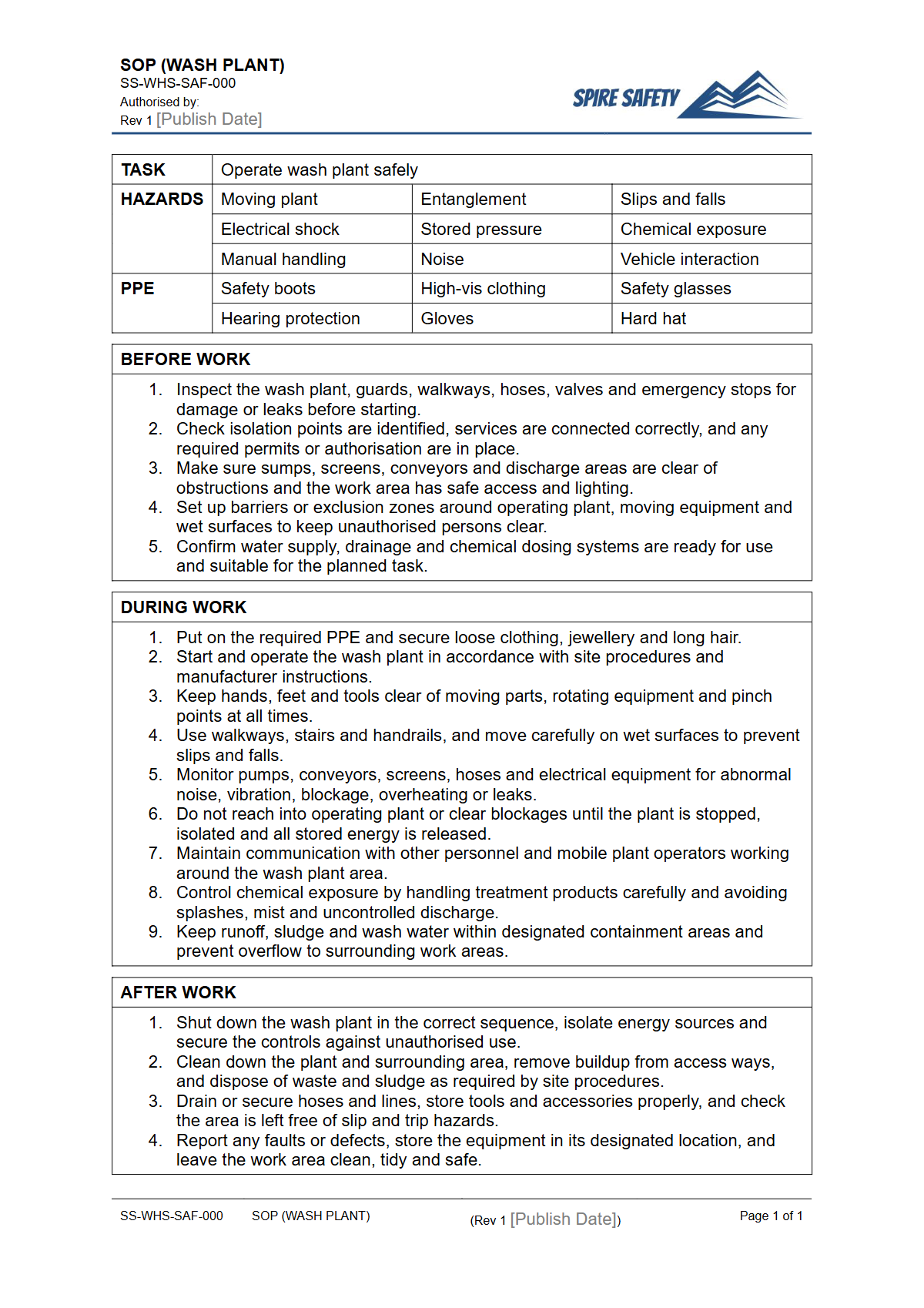
Download our free Safe Operating Procedure (Wash Plant) Template to formalise safety processes for your wash plant operations.
Free Safe Operating Procedure (Wash Plant) Template
DOCX • 126 KB + PDF
Updated Oct 2026
No signup required
Purpose of the Free Safe Operating Procedure (Wash Plant) Template
This free Safe Operating Procedure (Wash Plant) Template provides a structured framework for documenting the safe use of wash plants in mining, quarrying, and recycling operations. Developing a detailed Safe Operating Procedure (SOP) is a critical step in managing high-risk activities, ensuring workers understand the hazards and control measures associated with their tasks.
Wash plants involve numerous risks, including moving parts, high-pressure water, electrical systems, noise, dust, and slips, trips, and falls. A clear SOP helps mitigate these risks by outlining a consistent, step-by-step method for operation, shutdown, and maintenance.
Using this template helps your organisation meet its duty of care under Australian WHS legislation by providing evidence of a systematic approach to risk management. It standardises training, provides a reference for operators, and acts as a baseline for inspections and incident investigations.
A wash plant is often a complex system comprising multiple pieces of equipment. For example, managing the flow of material on conveyors requires its own specific safety protocol, which you can detail using our FREE Conveyer System SOP (Safe Operating Procedure) Template.
Video walkthrough
How to use the Free Safe Operating Procedure (Wash Plant) Template
This document is a template designed as a starting point. It must be customised to reflect the specific make, model, and configuration of the wash plant at your worksite, as well as the unique environmental conditions and materials being processed.
We are not liable for any incidents that may occur from the use of this document. It is the responsibility of the Person Conducting a Business or Undertaking (PCBU) to ensure it is tailored and implemented correctly.
To effectively use the template, you should:
- Conduct a risk assessment: Identify all potential hazards associated with your specific wash plant, including mechanical, electrical, chemical (e.g., flocculants), and ergonomic risks.
- Consult with workers: Involve experienced operators, supervisors, and maintenance staff in the drafting process. Their practical knowledge is invaluable for creating a procedure that is both safe and workable.
- Detail specific steps: Fill in each section with clear, concise instructions. This includes pre-start checks, startup sequences, routine operational duties, monitoring, shutdown procedures, and emergency responses like plant blockages or power failure.
- Specify PPE: List all mandatory Personal Protective Equipment (PPE), such as high-visibility clothing, steel-capped boots, hearing protection, safety glasses, and gloves.
A well-written SOP is a foundational document within comprehensive WHS management systems, helping to standardise safe work practices across your organisation.
When to use a Safe Operating Procedure
An SOP for a wash plant should be a living document, integrated into daily operations. It is not a file-and-forget exercise. Key times to use the SOP include:
- Operator Training and Competency: It should form the basis of all new operator training and regular refresher courses.
- Pre-Task Planning: Supervisors and work crews should review the SOP before commencing operations, especially after a shutdown period or when conditions change.
- Incident Investigations: When an incident or near-miss occurs, the SOP is a critical reference to determine if procedures were followed and whether they need to be updated.
- Audits and Inspections: Regular reviews and WHS compliance auditing activities should use the SOP as a benchmark to assess whether prescribed safety procedures are being followed correctly on the ground.
Consider the risks of mobile plant like loaders or excavators feeding the plant. You may also need procedures for specific equipment used nearby, for which our FREE Telehandler SOP (Safe Operating Procedure) Template can serve as a useful starting point.
Who should use this document
This Safe Operating Procedure is intended for a range of personnel within an organisation to ensure a shared understanding of safe work practices. This includes:
- Plant Operators: As the primary users, they rely on the SOP for step-by-step guidance on performing their tasks safely.
- Supervisors and Site Managers: They use the SOP to enforce safety standards, conduct toolbox talks, and supervise work.
- WHS Managers and Advisors: They are responsible for developing, reviewing, and updating the SOP as part of the overall safety management system, ensuring it aligns with legislative requirements and industry best practice.
- Maintenance Personnel: They must be familiar with the SOP, particularly the lockout/tagout and isolation procedures, before conducting any maintenance or repair work.
Personnel operating associated earthmoving equipment, such as those covered in our FREE Scraper SOP (Safe Operating Procedure) Template, should also be aware of the wash plant's operational zones and safety rules. Find more helpful documents like this in our free WHS resources library to support all aspects of your safety management system.
Common mistakes
Common mistakes to avoid
- Failing to implement and verify effective lockout/tagout procedures before clearing blockages or performing maintenance.
- Using a generic SOP from another site without customising it for the specific plant layout, equipment, and materials.
- Not providing adequate training on the SOP, assuming that reading the document is sufficient for competency.
- Neglecting to address risks from associated mobile plant, such as loaders and excavators, interacting with the wash plant area.
Legal references
Legal considerations
The following legal requirements may be relevant to this type of work.
- Work Health and Safety Act (Harmonised) — Provides the primary duties for protecting workers and other people from work health and safety risks.
- Work Health and Safety Regulations (Harmonised) — Sets out requirements supporting the management of workplace hazards and risks.
The following codes may be relevant to this type of work.
- Managing WHS Risks Code of Practice — Provides practical guidance on identifying hazards, assessing risks and applying effective controls.
- Work Health and Safety Consultation, Cooperation and Coordination Code of Practice — Provides practical guidance on consulting workers and coordinating with other duty holders.
- Managing the Work Environment and Facilities Code of Practice — Provides practical guidance on safe work environments, workplace facilities and related controls.
Did you know
Water and Weight
A typical sand and gravel wash plant can use thousands of litres of water per hour. The combination of water and aggregate material creates significant weight and pressure, making structural integrity and blockage management critical safety considerations.
Noise Hazard
The noise from vibrating screens, crushers, and pumps in a wash plant can easily exceed 85 dBA, the exposure standard for noise in Australia. Without proper hearing protection, workers are at high risk of permanent noise-induced hearing loss.
FAQ
Frequently asked questions
01What are the main hazards in operating a wash plant?
02How often should a Wash Plant Safe Operating Procedure be reviewed?
03Can this template be used for any type of wash plant?
04Who is responsible for enforcing the Safe Operating Procedure?
Share this resource
Free Safe Operating Procedure (Wash Plant) Template
Browse Categories
How To Use It
- 1Download and open in Word or PDF.
- 2Replace the placeholders with your business details.
- 3Get it reviewed by a WHS specialist before rollout.
Need it customised?
Our WHS consultants can adapt this template to your site, run a gap analysis, or audit what you already have in place.
Book a Free Consultation WHS consulting servicesor call 1300 156 382
Related templates
- Free Safe Operating Procedure (Washroom Deep Cleaning) Template
- Free Safe Operating Procedure (Waste Audit Sorting) Template
- Free Safe Operating Procedure (Waste Bay Cleanup) Template
- Free Safe Operating Procedure (Waste Bin Inspection) Template
- Free Safe Operating Procedure (Waste Bin Placement) Template
- Free Safe Operating Procedure (Waste Bin Tagging) Template