
Free Safe Operating Procedure (Washroom Deep Cleaning) Template
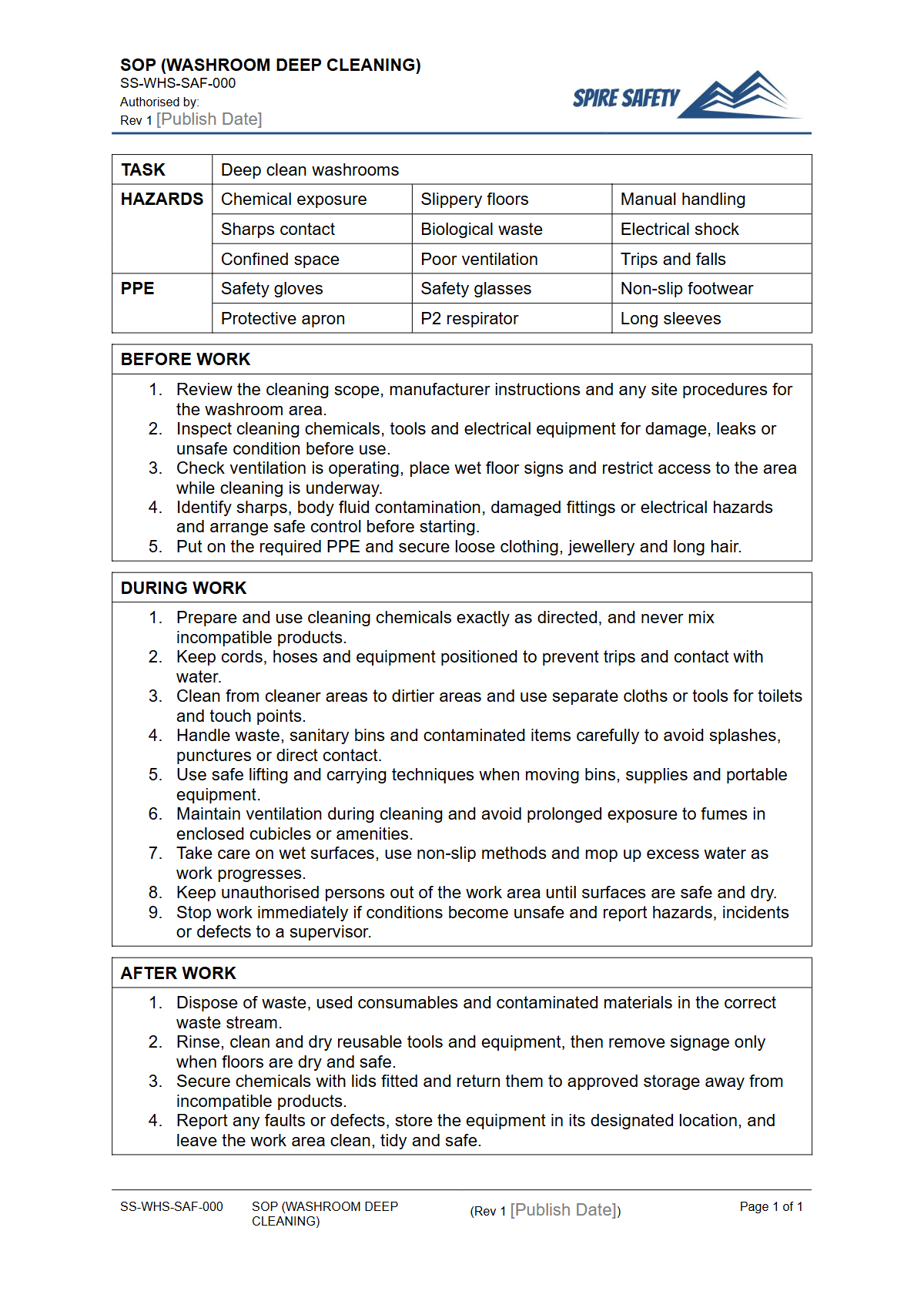
Download our free Safe Operating Procedure (Washroom Deep Cleaning) template to formalise your cleaning processes.
Free Safe Operating Procedure (Washroom Deep Cleaning) Template
DOCX • 126 KB + PDF
Updated Oct 2026
No signup required
Purpose of the Free Safe Operating Procedure (Washroom Deep Cleaning) Template
Formalising your cleaning processes with a Safe Operating Procedure (SOP) is a critical step in managing workplace health and safety. This Free Safe Operating Procedure (Washroom Deep Cleaning) Template provides a structured starting point for your business to define and communicate the safest way to perform this common but hazardous task.
Using an SOP helps ensure all workers follow the same steps, reducing the risk of injury from chemical exposure, manual handling, or slips and falls. It also serves as a vital training tool for new employees and a benchmark for refresher training, demonstrating your organisation's commitment to a safe system of work.
A documented procedure is a key component of effective WHS management systems, providing clear evidence of how your organisation identifies and controls risks. By outlining the required Personal Protective Equipment (PPE), chemical handling rules, and emergency procedures, this template helps you meet your duty of care under Australian WHS legislation.
Video walkthrough
How to use the Free Safe Operating Procedure (Washroom Deep Cleaning) Template
This document is a template, not a finished product. To use it effectively, you must adapt it to the specific chemicals, equipment, layout, and risks present in your workplace.
Download the DOCX file and follow these steps to create a site-specific SOP.
- Customise: Review every section and update the content to reflect your specific cleaning tasks, chemicals used (including names and dilutions), equipment (e.g., mops, buckets, floor polishers), and the layout of your washroom facilities.
- Consult: Under WHS law, you must consult with your workers. Share the draft SOP with your cleaning staff and their health and safety representatives. Their direct experience is invaluable for identifying practical risks and effective controls that may have been missed.
- Finalise: Incorporate feedback from the consultation process to create a final, practical, and effective document. Ensure the emergency procedures listed are correct for your site.
- Train: Induct and train all relevant workers on the finalised SOP. Training should cover all aspects of the procedure, including hazard identification, correct use of PPE, chemical handling, and what to do in an emergency. Keep records of this training.
- Review: Regularly review the SOP (e.g., annually, or after an incident) to ensure it remains current.
Important: We have provided this document as a starting point. It is your responsibility to ensure it is customised to reflect the specific hazards and control measures relevant to your workplace activities. If you require assistance, consider seeking professional WHS consulting.
Key Hazards in Washroom Deep Cleaning
Washroom cleaning involves several significant WHS hazards that must be controlled. Your SOP should explicitly address these based on a thorough risk assessment.
Chemical Hazards
Cleaners often work with disinfectants, detergents, and descalers that can be hazardous. Risks include skin irritation, respiratory issues from fumes, or chemical burns.
Your SOP must detail correct dilution ratios, the mandatory use of PPE (e.g., chemical-resistant gloves, safety glasses), and ensuring adequate ventilation. It should also reference the location of Safety Data Sheets (SDS) for all chemicals used.
Manual Tasks
Lifting heavy buckets of water, mopping, scrubbing, and moving cleaning carts can lead to musculoskeletal injuries. Controls may include using ergonomic equipment, decanting liquids into smaller containers, providing trolleys for transport, and training workers in safe lifting techniques.
Slips, Trips and Falls
Wet floors are a major cause of workplace incidents. Your SOP must include procedures for preventing access to wet areas, such as using “wet floor” signs and barriers.
It should also specify the correct footwear and a systematic cleaning process (e.g., cleaning from the furthest point from the exit) to minimise the risk of workers walking on wet surfaces.
Biological Hazards
Washrooms can harbour bacteria and viruses. Workers are at risk of exposure to biological hazards.
The SOP should mandate the use of appropriate PPE, particularly gloves, and outline procedures for hand hygiene and the safe disposal of contaminated waste.
When to use this Safe Operating Procedure
An SOP for washroom deep cleaning should be used as a primary reference document in several situations:
- Before work begins: Workers should review the SOP before starting any deep cleaning task.
- Worker training: It is a foundational document for inducting new cleaning staff.
- Refresher training: Use the SOP as a basis for periodic refresher courses to prevent procedural drift.
- Incident investigation: After a near miss or injury, the SOP should be reviewed to determine if the procedure was followed and if it needs improvement.
- Audits and inspections: The procedure serves as evidence of your safety processes during internal or external audits, such as WHS compliance auditing.
Who should use it
This SOP is intended for use by various roles within an organisation:
- Persons Conducting a Business or Undertaking (PCBUs): To help meet their primary duty of care to provide safe systems of work.
- Managers and Supervisors: To train staff, supervise work, and ensure safety protocols are consistently followed.
- Cleaning Staff / Workers: As a step-by-step guide to performing their tasks safely.
- Health and Safety Representatives (HSRs): To assist in the review and consultation process, ensuring the procedure is practical and safe from a worker's perspective.
Developing SOPs is crucial for many workplace tasks, not just cleaning. For example, businesses in hospitality might also require a template for deep fryer operation to standardise kitchen safety.
You can explore our complete free WHS resources library for other templates relevant to your operations.
Common mistakes
Common mistakes to avoid
- Using the template without customising it for the specific site, chemicals, and equipment.
- Failing to consult with cleaning staff when drafting or reviewing the procedure.
- Not providing the specific Personal Protective Equipment (PPE) listed in the SOP, or failing to train workers on its correct use.
- Neglecting to make Safety Data Sheets (SDS) for all cleaning chemicals readily accessible to workers.
Legal references
Legal considerations
The following legal requirements may be relevant to this type of work.
- Work Health and Safety Act (Harmonised) — Provides the primary duties for protecting workers and other people from work health and safety risks.
- Work Health and Safety Regulations (Harmonised) — Sets out requirements supporting the management of workplace hazards and risks.
The following codes may be relevant to this type of work.
- Managing WHS Risks Code of Practice — Provides practical guidance on identifying hazards, assessing risks and applying effective controls.
- Work Health and Safety Consultation, Cooperation and Coordination Code of Practice — Provides practical guidance on consulting workers and coordinating with other duty holders.
- Managing the Work Environment and Facilities Code of Practice — Provides practical guidance on safe work environments, workplace facilities and related controls.
Did you know
Slip, Trip and Fall Statistics
Slips, trips and falls are a leading cause of workplace injury in Australia. Wet and slippery surfaces, often resulting from cleaning activities, are one of the most common contributing factors to these preventable incidents.
Duty to Train
Under the model WHS Act, PCBUs have a primary duty of care that includes providing any information, training, instruction, or supervision that is necessary to protect all persons from risks to their health and safety.
FAQ
Frequently asked questions
01What is the difference between a SWMS and an SOP for washroom cleaning?
02How often should an SOP for washroom cleaning be reviewed?
03Do I need a Safety Data Sheet (SDS) for every chemical used?
04Can this template be used for general daily washroom cleaning?
Share this resource
Free Safe Operating Procedure (Washroom Deep Cleaning) Template
Browse Categories
How To Use It
- 1Download and open in Word or PDF.
- 2Replace the placeholders with your business details.
- 3Get it reviewed by a WHS specialist before rollout.
Need it customised?
Our WHS consultants can adapt this template to your site, run a gap analysis, or audit what you already have in place.
Book a Free Consultation WHS consulting servicesor call 1300 156 382
Related templates
- Free Safe Operating Procedure (Waste Audit Sorting) Template
- Free Safe Operating Procedure (Waste Bay Cleanup) Template
- Free Safe Operating Procedure (Waste Bin Inspection) Template
- Free Safe Operating Procedure (Waste Bin Placement) Template
- Free Safe Operating Procedure (Waste Bin Tagging) Template
- Free Safe Operating Procedure (Waste Compactor) Template