
Free Safe Operating Procedure (Wash Bay Sump Clean) Template
Manage risks like chemical exposure and confined spaces during wash bay sump cleaning. Download our free, customisable Safe Operating Procedure template now.
Free Safe Operating Procedure (Wash Bay Sump Clean) Template
DOCX • 126 KB + PDF
Updated Oct 2026
No signup required
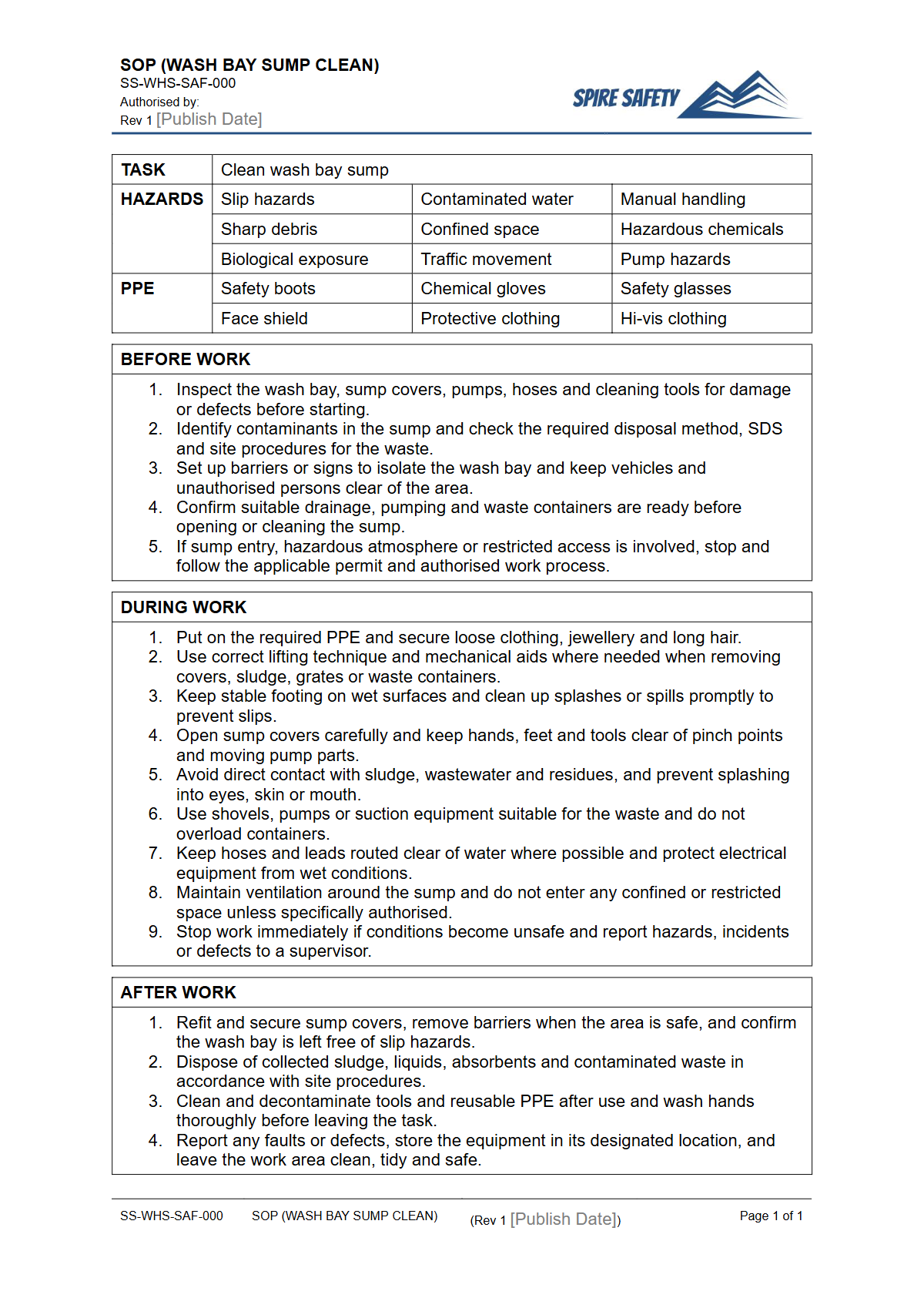
Cleaning a wash bay sump is a critical maintenance task that presents significant health and safety risks, including exposure to hazardous chemicals, working in confined spaces, and hazardous manual tasks. This free Safe Operating Procedure (Wash bay Sump Clean) template provides a structured framework for organisations to develop a comprehensive procedure that controls these risks.
It is designed to be adapted to your specific site, equipment, and cleaning agents, forming a key part of your safety management system.
Video walkthrough
Purpose of the Free Safe Operating Procedure (Wash Bay Sump Clean) Template
The primary purpose of this Safe Operating Procedure is to provide a clear, step-by-step guide for cleaning a wash bay sump safely. It helps persons conducting a business or undertaking (PCBUs) fulfil their duty of care by formally documenting hazards and control measures.
Using this template helps standardise the cleaning process, reducing the chance of incidents caused by inconsistent practices. It prompts a thorough consideration of risks such as chemical burns, inhalation of toxic fumes, slips on wet surfaces, musculoskeletal injuries from lifting heavy grates, and the severe dangers associated with entering a confined space.
Documenting these procedures is a fundamental component of building robust WHS management systems that protect workers and ensure operational continuity.
How to use the Free Safe Operating Procedure (Wash Bay Sump Clean) Template
This template is a starting point, not a final document. To use it effectively, you must customise it to reflect the specific realities of your workplace.
Download the DOCX file and begin by conducting a site-specific risk assessment for the wash bay sump cleaning task. Involve the workers who perform the job in this process.
Edit the document to include details about your specific sump design, the types of vehicles or equipment washed, the exact chemicals used for cleaning, and the personal protective equipment (PPE) required. It is critical that you adapt this template; we are not liable for your safety outcomes.
A regular WHS compliance audit can help verify that your customised procedures are being followed correctly and remain effective over time.
Key Elements Covered in the Template
Our template provides a comprehensive structure for you to build upon, covering the essential stages of the task. It includes sections for:
- Required PPE: A checklist to specify items like chemical-resistant gloves, safety goggles, face shields, waterproof boots, and respiratory protection based on your risk assessment.
- Pre-operational Checks: Steps to ensure the area is clear, signage is in place, and all necessary equipment and cleaning agents are ready and in good condition. This also includes steps for energy isolation (lockout-tagout) for any associated pumps or machinery.
- Step-by-Step Procedure: A logical sequence for performing the cleaning task, from removing the sump grate to disposing of the waste. This is the core of the SOP and requires the most site-specific customisation.
- Confined Space Entry: Prompts to determine if the sump is a confined space and, if so, to integrate your confined space entry permit and procedures.
- Waste Disposal: Guidelines for managing and disposing of the collected sludge and contaminated water in accordance with local environmental regulations.
- Emergency Procedures: Instructions for responding to incidents such as chemical spills, personal exposure, or medical emergencies.
Developing a detailed SOP can be complex. If you require expert assistance in adapting this template or conducting the necessary risk assessments, consider engaging our WHS consulting team for tailored support.
When to use this Safe Operating Procedure
A Safe Operating Procedure for wash bay sump cleaning should be used consistently. It is a vital tool for worker induction and training, ensuring every new operator understands the approved, safe method before they begin.
It should also be a central document for periodic refresher training to prevent complacency and reinforce safe work habits. Furthermore, the SOP must be reviewed and potentially updated following any near miss or incident, whenever new equipment or chemicals are introduced, or if there is a change in the work environment.
The procedure isn't just a document for training; it should be readily accessible in the work area for reference during the task.
Who should use this Safe Operating Procedure
This SOP is intended for several groups within an organisation. The primary users are the workers assigned to clean the wash bay sump.
They must be trained on the procedure and follow its steps every time. Supervisors and team leaders must also use the SOP to oversee the work, conduct pre-start checks, and ensure the documented controls are implemented effectively.
WHS managers and personnel will use the SOP as a key document within the overall safety system, for auditing purposes, and as a basis for incident investigations. For related plant, ensure you have specific procedures documented, such as our free Air Compressor SOP template, if one is used during the cleaning process.
If heavy sump grates or equipment need to be moved, operators must be trained and competent on the machinery used. A task like this might require a specific Telehandler SOP if one is used for the lift.
By ensuring you have documented procedures for all high-risk tasks, you create a more predictable and safer workplace. You can find more templates like this in our extensive free WHS resources library.
Common mistakes
Common mistakes to avoid
- Assuming the sump is not a confined space without a proper assessment.
- Using incorrect PPE for the specific chemicals and contaminants involved.
- Failing to properly isolate energy sources (e.g., pumps) using lockout-tagout procedures.
- Improper disposal of contaminated sludge and wastewater, violating environmental regulations.
Legal references
Legal considerations
The following legal requirements may be relevant to this type of work.
- Work Health and Safety Act (Harmonised) — Provides the primary duties for protecting workers and other people from work health and safety risks.
- Work Health and Safety Regulations (Harmonised) — Sets out requirements supporting the management of workplace hazards and risks.
The following codes may be relevant to this type of work.
- Managing WHS Risks Code of Practice — Provides practical guidance on identifying hazards, assessing risks and applying effective controls.
- Work Health and Safety Consultation, Cooperation and Coordination Code of Practice — Provides practical guidance on consulting workers and coordinating with other duty holders.
- Managing the Work Environment and Facilities Code of Practice — Provides practical guidance on safe work environments, workplace facilities and related controls.
Did you know
Sludge Can Be Deceptive
Wash bay sludge can contain a cocktail of heavy metals, oils, and detergents. Classifying this waste correctly is a key environmental and safety requirement before disposal.
Confined Space Risk
Many wash bay sumps are considered confined spaces under WHS regulations, requiring specific entry permits, atmospheric testing, and rescue plans before work can begin.
FAQ
Frequently asked questions
01What are the main hazards of cleaning a wash bay sump?
02Is this SOP template enough to be compliant?
03How often should a wash bay sump be cleaned?
04What PPE is required for cleaning a wash bay sump?
Share this resource
Free Safe Operating Procedure (Wash Bay Sump Clean) Template
Browse Categories
How To Use It
- 1Download and open in Word or PDF.
- 2Replace the placeholders with your business details.
- 3Get it reviewed by a WHS specialist before rollout.
Need it customised?
Our WHS consultants can adapt this template to your site, run a gap analysis, or audit what you already have in place.
Book a Free Consultation WHS consulting servicesor call 1300 156 382
Related templates
- Free Safe Operating Procedure (Wash Plant) Template
- Free Safe Operating Procedure (Washroom Deep Cleaning) Template
- Free Safe Operating Procedure (Waste Audit Sorting) Template
- Free Safe Operating Procedure (Waste Bay Cleanup) Template
- Free Safe Operating Procedure (Waste Bin Inspection) Template
- Free Safe Operating Procedure (Waste Bin Placement) Template