
Free Safe Operating Procedure (Wall Chaser) Template
Manage high-risk dust and equipment hazards on site with our structured Safe Operating Procedure for wall chasers. Download your free template today.
Free Safe Operating Procedure (Wall Chaser) Template
DOCX • 126 KB + PDF
Updated Oct 2026
No signup required
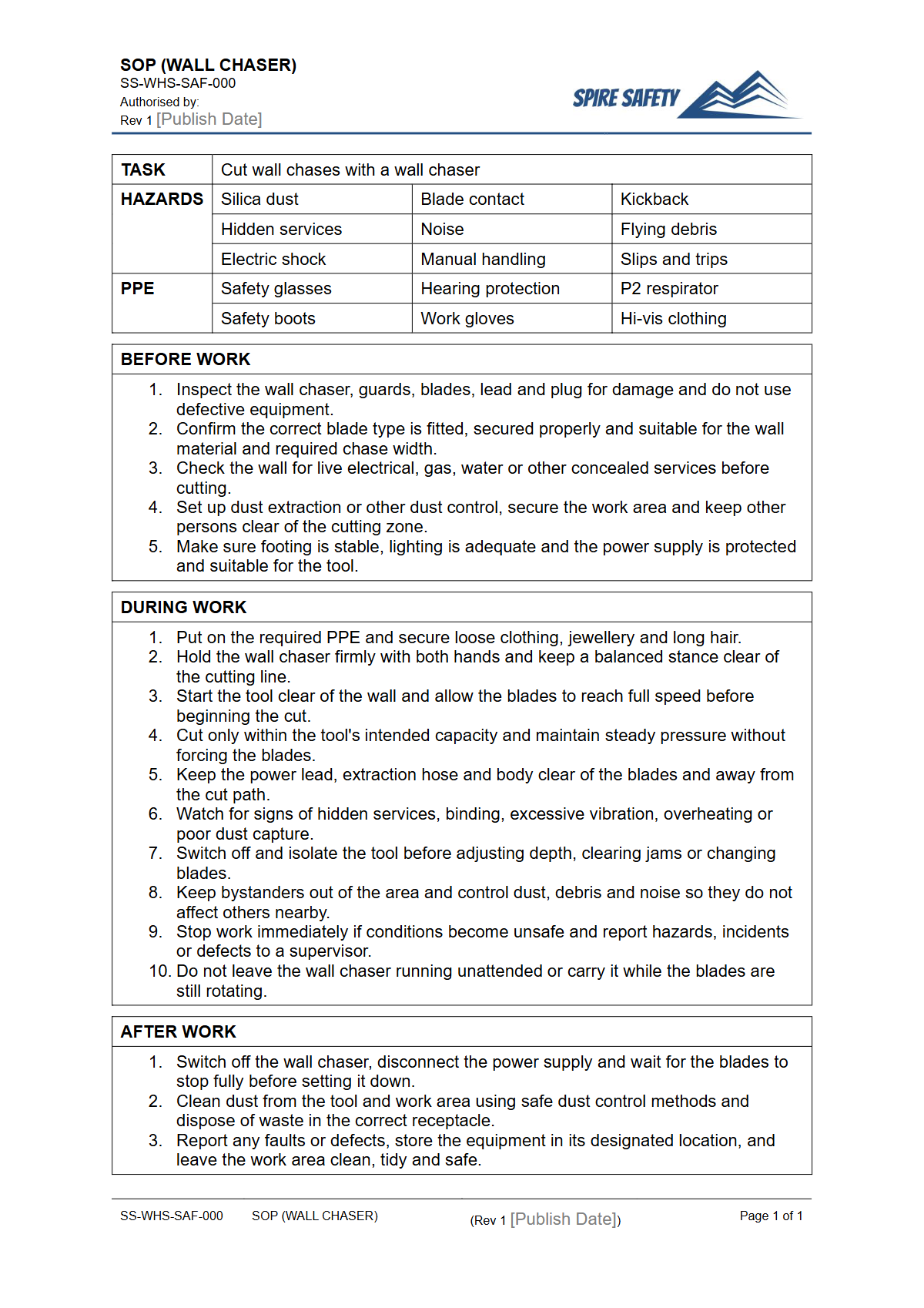
Purpose of the Free Safe Operating Procedure (Wall Chaser) Template
Operating a wall chaser introduces significant workplace hazards, most notably the generation of respirable crystalline silica (RCS) dust, but also risks of kickback, noise, vibration, and electrical shock. This Free Safe Operating Procedure (Wall Chaser) Template provides a structured framework for documenting the required steps to use this equipment safely.
A comprehensive SOP is a critical component of a safe system of work, helping your organisation meet its duty of care under Australian WHS laws by controlling risks and providing clear instructions to workers.
A well-defined SOP clarifies pre-operational checks, safe usage steps, and post-operational cleaning and maintenance. It acts as a vital tool for worker training, competency assessment, and ongoing supervision.
By formalising these procedures, you create a consistent and repeatable process that minimises the chance of incidents. Similar to how one would manage risks for ground-disturbing equipment using a FREE Trencher SOP Template, this document helps standardise safety for a specific high-risk task.
Video walkthrough
How to use the Free Safe Operating Procedure (Wall Chaser) Template
This Safe Operating Procedure is provided as a fully editable DOCX file and a print-ready PDF. It is designed as a starting point, aligned with the principles of the model WHS framework.
It is not a complete, ready-to-use document.
Important: We have created this template as a guide, but it is essential that you customise it to reflect the specific equipment, materials, and environment of your workplace. You must consult with your workers and other relevant parties to identify all potential hazards and implement suitable control measures.
Integrating this SOP into your broader WHS management systems ensures it becomes a living document, actively used and reviewed as part of your overall safety strategy.
To effectively use this template:
- Download the DOCX file.
- Review each section and add site-specific details, including the make and model of your wall chaser.
- Conduct a risk assessment for the task of chasing walls in your specific work environment and document the controls.
- Incorporate details on your chosen dust control methods (e.g., on-tool extraction with an M or H-class vacuum).
- List the specific Personal Protective Equipment (PPE) required.
- Consult with operators, supervisors, and health and safety representatives during the drafting process.
- Finalise the document, get it approved by management, and use it to train all relevant workers.
When to use it
A Safe Operating Procedure for a wall chaser should be developed, approved, and implemented before any worker is permitted to use the equipment. It is a foundational document that should be used during new worker inductions and for specific task training.
Supervisors should refer to the SOP to ensure work is being performed as required, and it should be readily accessible to operators at all times. The SOP is also a key reference document during incident investigations or when planning work that involves cutting into concrete, brick, or masonry. For other high-risk portable tools, a similar approach should be taken, such as when using our FREE Circular Saw SOP Template.
Who should use it
This template is intended for Persons Conducting a Business or Undertaking (PCBUs), site managers, WHS advisors, and supervisors in the construction, electrical, and plumbing trades. Anyone responsible for managing workplace safety, purchasing plant and equipment, or supervising workers has a role in implementing and enforcing the SOP.
Operators themselves are the primary end-users, as it provides them with clear, step-by-step guidance on how to perform their work safely. Periodic checks and formal safety audits can verify that the procedures documented are being followed correctly, and our WHS compliance auditing services can provide independent assurance.
The SOP should be a central part of your safety documentation, alongside risk assessments, maintenance logs, and worker training records. It’s also useful for other common equipment found on site; for example, many dust extraction systems are powered by compressed air, making a Free Air Compressor SOP Template a valuable related document. To find more templates for your business, you can browse our complete free WHS resources library.
Common mistakes
Common mistakes to avoid
- Using the tool without an integrated dust extraction system (M or H-class vacuum).
- Failing to inspect the work area for hidden services like electrical conduits, water pipes, or structural steel.
- Applying excessive force, which can cause the blades to jam and the tool to kick back violently.
- Using incorrect, damaged, or worn-out blades for the material being cut.
Legal references
Legal considerations
The following legal requirements may be relevant to this type of work.
- Work Health and Safety Act (Harmonised) — Provides the primary duties for protecting workers and other people from work health and safety risks.
- Work Health and Safety Regulations (Harmonised) — Sets out requirements supporting the management of workplace hazards and risks.
The following codes may be relevant to this type of work.
- Managing WHS Risks Code of Practice — Provides practical guidance on identifying hazards, assessing risks and applying effective controls.
- Work Health and Safety Consultation, Cooperation and Coordination Code of Practice — Provides practical guidance on consulting workers and coordinating with other duty holders.
- Managing the Work Environment and Facilities Code of Practice — Provides practical guidance on safe work environments, workplace facilities and related controls.
Did you know
Invisible Danger
Respirable crystalline silica (RCS) particles are 100 times smaller than a grain of sand and are invisible in normal light. Effective dust control, like on-tool water suppression or vacuum extraction, is the only reliable way to manage this hazard.
Blade Speed
The twin diamond blades on a typical wall chaser can rotate at speeds exceeding 5,000 RPM. This high speed allows it to cut through hard materials like concrete but also creates the potential for violent kickback if the blades jam.
FAQ
Frequently asked questions
01What are the main hazards of using a wall chaser?
02Is a specific licence required to operate a wall chaser in Australia?
03What PPE is essential when using a wall chaser?
04How often should a Safe Operating Procedure for a wall chaser be reviewed?
Share this resource
Free Safe Operating Procedure (Wall Chaser) Template
Browse Categories
How To Use It
- 1Download and open in Word or PDF.
- 2Replace the placeholders with your business details.
- 3Get it reviewed by a WHS specialist before rollout.
Need it customised?
Our WHS consultants can adapt this template to your site, run a gap analysis, or audit what you already have in place.
Book a Free Consultation WHS consulting servicesor call 1300 156 382
Related templates
- Free Safe Operating Procedure (Wall Sander) Template
- Free Safe Operating Procedure (Wall Scanner) Template
- Free Safe Operating Procedure (Wall Washing) Template
- Free Safe Operating Procedure (Ward Waste Collection) Template
- Free Safe Operating Procedure (Warping Machine) Template
- Free Safe Operating Procedure (Wash Bay Sump Clean) Template