
Free Safe Operating Procedure (Walking Aid Inspection) Template
Download our free Safe Operating Procedure (Walking Aid Inspection) Template to standardise your equipment checks. Get your DOCX and PDF to start today.
Free Safe Operating Procedure (Walking Aid Inspection) Template
DOCX • 126 KB + PDF
Updated Oct 2026
No signup required
Purpose of the Free Safe Operating Procedure (Walking Aid Inspection) Template
Walking aids like frames, canes, and crutches are critical for mobility and safety, particularly in healthcare, aged care, and disability support settings. Ensuring these devices are in safe, working order is a key responsibility for any Person Conducting a Business or Undertaking (PCBU).
This Free Safe Operating Procedure (Walking Aid Inspection) Template provides a structured starting point for creating a formalised process for these essential checks. Using this SOP helps standardise inspections, reduce the risk of falls or equipment failure, and document your organisation's commitment to safety.
A well-defined SOP is a fundamental component of a proactive safety culture. It outlines the step-by-step process for a specific task, identifies potential hazards, and specifies the required control measures.
Implementing robust procedures for all critical tasks is a cornerstone of effective WHS management systems, helping to ensure consistency and accountability across your team.
Video walkthrough
How to use the Free Safe Operating Procedure (Walking Aid Inspection) Template
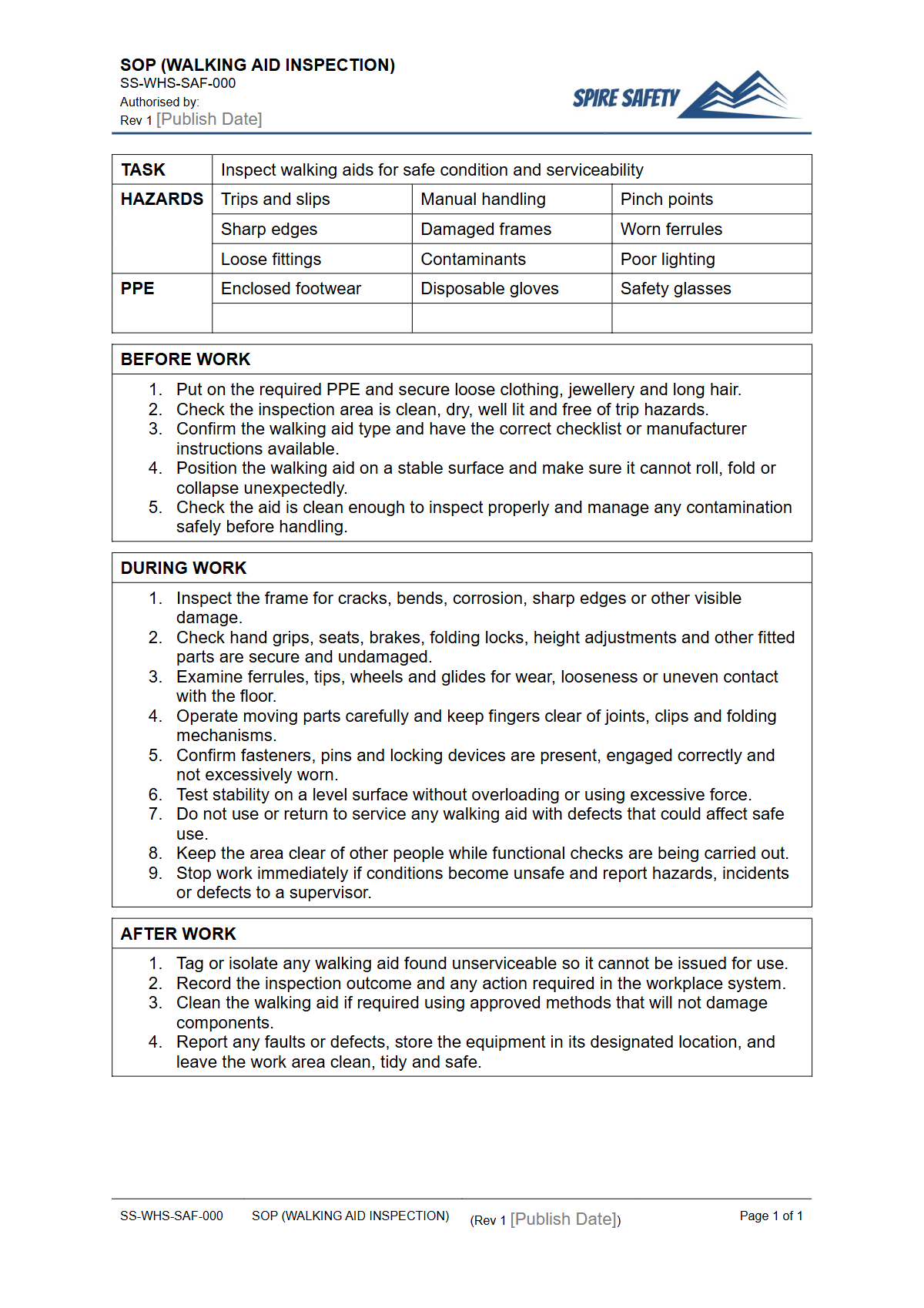
This resource is available for download as a DOCX file for easy editing and a PDF for straightforward printing. The template includes sections for outlining the task, identifying hazards and risks, detailing pre-inspection checks, outlining the step-by-step inspection process, and concluding procedures.
It is designed as a comprehensive framework aligned with Australian WHS practice.
Important: It is crucial to remember that this is a template. We provide it as a starting point, and you must customise it to reflect the specific types of walking aids used, your unique workplace environment, and the legal requirements applicable to your organisation.
You will need to add your company details, list the specific models of equipment, and adapt the inspection points to suit each device.
The principles of documenting safe procedures apply to a wide range of equipment, not just mobility aids. For example, even common kitchen equipment requires clear instructions, as detailed in our Free Safe Operating Procedure (Deep Fryer - Standard Operation) Template.
When to Conduct a Walking Aid Inspection
A formal inspection using this Safe Operating Procedure should be integrated into your regular maintenance schedule. Inspections should be conducted:
- At regular intervals: Establish a frequency (e.g., monthly, quarterly) based on manufacturer recommendations, level of use, and a risk assessment.
- Before first use: Any new walking aid should be inspected to ensure it arrived free from defects.
- After a reported issue: If a user or staff member reports a concern, a full inspection should be performed before the aid is returned to service.
- Following an incident: If a fall or near miss occurs involving a walking aid, it must be taken out of service and thoroughly inspected to identify any contributing equipment faults.
Regular checks are vital for demonstrating due diligence. The records generated from following this SOP provide valuable evidence during a formal WHS compliance auditing process, showing that your safety systems are not just documented but also actively implemented.
Who Should Use This SOP
This SOP is intended for any personnel responsible for the safety and maintenance of mobility equipment. This may include:
- WHS Officers or Safety Advisors
- Maintenance staff
- Care staff in aged care or healthcare facilities
- Team leaders or supervisors in disability support services
- Therapists (e.g., physiotherapists, occupational therapists) who prescribe or manage equipment
It is essential that anyone tasked with performing these inspections is deemed competent. This involves providing adequate training on how to follow the procedure, how to correctly identify faults (e.g., stress fractures, worn ferrules, loose fittings), and what steps to take when a defect is found. This principle of training and procedure applies to all equipment, from simple aids to more complex machinery covered by resources like the Free Air Compressor SOP (Safe Operating Procedure) Template.
Developing a robust SOP requires a thorough understanding of the task's hazards. For equipment that presents different types of risks, such as power tools, the procedure must be equally detailed.
You can see an example of this in our FREE Circular Saw SOP (Safe Operating Procedure) Template, which outlines controls for mechanical, electrical, and noise hazards.
Common mistakes
Common mistakes to avoid
- Using a single, generic checklist for different types of walking aids (e.g., using a cane checklist for a wheeled walker).
- Failing to train staff on how to correctly identify specific faults like stress fractures or worn components.
- Neglecting to formally document inspection findings, dates, and any corrective actions taken.
- Returning a faulty or damaged walking aid to service without proper repair or replacement.
Legal references
Legal considerations
The following legal requirements may be relevant to this type of work.
- Work Health and Safety Act (Harmonised) — Provides the primary duties for protecting workers and other people from work health and safety risks.
- Work Health and Safety Regulations (Harmonised) — Sets out requirements supporting the management of workplace hazards and risks.
The following codes may be relevant to this type of work.
- Managing WHS Risks Code of Practice — Provides practical guidance on identifying hazards, assessing risks and applying effective controls.
- Work Health and Safety Consultation, Cooperation and Coordination Code of Practice — Provides practical guidance on consulting workers and coordinating with other duty holders.
- Managing the Work Environment and Facilities Code of Practice — Provides practical guidance on safe work environments, workplace facilities and related controls.
Did you know
A Common Culprit
Worn-out or damaged rubber tips (ferrules) on the bottom of canes, crutches, and walkers are one of the most common and easily preventable causes of walking aid failure, significantly increasing the risk of a slip and fall.
Falls Statistics
According to Safe Work Australia, falls are a leading cause of serious injury claims in the healthcare and social assistance industry, highlighting the critical importance of maintaining equipment like walking aids.
FAQ
Frequently asked questions
01What should be included in a walking aid inspection SOP?
02How often should walking aids be inspected?
03Who is responsible for inspecting walking aids in a workplace?
04Is a Safe Operating Procedure a legal requirement for walking aid inspection?
Share this resource
Free Safe Operating Procedure (Walking Aid Inspection) Template
Browse Categories
How To Use It
- 1Download and open in Word or PDF.
- 2Replace the placeholders with your business details.
- 3Get it reviewed by a WHS specialist before rollout.
Need it customised?
Our WHS consultants can adapt this template to your site, run a gap analysis, or audit what you already have in place.
Book a Free Consultation WHS consulting servicesor call 1300 156 382
Related templates
- Free Safe Operating Procedure (Walkway Leaf Clearing) Template
- Free Safe Operating Procedure (Wall Chaser) Template
- Free Safe Operating Procedure (Wall Sander) Template
- Free Safe Operating Procedure (Wall Scanner) Template
- Free Safe Operating Procedure (Wall Washing) Template
- Free Safe Operating Procedure (Ward Waste Collection) Template