
Free Safe Operating Procedure (Voltage Detector) Template
Download our free Safe Operating Procedure for voltage detectors to manage electrical hazards.
Free Safe Operating Procedure (Voltage Detector) Template
DOCX • 126 KB + PDF
Updated Oct 2026
No signup required
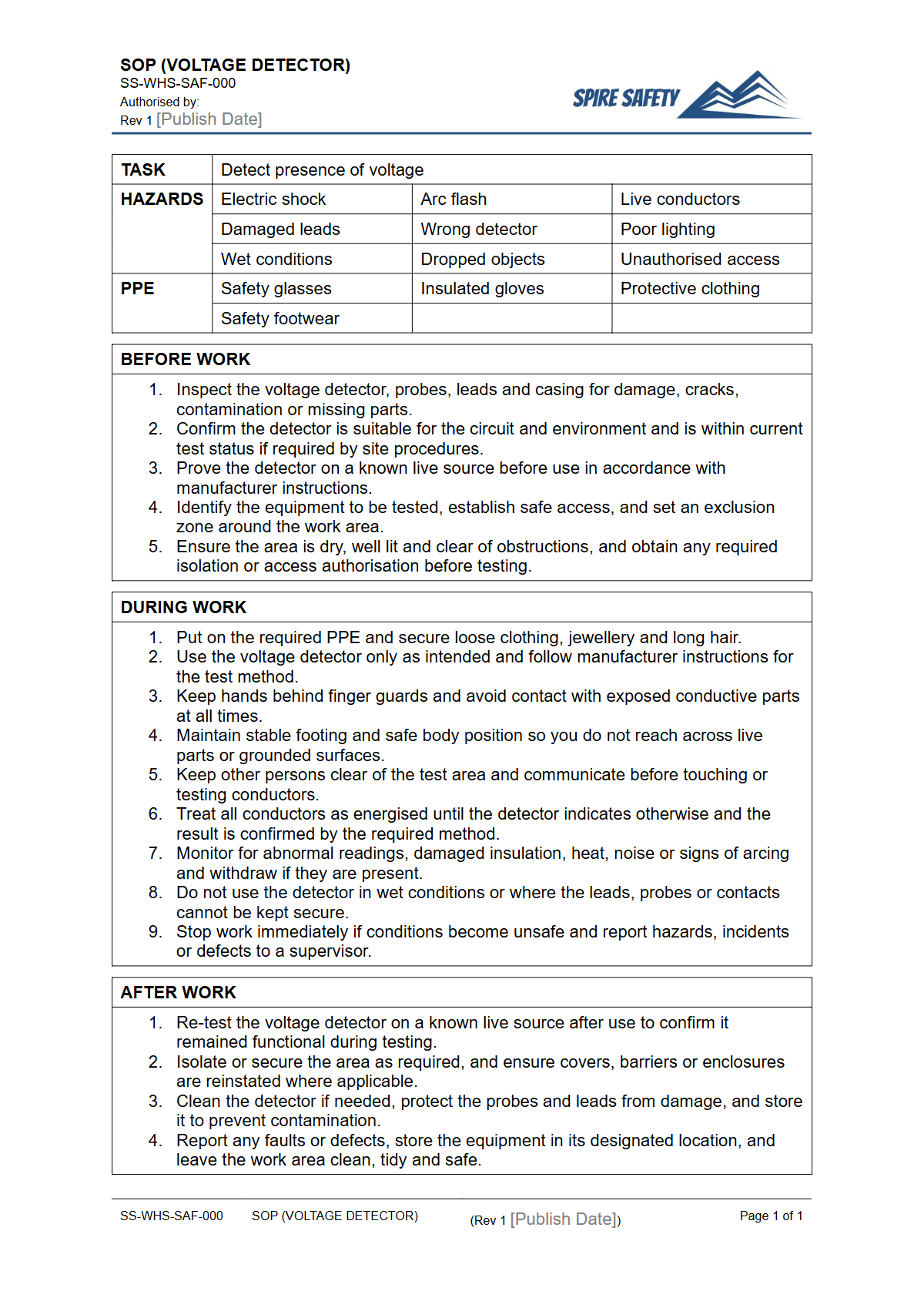
Purpose of the Free Safe Operating Procedure (Voltage Detector) Template
This Free Safe Operating Procedure (Voltage Detector) Template provides a structured framework for documenting the safe use of non-contact and contact voltage testers. Formalising this process is critical for preventing electric shock, arc flash, and other severe injuries that can result from accidental contact with live electrical parts.
The primary purpose of this SOP is to enforce the 'test before you touch' principle—a non-negotiable rule in electrical safety.
Using a clear, step-by-step procedure helps ensure every worker follows a consistent, safe method for verifying the absence of voltage. A well-defined SOP is a critical component of your overall safety framework, helping to demonstrate due diligence and build a proactive safety culture.
Integrating procedures like this into your broader WHS management systems ensures a consistent and systematic approach to risk control across your entire organisation.
This Safe Operating Procedure template will help you:
- Identify the specific hazards associated with using voltage detectors.
- Outline pre-use inspection requirements for testing equipment.
- Define the mandatory personal protective equipment (PPE) for the task.
- Establish a clear, sequential process for testing for voltage safely.
- Document emergency and first aid procedures in case of an incident.
Video walkthrough
How to use the Free Safe Operating Procedure (Voltage Detector) Template
After downloading the template in your preferred format (DOCX or PDF), you must customise it to reflect your specific operational environment. This document is a starting point, aligned with Australian WHS principles, but it requires your input to become a functional safety tool for your workplace.
It is crucial to remember that this is a template, not a finished document. We have designed it to be adapted to your specific workplace, including the exact models of voltage detectors used, the types of electrical systems present, and your unique operational risks. We strongly recommend consulting with competent electricians and the workers who will be performing the task to ensure the final SOP is practical and effective.
Follow these steps to implement the SOP:
- Download and Customise: Fill in the blank fields with your company’s details, specific equipment models, and site-specific procedures.
- Risk Assessment: Use the template as a guide to review and confirm your existing risk assessment for electrical work is comprehensive.
- Consult and Finalise: Discuss the draft procedure with your team to gather feedback and ensure it is understood by everyone who will use it.
- Train All Relevant Personnel: Provide training on the final, approved SOP. Ensure workers can demonstrate their understanding and competency before they are authorised to perform the task.
- Review and Revise: The SOP should be reviewed regularly, after any incident, or when new equipment or regulations are introduced.
Spire Safety offers a wide range of templates to help you document your processes for various tasks and equipment, all available in our free WHS resources library.
When to use it
A Safe Operating Procedure for a voltage detector should be used every time a worker needs to verify that an electrical circuit or piece of equipment has been successfully de-energised. It is not an optional document; it is a critical control measure for high-risk electrical tasks.
Key situations include:
- Lockout/Tagout (LOTO) Procedures: The SOP is an essential part of any LOTO program, used to confirm zero energy state after isolation.
- Electrical Maintenance and Repair: Before any physical work begins on electrical components, circuits, or machinery.
- Fault-Finding and Diagnostics: When troubleshooting electrical systems to safely identify live and dead circuits.
- Demolition and Decommissioning: To ensure all power sources have been disconnected before dismantling structures or equipment.
Regular reviews of SOPs should be part of your safety assurance activities, which can be formalised through a program of WHS compliance auditing to verify that procedures are effective and being followed correctly.
Who should use it
This Safe Operating Procedure is intended for personnel who are trained, competent, and authorised to work on or near electrical systems. The specific roles include:
- Licensed Electricians: For all installation, maintenance, and repair work.
- Service and Maintenance Technicians: For verifying isolation before commencing mechanical or other non-electrical maintenance on equipment.
- Supervisors and WHS Managers: To use as a tool for training, monitoring work, and investigating incidents.
Only individuals who have received specific training on the use of voltage detectors and the associated electrical hazards should perform this task. Just as a worker using high-energy equipment needs a specific free Oxy Acetylene SOP, anyone tasked with electrical verification must be trained and deemed competent in this specific procedure.
For organisations needing support in defining roles, responsibilities, and competency frameworks, our WHS consulting services can provide expert guidance.
Similar principles of procedural safety apply to other high-risk tools, where a documented process like our free Circular Saw SOP is essential for managing hazards effectively.
Common mistakes
Common mistakes to avoid
- Forgetting to test the detector on a known live source before and after testing the target circuit.
- Using a detector with an incorrect voltage rating (e.g., a low-voltage detector on a high-voltage system).
- Failing to wear appropriate electrical PPE, particularly insulated gloves and eye protection.
- Making contact with the probes or circuit with bare hands, assuming the test will show it's dead.
Legal references
Legal considerations
The following legal requirements may be relevant to this type of work.
- Work Health and Safety Act (Harmonised) — Provides the primary duties for protecting workers and other people from work health and safety risks.
- Work Health and Safety Regulations (Harmonised) — Sets out requirements supporting the management of workplace hazards and risks.
The following codes may be relevant to this type of work.
- Managing WHS Risks Code of Practice — Provides practical guidance on identifying hazards, assessing risks and applying effective controls.
- Work Health and Safety Consultation, Cooperation and Coordination Code of Practice — Provides practical guidance on consulting workers and coordinating with other duty holders.
- Managing the Work Environment and Facilities Code of Practice — Provides practical guidance on safe work environments, workplace facilities and related controls.
Did you know
Proving Dead
The 'test before you touch' principle involves a three-step process: test the detector on a known live source, test the target circuit, and then re-test on the known live source to ensure the detector is still working correctly.
Phantom Voltage
Some high-impedance digital multimeters can detect misleading 'phantom' voltages induced by adjacent live wiring. Purpose-built voltage detectors or low-impedance meters are designed to ignore this effect and give a true 'dead' or 'live' indication.
FAQ
Frequently asked questions
01What must be included in a Safe Operating Procedure for a voltage detector?
02How often should a voltage detector SOP be reviewed?
03Is a voltage detector a reliable way to confirm de-energisation?
04What PPE is required when using a voltage detector?
Share this resource
Free Safe Operating Procedure (Voltage Detector) Template
Browse Categories
How To Use It
- 1Download and open in Word or PDF.
- 2Replace the placeholders with your business details.
- 3Get it reviewed by a WHS specialist before rollout.
Need it customised?
Our WHS consultants can adapt this template to your site, run a gap analysis, or audit what you already have in place.
Book a Free Consultation WHS consulting servicesor call 1300 156 382
Related templates
- Free Safe Operating Procedure (Waffle Maker) Template
- Free Safe Operating Procedure (Walk Through Scanner) Template
- Free Safe Operating Procedure (Walk-In Freezer) Template
- Free Safe Operating Procedure (Walker Cleaning) Template
- Free Safe Operating Procedure (Walking Aid Inspection) Template
- Free Safe Operating Procedure (Walkway Leaf Clearing) Template