
Free Safe Operating Procedure (Walk Through Scanner) Template
Download our free Safe Operating Procedure (Walk Through Scanner) template to establish clear, safe work instructions.
Free Safe Operating Procedure (Walk Through Scanner) Template
DOCX • 126 KB + PDF
Updated Oct 2026
No signup required
Purpose of the Free Safe Operating Procedure (Walk Through Scanner) Template
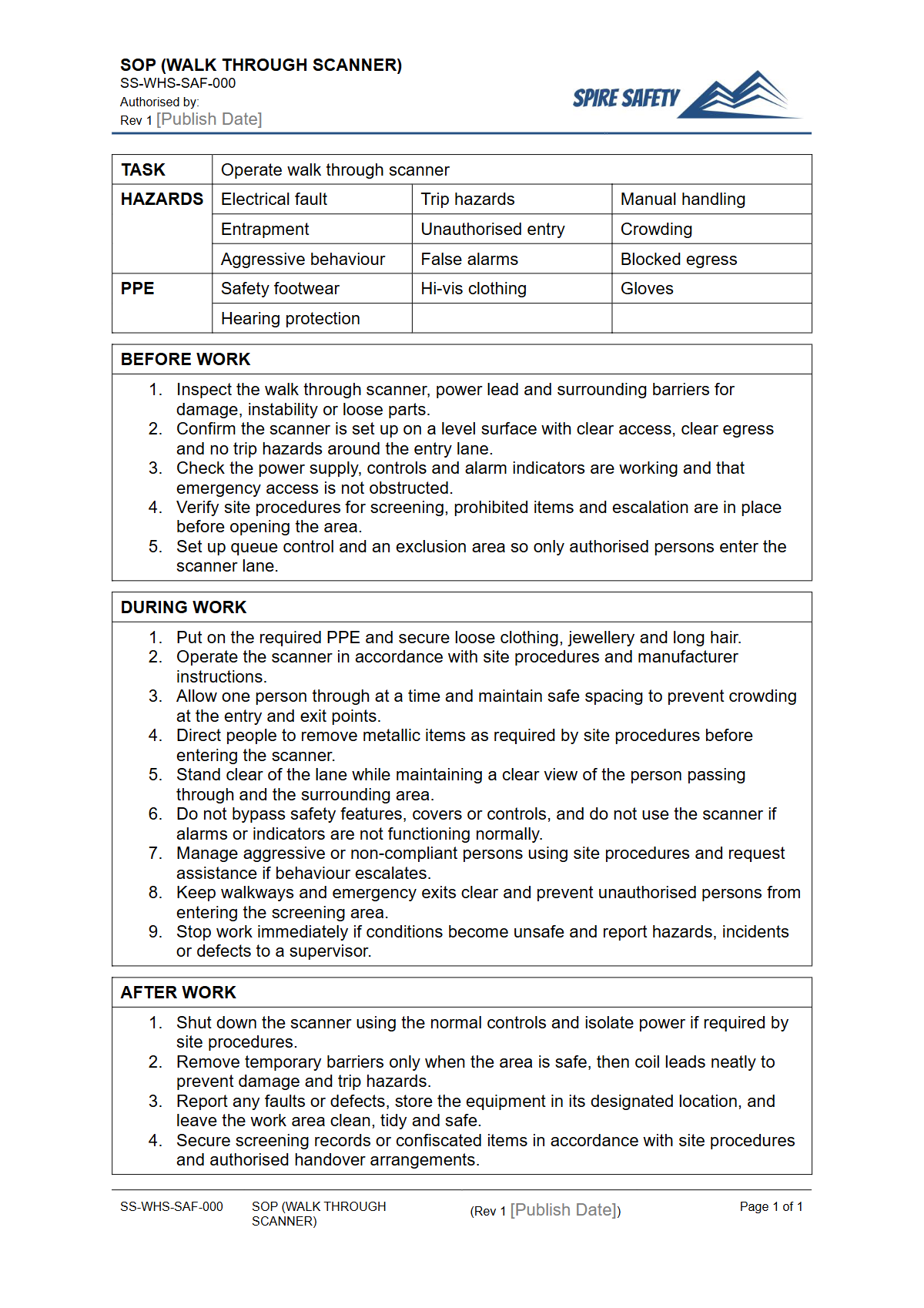
A walk-through scanner, or metal detector, is a critical control measure for security and loss prevention in many Australian workplaces. This Free Safe Operating Procedure (Walk Through Scanner) Template provides a structured framework for documenting the safe and effective use of this equipment.
Its primary purpose is to ensure that all personnel operate the scanner consistently, safely, and in accordance with your organisation's specific requirements. By formalising procedures, you minimise risks to operators, patrons, and the public, while ensuring the equipment functions as intended to detect prohibited items.
Using a standardised SOP helps meet your duty of care obligations under WHS legislation by providing clear instructions and outlining risk controls. It serves as a vital training tool for new staff and a reference point for experienced operators, promoting a consistent approach to security screening.
Formalising your processes is a key part of developing broader WHS management systems that protect your people and your business.
Video walkthrough
How to use the Free Safe Operating Procedure (Walk Through Scanner) Template
This template is available for instant download in both DOCX and PDF formats. We recommend using the DOCX version to add, remove, and edit the content to suit your specific operational needs.
A Safe Operating Procedure (SOP) is only effective when it is tailored to the exact context in which it will be used.
Important: You must customise this document to align with your workplace. This includes adding details about your specific scanner model, the physical location of the unit, your unique alarm response protocols, and any site-specific hazards.
We are not liable for any incidents arising from the use of an un-customised or improperly adapted template. The document should be reviewed and approved by a competent person before implementation.
Key Elements of a Walk-Through Scanner SOP
A comprehensive SOP for a walk-through scanner should go beyond basic operation. Our template prompts you to consider several critical areas to build a robust procedure.
These include pre-operational checks to verify the scanner is calibrated and functioning correctly, step-by-step instructions for guiding individuals through the scanner, and clear protocols for responding to an alarm. It should also detail routine maintenance, cleaning, and testing schedules to ensure ongoing reliability.
Just as you would detail specific maintenance checks in our free Conveyer System SOP, your scanner procedure must include manufacturer-recommended upkeep.
Furthermore, your SOP must outline the training requirements for all operators. This ensures they not only know how to use the equipment but also understand the principles behind it, the limitations of the technology, and the appropriate way to interact with people being screened.
Documenting these elements helps demonstrate due diligence and provides a clear operational standard for everyone to follow.
When to Use a Scanner SOP
A Safe Operating Procedure for a walk-through scanner should be developed and implemented before the equipment is put into service. It is essential for any environment where people are systematically screened for metallic items. Common applications include:
- Event venues and stadiums
- Airports and transport hubs
- Secure government buildings and courthouses
- Distribution centres and warehouses for loss prevention
- Nightclubs and entertainment venues
- Manufacturing facilities with high-value materials
The SOP should be readily accessible to all operators at or near the location of the scanner. Its use should be reinforced through induction, training, and periodic reviews, which can be verified during regular WHS compliance auditing.
Who Should Use This Template
This resource is designed for individuals responsible for workplace safety, security, and operational management. This includes:
- WHS Managers and Safety Officers
- Security Managers and Supervisors
- Business Owners and Directors
- Event and Venue Managers
- Facilities and Operations Managers
Whether you are setting up a new security checkpoint or formalising existing practices, this template provides a solid foundation. It helps ensure that safety and procedural considerations are integrated from the start.
If your workplace uses other types of equipment, you may also find value in resources like our template for an Air Compressor SOP. You can explore our complete extensive library of free WHS resources to find other documents relevant to your operations.
Common mistakes
Common mistakes to avoid
- Failing to perform and document daily calibration tests.
- Providing inadequate training on how to respond to an alarm and interact with patrons.
- Not customising the procedure for the specific scanner model and its physical environment.
- Neglecting to create clear protocols for secondary screening after an initial alarm.
Legal references
Legal considerations
The following legal requirements may be relevant to this type of work.
- Work Health and Safety Act (Harmonised) — Provides the primary duties for protecting workers and other people from work health and safety risks.
- Work Health and Safety Regulations (Harmonised) — Sets out requirements supporting the management of workplace hazards and risks.
The following codes may be relevant to this type of work.
- Managing WHS Risks Code of Practice — Provides practical guidance on identifying hazards, assessing risks and applying effective controls.
- Work Health and Safety Consultation, Cooperation and Coordination Code of Practice — Provides practical guidance on consulting workers and coordinating with other duty holders.
- Managing the Work Environment and Facilities Code of Practice — Provides practical guidance on safe work environments, workplace facilities and related controls.
Did you know
Scanner Technology
Most modern walk-through metal detectors use Pulse Induction (PI) technology. PI systems send short, powerful bursts of current through a coil of wire, creating a brief magnetic field that is highly effective at detecting a wide range of metal objects.
Calibration is Key
Walk-through scanners require regular calibration using a specific test object to ensure they are detecting at the required sensitivity level. Environmental factors like nearby large metal objects or electrical interference can affect performance, making routine checks crucial.
FAQ
Frequently asked questions
01What should be included in an SOP for a walk-through scanner?
02Is an SOP a legal requirement for walk-through scanners in Australia?
03How often should an SOP for a walk-through scanner be reviewed?
04Can this template be used for handheld metal detectors as well?
Share this resource
Free Safe Operating Procedure (Walk Through Scanner) Template
Browse Categories
How To Use It
- 1Download and open in Word or PDF.
- 2Replace the placeholders with your business details.
- 3Get it reviewed by a WHS specialist before rollout.
Need it customised?
Our WHS consultants can adapt this template to your site, run a gap analysis, or audit what you already have in place.
Book a Free Consultation WHS consulting servicesor call 1300 156 382
Related templates
- Free Safe Operating Procedure (Walk-In Freezer) Template
- Free Safe Operating Procedure (Walker Cleaning) Template
- Free Safe Operating Procedure (Walking Aid Inspection) Template
- Free Safe Operating Procedure (Walkway Leaf Clearing) Template
- Free Safe Operating Procedure (Wall Chaser) Template
- Free Safe Operating Procedure (Wall Sander) Template