
Free Safe Operating Procedure (Vibratory Feeder) Template
Download our free Safe Operating Procedure (Vibratory Feeder) template to formalise safe work practices. This customisable DOCX helps manage operational risks.
Free Safe Operating Procedure (Vibratory Feeder) Template
DOCX • 126 KB + PDF
Updated Oct 2026
No signup required
Purpose of the Free Safe Operating Procedure (Vibratory Feeder) Template
This Safe Operating Procedure (SOP) template for vibratory feeders provides a structured framework for documenting the safe use of this equipment in your workplace. Vibratory feeders are essential for moving bulk materials in industries like mining, manufacturing, and food processing, but they introduce significant hazards such as entanglement, noise, vibration, and crushing.
Using our free Safe Operating Procedure (Vibratory Feeder) Template helps you establish and communicate clear, step-by-step instructions to minimise these risks. The document is designed to be a key part of your safety management system, promoting consistent and safe work practices for all operators.
A well-developed SOP is a critical administrative control that supports your primary duty of care as a Person Conducting a Business or Undertaking (PCBU). It serves as a training tool for new operators and a reference for experienced staff, ensuring everyone understands the required safety protocols.
This template covers key areas including pre-operational checks, operational steps, shutdown procedures, and emergency responses. Integrating this procedure into your daily operations helps build a stronger safety culture and demonstrates a commitment to managing workplace hazards effectively.
Video walkthrough
How to use the Free Safe Operating Procedure (Vibratory Feeder) Template
Our free Safe Operating Procedure (Vibratory Feeder) Template is provided in both DOCX and PDF formats for your convenience. The DOCX file is fully editable, allowing you to tailor it to your specific operational needs.
To use the template effectively, you should conduct a thorough risk assessment on your vibratory feeder operations to identify all relevant hazards and determine appropriate control measures. The information from this assessment should then be used to populate and modify the sections within the template.
It is crucial to remember that this is a template, not a finished document. We have drafted it as a starting point, but you must customise every section to reflect the specific vibratory feeder models, site conditions, and control measures present in your workplace.
Involve your workers and their health and safety representatives in the customisation process to ensure the SOP is practical and reflects the reality of the task. Once finalised, the SOP should be used as part of your overall WHS management system, which includes training, supervision, and regular reviews.
What the Safe Operating Procedure Includes
This comprehensive template is structured to align with Australian WHS best practices and includes dedicated sections to guide you through creating a robust procedure. Key components include:
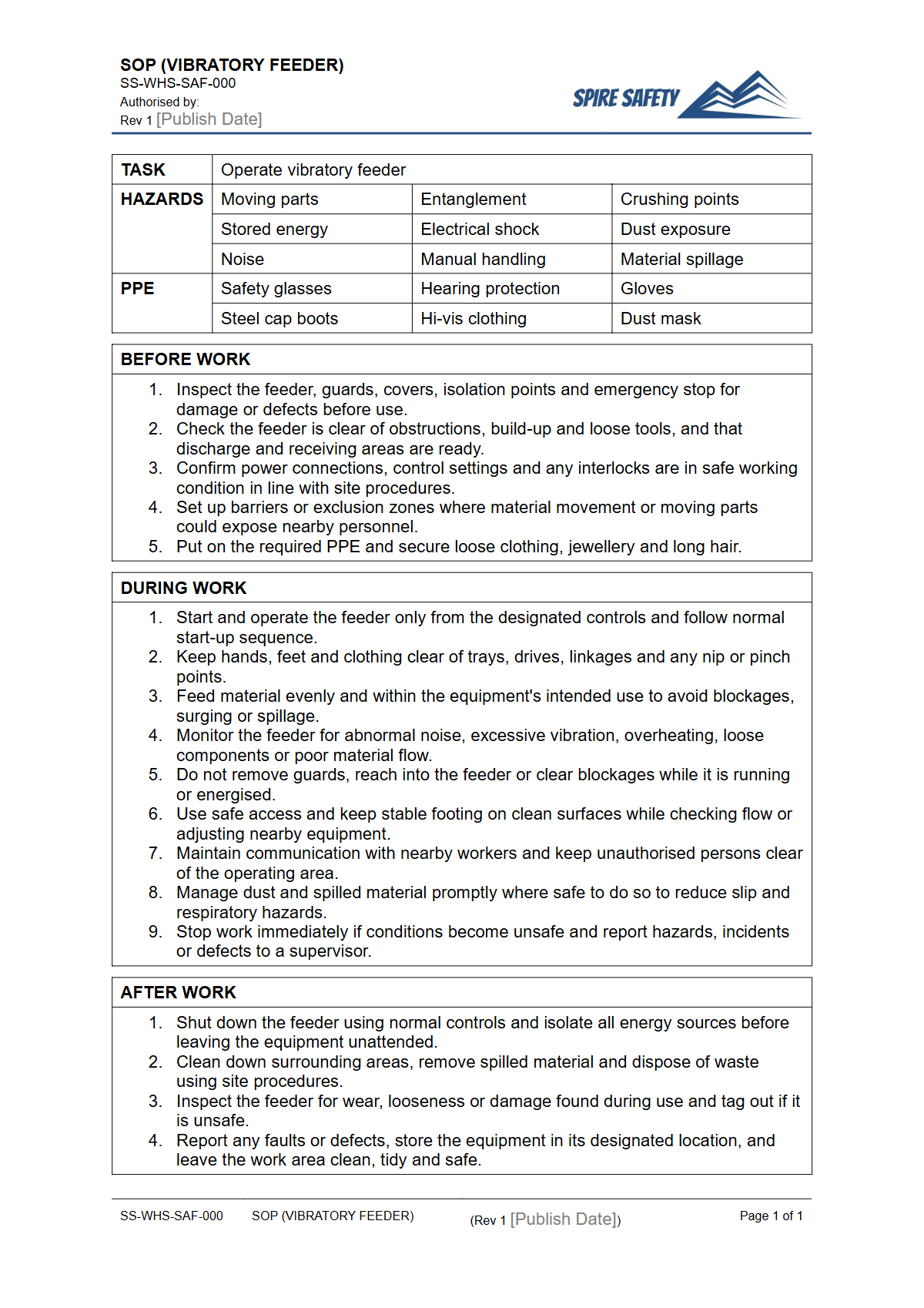
- Risk Assessment Matrix: A section to document the outcomes of your risk assessment before and after controls are implemented.
- Personal Protective Equipment (PPE): A list of required PPE for operators, such as hearing protection, safety glasses, gloves, and steel-capped boots.
- Pre-Operational Checks: A checklist of safety inspections to be completed before starting the equipment, including checking guards, emergency stops, and the surrounding area.
- Step-by-Step Operating Sequence: Detailed instructions for safely starting, operating, and monitoring the vibratory feeder, including material loading and flow management.
- Shutdown and Cleaning Procedures: Safe methods for powering down the equipment, including essential lockout/tagout (LOTO) steps for maintenance and cleaning tasks. Related material handling equipment often requires its own procedure, such as a Conveyer System SOP.
- Emergency Procedures: Clear guidance on how to respond to common emergencies, such as equipment malfunction, blockages, or personal injury.
When to use a Vibratory Feeder SOP
A Safe Operating Procedure for a vibratory feeder should be used whenever the equipment is in operation, including for standard production, maintenance, and cleaning. It is particularly important during operator training and for tasks that are performed infrequently, where workers may not remember all the required safety steps.
The SOP should be readily accessible to all relevant personnel at or near the location of the equipment. Furthermore, this document is essential during safety inductions for new employees or contractors who will be working with or near the machinery.
Its use should be reinforced through regular supervision and periodic WHS compliance audits to ensure practices have not deviated from the documented procedure.
The SOP should also be reviewed and updated whenever there is a change to the equipment, the work process, or the work environment. Following any incident or near miss involving the vibratory feeder, the SOP must be reviewed as part of the investigation to identify any gaps or necessary improvements.
Similarly, many sites that use feeders also use mobile plant to load them; it's vital to have procedures for that equipment too, such as a Telehandler SOP if one is used on site.
Who Should Use This Safe Operating Procedure
This template is designed for use by WHS managers, supervisors, and business owners responsible for health and safety in workplaces where vibratory feeders are used. These individuals can adapt the template to create a site-specific SOP.
Once finalised, the primary users of the Safe Operating Procedure are the machine operators, maintenance personnel, and cleaners who directly interact with the equipment. Supervisors must also use the document to train staff and monitor compliance with safe work practices.
This SOP is relevant across various industries, including mining, aggregates, agriculture, pharmaceuticals, and food production. Whether you are managing a large-scale industrial plant or a smaller workshop, formalising your procedures is a key step in preventing injuries. Many workshops also benefit from formalising procedures for other common equipment, like a dedicated Air Compressor SOP. You can find more helpful documents like this in our extensive library of free WHS resources.
Common mistakes
Common mistakes to avoid
- Failing to customise the template for the specific machine model, material type, and work environment.
- Neglecting to include detailed, machine-specific lockout/tagout procedures for cleaning and maintenance.
- Underestimating noise and vibration as significant long-term health hazards requiring specific controls.
- Not providing adequate hands-on training or verifying worker competency after they have read the SOP.
Legal references
Legal considerations
The following legal requirements may be relevant to this type of work.
- Work Health and Safety Act (Harmonised) — Provides the primary duties for protecting workers and other people from work health and safety risks.
- Work Health and Safety Regulations (Harmonised) — Sets out requirements supporting the management of workplace hazards and risks.
The following codes may be relevant to this type of work.
- Managing WHS Risks Code of Practice — Provides practical guidance on identifying hazards, assessing risks and applying effective controls.
- Work Health and Safety Consultation, Cooperation and Coordination Code of Practice — Provides practical guidance on consulting workers and coordinating with other duty holders.
- Managing the Work Environment and Facilities Code of Practice — Provides practical guidance on safe work environments, workplace facilities and related controls.
Did you know
Vibration Risks
Hand-Arm Vibration Syndrome (HAVS) is a serious risk for workers maintaining vibratory equipment. It can cause permanent damage to nerves, joints, and blood vessels, making detailed maintenance procedures in an SOP critical.
Material Flow Control
Vibratory feeders use controlled, high-frequency vibration to move bulk materials at a consistent, measured rate. This same principle is applied in diverse fields from mining and aggregate processing to pharmaceuticals and food production.
FAQ
Frequently asked questions
01What are the main hazards associated with operating a vibratory feeder?
02How often should a Safe Operating Procedure for a vibratory feeder be reviewed?
03Is a Safe Operating Procedure a legal requirement for vibratory feeders in Australia?
04What training should accompany a vibratory feeder SOP?
Share this resource
Free Safe Operating Procedure (Vibratory Feeder) Template
Browse Categories
How To Use It
- 1Download and open in Word or PDF.
- 2Replace the placeholders with your business details.
- 3Get it reviewed by a WHS specialist before rollout.
Need it customised?
Our WHS consultants can adapt this template to your site, run a gap analysis, or audit what you already have in place.
Book a Free Consultation WHS consulting servicesor call 1300 156 382
Related templates
- Free Safe Operating Procedure (Vibro Hammer) Template
- Free Safe Operating Procedure (Vine Training) Template
- Free Safe Operating Procedure (Vineyard Pruning) Template
- Free Safe Operating Procedure (Vinyl Cutter) Template
- Free Safe Operating Procedure (Visitor Wheelchair Use) Template
- Free Safe Operating Procedure (Voltage Detector) Template