
Free Safe Operating Procedure (Vineyard Pruning) Template
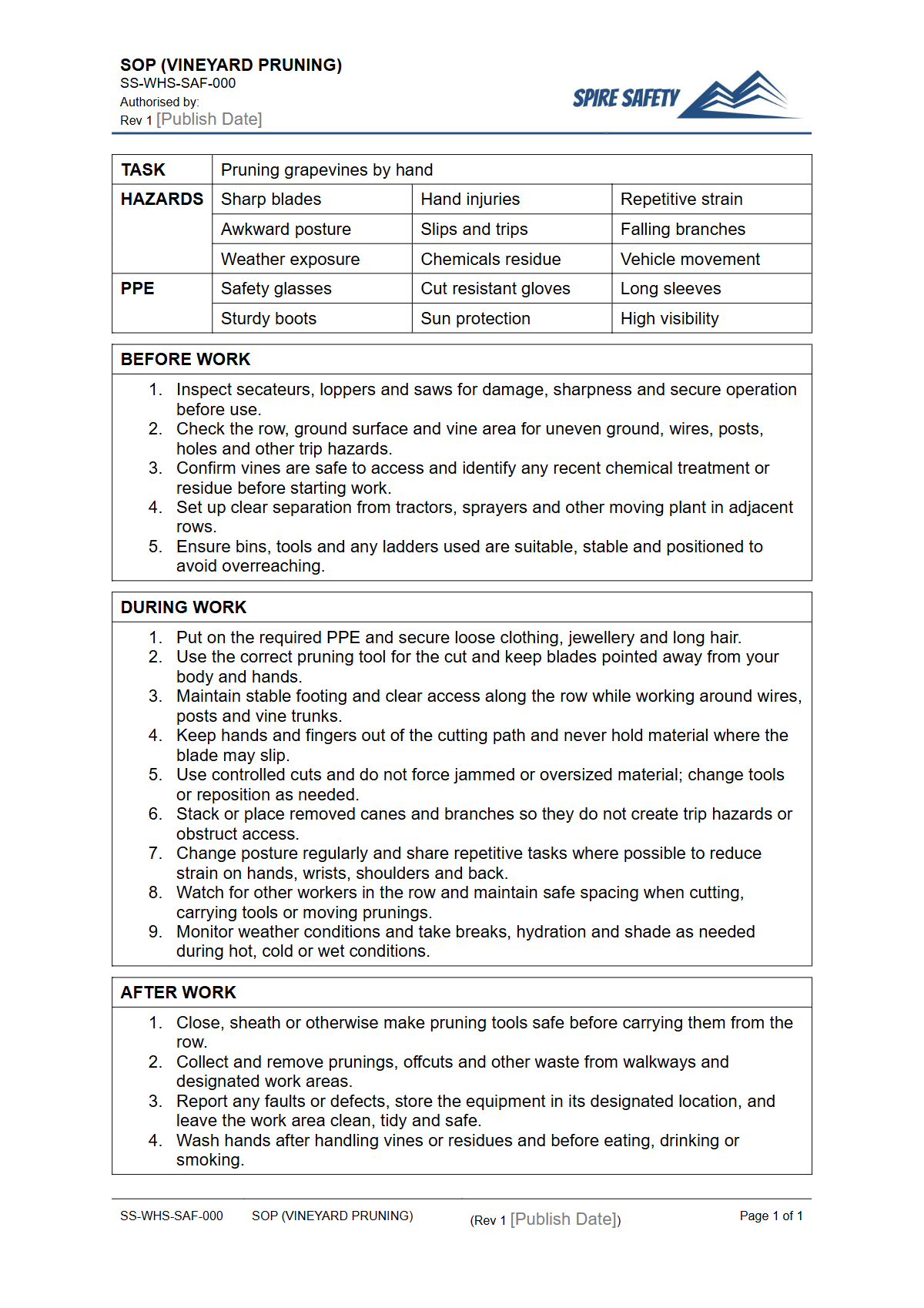
Download our free Safe Operating Procedure for vineyard pruning. This template helps formalise your safety processes for this common agricultural task.
Free Safe Operating Procedure (Vineyard Pruning) Template
DOCX • 126 KB + PDF
Updated Oct 2026
No signup required
Purpose of the Free Safe Operating Procedure (Vineyard Pruning) Template
Vineyard pruning is a skilled, repetitive task essential to viticulture, but it carries significant work health and safety risks. This Free Safe Operating Procedure (Vineyard Pruning) Template provides a structured framework to help vineyards manage these risks effectively.
It guides you in formally documenting the step-by-step process for safe pruning, identifying potential hazards, and outlining clear control measures. By implementing a thorough SOP, you can protect workers from common injuries like cuts, musculoskeletal disorders, and slips, while promoting a consistent and safe system of work across your entire team.
Video walkthrough
How to use the Free Safe Operating Procedure (Vineyard Pruning) Template
This resource is available as a fully editable DOCX file, with a PDF version also provided for easy printing and distribution. To use it, download the template and begin adapting it to your specific operational context. A well-developed SOP should form a critical component of your overall WHS management systems.
Important Note: This is a template and is not a substitute for professional WHS advice. We strongly recommend you customise this document to reflect the specific equipment (e.g., manual secateurs, powered pruners), environment, and personnel of your workplace, in consultation with your team.
Your customised SOP should include details such as the specific types of pruning cuts required, PPE mandates (gloves, eye protection, sun protection), first aid procedures, and emergency contacts. It should be a practical tool used daily, not just a document filed away.
Key Hazards in Vineyard Pruning
A comprehensive risk assessment is the first step in developing your SOP. The primary hazards associated with vineyard pruning include:
- Musculoskeletal Injuries: Repetitive movements, awkward postures, and forceful exertions can lead to sprains, strains, and chronic conditions affecting the hands, wrists, shoulders, and back.
- Cuts and Lacerations: Using sharp tools like secateurs and loppers creates an obvious risk of cuts to the hands and body.
- Slips, Trips, and Falls: Workers often navigate uneven, wet, or sloping ground, increasing the risk of falls. Cuttings left on the ground can also create a significant trip hazard.
- Environmental Factors: Exposure to UV radiation, extreme heat or cold, insect bites, and snakes are all potential hazards in an outdoor agricultural setting.
- Mechanical Hazards: If using powered pruners or other machinery like a FREE Telehandler SOP, risks include entanglement, impact, and noise exposure.
Implementing Effective Controls
Your SOP should detail control measures based on the hierarchy of controls. For vineyard pruning, this includes providing ergonomically designed tools to reduce physical strain and ensuring they are kept sharp and well-maintained.
Administrative controls are vital, such as implementing job rotation to vary tasks and reduce repetitive strain, providing comprehensive training, and scheduling work to avoid the hottest parts of the day. You should also clearly specify the required Personal Protective Equipment (PPE), including UV-rated long-sleeved clothing, wide-brimmed hats, safety glasses, sturdy enclosed footwear, and appropriate gloves.
Training and Competency
An SOP is only effective if workers are trained on its contents and are competent to perform the task safely. Training should cover not just the procedure itself but also hazard identification, correct tool use and maintenance, and ergonomic best practices.
Records of this training should be maintained for all workers. For other agricultural tasks, you can establish similar procedures using resources like our FREE Planter SOP to ensure consistency in your safety documentation.
For businesses needing support to develop and implement these frameworks, specialist WHS consulting can provide valuable guidance.
Review and Updates
Safety procedures should evolve with your business. This SOP must be treated as a living document, reviewed at least annually or before the start of each pruning season.
It should also be updated immediately following any incident or near miss, or when new equipment or techniques are introduced. Regular reviews, potentially as part of a scheduled WHS compliance auditing program, ensure your procedures remain relevant and effective.
You can find more templates for common agricultural equipment, such as a FREE Spreader SOP, in our complete library of safety resources.
Common mistakes
Common mistakes to avoid
- Using dull or poorly maintained pruning tools, which increases physical effort and the risk of injury.
- Failing to provide or enforce the use of appropriate PPE, such as cut-resistant gloves and safety glasses.
- Neglecting to train workers on ergonomic best practices for posture, grip, and movement.
- Treating the SOP as a 'set and forget' document instead of reviewing and updating it regularly.
Legal references
Legal considerations
The following legal requirements may be relevant to this type of work.
- Work Health and Safety Act (Harmonised) — Provides the primary duties for protecting workers and other people from work health and safety risks.
- Work Health and Safety Regulations (Harmonised) — Sets out requirements supporting the management of workplace hazards and risks.
The following codes may be relevant to this type of work.
- Managing WHS Risks Code of Practice — Provides practical guidance on identifying hazards, assessing risks and applying effective controls.
- Work Health and Safety Consultation, Cooperation and Coordination Code of Practice — Provides practical guidance on consulting workers and coordinating with other duty holders.
- Managing the Work Environment and Facilities Code of Practice — Provides practical guidance on safe work environments, workplace facilities and related controls.
Did you know
Pruning by Numbers
A single vineyard worker can make between 5,000 and 10,000 individual cuts per day during pruning season, highlighting the significant risk of developing a repetitive strain injury.
Ergonomic Evolution
The design of pruning shears has evolved to reduce hand fatigue, with features like rotating handles, power assistance, and lighter materials becoming more common to combat musculoskeletal disorders.
FAQ
Frequently asked questions
01What are the main WHS hazards of vineyard pruning?
02How often should a vineyard pruning SOP be reviewed?
03Is using a template enough for WHS compliance?
04Who should be involved in creating a Safe Operating Procedure for pruning?
Share this resource
Free Safe Operating Procedure (Vineyard Pruning) Template
Browse Categories
How To Use It
- 1Download and open in Word or PDF.
- 2Replace the placeholders with your business details.
- 3Get it reviewed by a WHS specialist before rollout.
Need it customised?
Our WHS consultants can adapt this template to your site, run a gap analysis, or audit what you already have in place.
Book a Free Consultation WHS consulting servicesor call 1300 156 382
Related templates
- Free Safe Operating Procedure (Vinyl Cutter) Template
- Free Safe Operating Procedure (Visitor Wheelchair Use) Template
- Free Safe Operating Procedure (Voltage Detector) Template
- Free Safe Operating Procedure (Waffle Maker) Template
- Free Safe Operating Procedure (Walk Through Scanner) Template
- Free Safe Operating Procedure (Walk-In Freezer) Template