
Free Safe Operating Procedure (Vinyl Cutter) Template
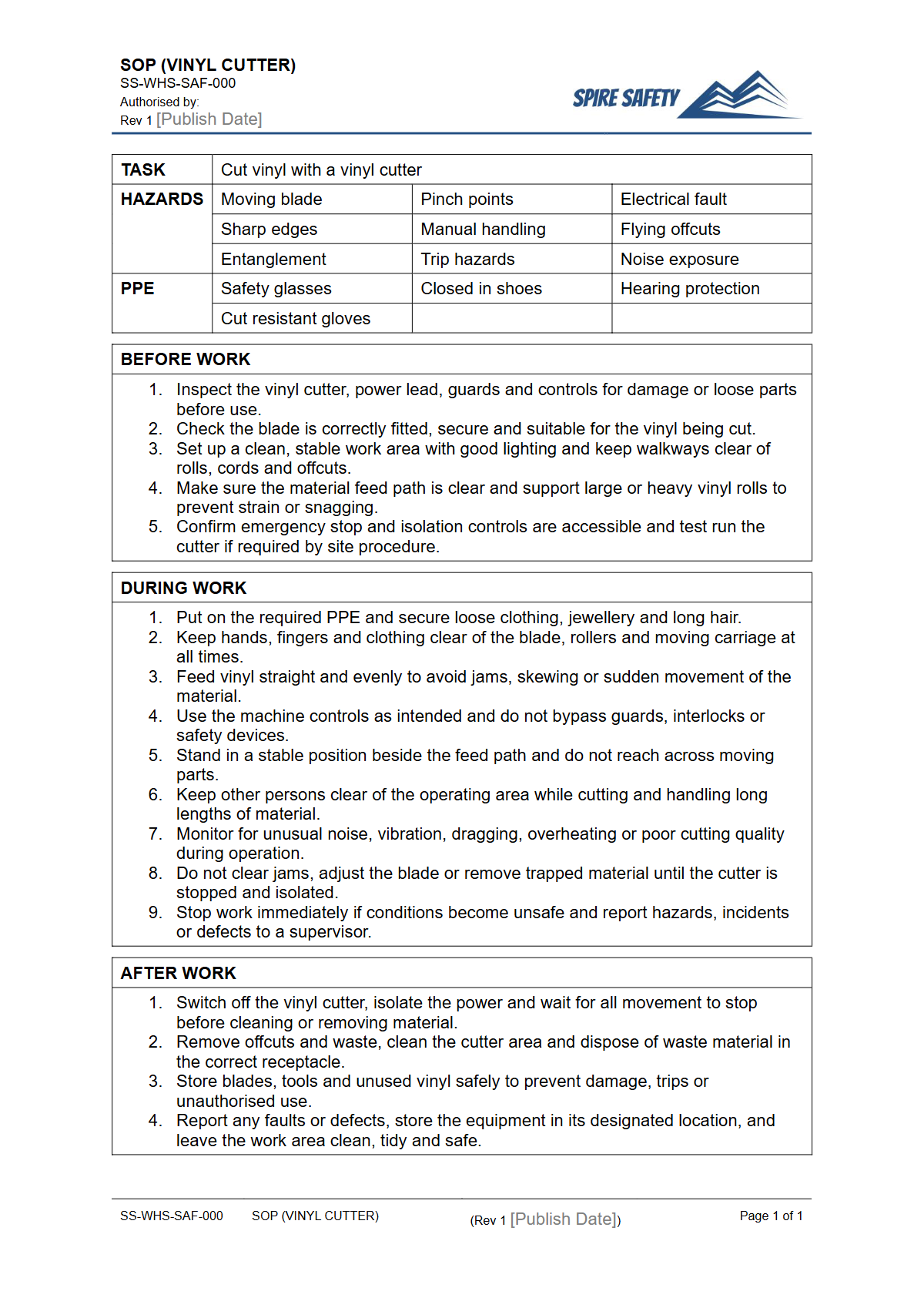
Download our free Safe Operating Procedure (Vinyl Cutter) Template to outline key hazards and control measures.
Free Safe Operating Procedure (Vinyl Cutter) Template
DOCX • 126 KB + PDF
Updated Oct 2026
No signup required
Purpose of the Free Safe Operating Procedure (Vinyl Cutter) Template
A Safe Operating Procedure (SOP) is a critical document for managing health and safety risks in any workplace. This Free Safe Operating Procedure (Vinyl Cutter) Template provides a structured starting point for documenting the step-by-step process for safely using a vinyl cutter.
Using this equipment involves specific hazards, including sharp blades, moving mechanical parts, pinch points, and electrical risks. This SOP helps your organisation provide clear instructions to workers, ensuring they understand the hazards and the control measures required to operate the machinery safely.
Implementing formalised procedures is a key part of demonstrating due diligence and fulfilling your duty of care as a Person Conducting a Business or Undertaking (PCBU). A well-drafted SOP serves as a valuable tool for worker induction, training, and ongoing supervision, forming a cornerstone of your safety practices.
It standardises operations, reduces the likelihood of incidents, and helps build a stronger safety culture.
Video walkthrough
How to use the Free Safe Operating Procedure (Vinyl Cutter) Template
This Free Safe Operating Procedure (Vinyl Cutter) Template is designed for ease of use. Simply download the DOCX file and open it in Microsoft Word or a compatible program.
You can then edit the content to align with your specific machinery, workplace environment, and organisational procedures. A PDF version is also available for easy printing and distribution.
Important: This document is a template only. We have no way of knowing your specific machinery, materials, or work environment.
You MUST customise this Safe Operating Procedure to reflect the actual hazards and control measures relevant to your workplace. This should be done in consultation with the people who actually operate the equipment, as they will have the most practical knowledge of the risks involved.
Customisation Checklist:
- Plant Specifics: Insert the exact make, model, and serial number of your vinyl cutter.
- Risk Assessment: Review and update the listed hazards and control measures based on your own WHS consulting and risk assessment process.
- PPE: Specify the exact Personal Protective Equipment (PPE) required, if any (e.g., safety glasses are not typically required but may be if other work is occurring nearby).
- Emergency Procedures: Add site-specific emergency contacts and shutdown procedures.
- Consultation: Ensure you consult with workers and supervisors during the drafting and review process.
When to use a Vinyl Cutter SOP
An SOP for a vinyl cutter should be used as a primary reference document in several situations. It is essential during the induction and training of new employees or any worker who will be using the machine for the first time.
It provides a consistent training framework and a benchmark for assessing competency.
The SOP should also be readily available in the work area for operators to reference at any time. It becomes particularly important when tasks are performed infrequently, helping to refresh a worker's memory on the correct procedure.
Furthermore, the SOP should be reviewed and referenced after any incident or near-miss, or when changes are made to the equipment, materials, or process.
Who should use this SOP
This Safe Operating Procedure is intended for several groups within an organisation. The primary users are the machine operators themselves, who must follow the procedure to ensure their own safety and the safety of others.
Supervisors and managers should use the document to oversee work, enforce safe practices, and conduct safety observations or checks.
Safety officers, WHS representatives, and trainers will use the SOP as a key part of their training programs and safety management activities. Ultimately, the responsibility for ensuring an SOP is developed and implemented rests with the PCBU.
This document is a fundamental component of effective WHS management systems, demonstrating a systematic approach to controlling risks associated with plant and equipment. The effectiveness of these procedures is often a focus during a WHS compliance auditing process.
For workshops with a variety of tools, it is best practice to have a specific SOP for each piece of high-risk equipment. While a vinyl cutter may seem low-risk compared to other machinery, it shares a workspace with them.
You can use our free Circular Saw SOP template as a starting point for other common tools. All procedures should be stored together in an accessible location, forming a comprehensive manual for workshop safety. For even more templates and guides, explore our complete free WHS resources library.
Common mistakes
Common mistakes to avoid
- Leaving the machine unattended while it is operating.
- Failing to properly secure loose clothing, hair, or jewellery that could get caught in moving parts.
- Using an incorrect blade depth or pressure setting, leading to damaged material or a jammed machine.
- Neglecting to perform pre-operational checks on the machine and work area.
Legal references
Legal considerations
The following legal requirements may be relevant to this type of work.
- Work Health and Safety Act (Harmonised) — Provides the primary duties for protecting workers and other people from work health and safety risks.
- Work Health and Safety Regulations (Harmonised) — Sets out requirements supporting the management of workplace hazards and risks.
The following codes may be relevant to this type of work.
- Managing WHS Risks Code of Practice — Provides practical guidance on identifying hazards, assessing risks and applying effective controls.
- Work Health and Safety Consultation, Cooperation and Coordination Code of Practice — Provides practical guidance on consulting workers and coordinating with other duty holders.
- Managing the Work Environment and Facilities Code of Practice — Provides practical guidance on safe work environments, workplace facilities and related controls.
Did you know
From Plotter to Cutter
The modern vinyl cutter evolved from the pen plotter, an early computer output device. By replacing the pen with a sharp blade, engineers adapted the technology to cut shapes out of vinyl instead of drawing them on paper.
FAQ
Frequently asked questions
01What are the main hazards of using a vinyl cutter?
02Does this vinyl cutter SOP template meet Australian WHS requirements?
03How often should a Safe Operating Procedure for a vinyl cutter be reviewed?
04Who is responsible for writing and implementing an SOP for a vinyl cutter?
Share this resource
Free Safe Operating Procedure (Vinyl Cutter) Template
Browse Categories
How To Use It
- 1Download and open in Word or PDF.
- 2Replace the placeholders with your business details.
- 3Get it reviewed by a WHS specialist before rollout.
Need it customised?
Our WHS consultants can adapt this template to your site, run a gap analysis, or audit what you already have in place.
Book a Free Consultation WHS consulting servicesor call 1300 156 382
Related templates
- Free Safe Operating Procedure (Visitor Wheelchair Use) Template
- Free Safe Operating Procedure (Voltage Detector) Template
- Free Safe Operating Procedure (Waffle Maker) Template
- Free Safe Operating Procedure (Walk Through Scanner) Template
- Free Safe Operating Procedure (Walk-In Freezer) Template
- Free Safe Operating Procedure (Walker Cleaning) Template