
Free Safe Operating Procedure (Vibration Logger) Template
Effectively manage health risks from vibration with our free Safe Operating Procedure (Vibration Logger) Template. Download your customisable DOCX now.
Free Safe Operating Procedure (Vibration Logger) Template
DOCX • 126 KB + PDF
Updated Oct 2026
No signup required
Purpose of the Free Safe Operating Procedure (Vibration Logger) Template
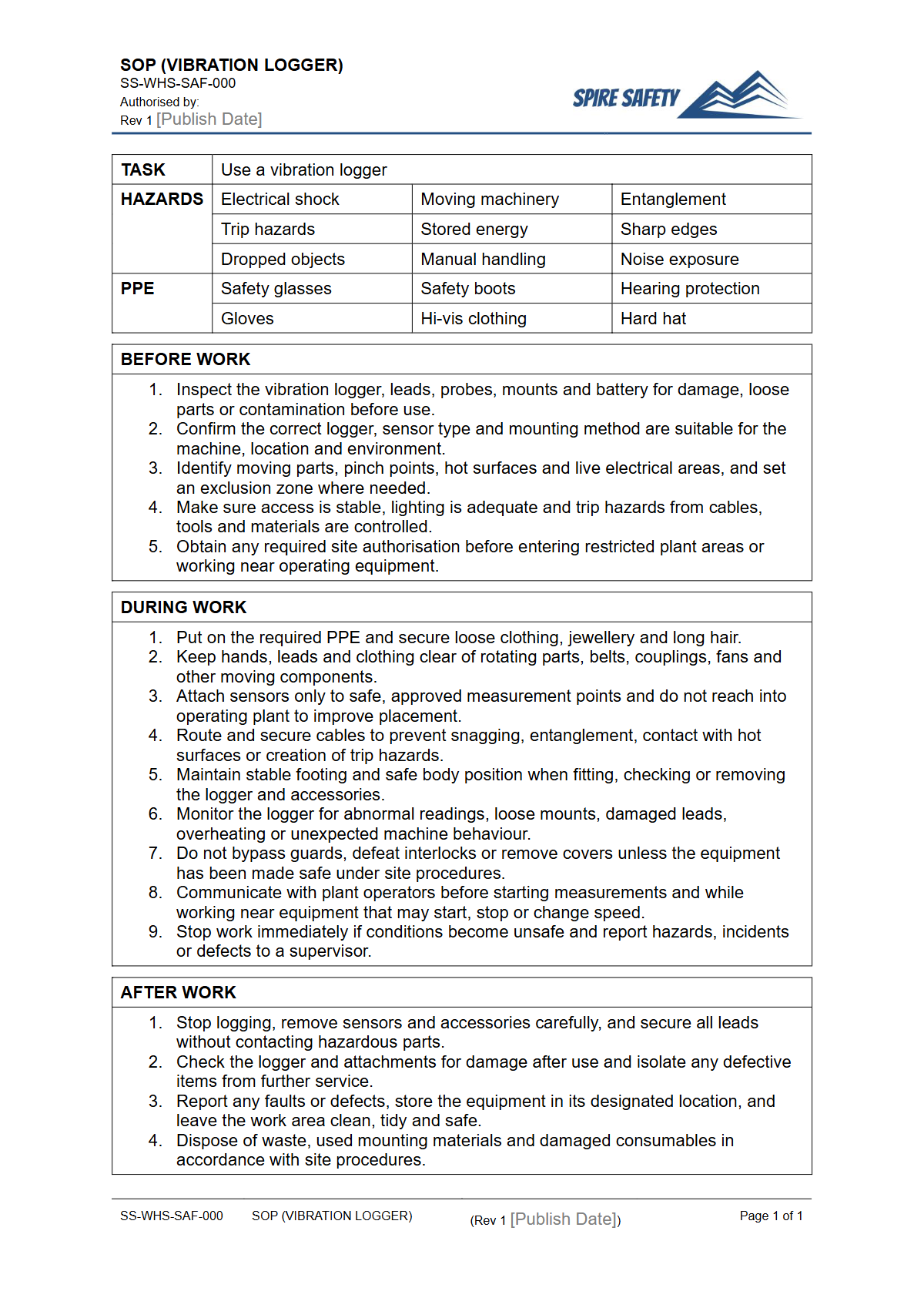
This Safe Operating Procedure (SOP) template provides a structured framework for the safe and consistent use of a vibration logger. Using a vibration logger is a critical task for identifying, assessing, and controlling worker exposure to harmful levels of vibration from powered tools and machinery.
This document helps your organisation establish a formal process for measuring vibration, which is the first step in mitigating risks such as Hand-Arm Vibration Syndrome (HAVS) and Whole-Body Vibration (WBV).
By documenting the correct methodology—from equipment calibration to data recording—this SOP ensures that vibration measurements are accurate and reliable. This data forms the evidence base for implementing effective control measures, such as modifying equipment, changing work practices, or scheduling job rotation.
A documented procedure supports your overall risk management process and demonstrates a commitment to worker health and safety. The principles outlined are similar to those in equipment-specific guides like our Free Air Compressor SOP, focusing on systematic and safe operation.
Video walkthrough
How to use the Free Safe Operating Procedure (Vibration Logger) Template
To implement this Safe Operating Procedure for a vibration logger, simply download the DOCX or PDF file and integrate it into your existing WHS management system. The template is designed to be a starting point, outlining key steps for pre-operational checks, operation, and post-operational procedures.
You must adapt the content to suit your specific circumstances. This includes inserting details about the make and model of your vibration logger, the specific tools being tested (e.g., grinders, impact wrenches, jackhammers), and the environmental conditions of your workplace.
It is crucial to conduct a site-specific risk assessment to identify all relevant hazards and detail the corresponding control measures.
Important Customisation Note
This template is aligned with Australian WHS practice, but it is not a complete, ready-to-use document. We provide it as a starting point.
You must customise it to reflect the specific equipment, personnel, and risks in your workplace. Responsibility for creating a safe system of work and ensuring compliance rests with the Person Conducting a Business or Undertaking (PCBU).
When to use this Safe Operating Procedure
A Safe Operating Procedure for a vibration logger should be used whenever vibration exposure needs to be quantified as part of a workplace risk management plan. Key situations include:
- When conducting initial risk assessments on new plant, tools, or equipment that produce vibration.
- As part of periodic reviews of existing tasks known to expose workers to vibration.
- During the investigation of a health and safety incident or a worker's report of symptoms related to vibration exposure.
- To validate the effectiveness of control measures that have been implemented to reduce vibration.
- As a component of a comprehensive health surveillance program for at-risk workers.
Integrating procedures like this one is a key function of robust WHS management systems, ensuring that safety processes are proactive rather than reactive. These procedures help formalise the technical aspects of hazard management, similar to how our free Trencher SOP Template guides the safe use of heavy machinery.
Who should use this Safe Operating Procedure
This SOP should be used by personnel who are responsible for conducting WHS assessments and monitoring workplace hazards. This typically includes:
- WHS Managers and Safety Advisors
- Site Supervisors and Team Leaders
- Competent Workers specifically trained and authorised to operate vibration monitoring equipment
- Occupational Hygienists
All personnel involved in using the vibration logger must be trained on the contents of the final, customised SOP. For organisations without in-house expertise, engaging external WHS consulting services can provide the necessary technical knowledge to correctly measure and interpret vibration data.
Periodic WHS compliance audits can then verify that these procedures are being followed correctly, ensuring the ongoing protection of your team. This SOP is just one of many useful documents available in our free WHS resources library to help support your safety initiatives.
Common mistakes
Common mistakes to avoid
- Failing to properly calibrate the vibration logger before each measurement session.
- Placing the sensor (accelerometer) in the wrong location or orientation on the tool.
- Measuring for too short a duration, leading to unrepresentative exposure data.
- Neglecting to document task details and environmental conditions during measurement.
Legal references
Legal considerations
The following legal requirements may be relevant to this type of work.
- Work Health and Safety Act (Harmonised) — Provides the primary duties for protecting workers and other people from work health and safety risks.
- Work Health and Safety Regulations (Harmonised) — Sets out requirements supporting the management of workplace hazards and risks.
The following codes may be relevant to this type of work.
- Managing WHS Risks Code of Practice — Provides practical guidance on identifying hazards, assessing risks and applying effective controls.
- Work Health and Safety Consultation, Cooperation and Coordination Code of Practice — Provides practical guidance on consulting workers and coordinating with other duty holders.
- Managing the Work Environment and Facilities Code of Practice — Provides practical guidance on safe work environments, workplace facilities and related controls.
Did you know
Exposure Standards
Safe Work Australia sets an 'exposure standard' for hand-arm vibration at 5 m/s² averaged over an 8-hour day. The 'exposure action level', where employers must take action to reduce exposure, is half that value at 2.5 m/s².
Vibration White Finger
Hand-Arm Vibration Syndrome (HAVS) is often called 'Vibration White Finger' because a common symptom is episodic blanching of the fingers, especially when cold. It can also cause tingling, numbness, and permanent loss of nerve function.
FAQ
Frequently asked questions
01What is a vibration logger and why is it important for WHS?
02Does this SOP template cover both Hand-Arm Vibration (HAV) and Whole-Body Vibration (WBV)?
03How often should vibration monitoring be conducted?
04What training is required to use a vibration logger?
Share this resource
Free Safe Operating Procedure (Vibration Logger) Template
Browse Categories
How To Use It
- 1Download and open in Word or PDF.
- 2Replace the placeholders with your business details.
- 3Get it reviewed by a WHS specialist before rollout.
Need it customised?
Our WHS consultants can adapt this template to your site, run a gap analysis, or audit what you already have in place.
Book a Free Consultation WHS consulting servicesor call 1300 156 382
Related templates
- Free Safe Operating Procedure (Vibration Meter) Template
- Free Safe Operating Procedure (Vibratory Feeder) Template
- Free Safe Operating Procedure (Vibro Hammer) Template
- Free Safe Operating Procedure (Vine Training) Template
- Free Safe Operating Procedure (Vineyard Pruning) Template
- Free Safe Operating Procedure (Vinyl Cutter) Template