
Free Safe Operating Procedure (Vet Waiting Room Clean) Template
Maintain a safe and hygienic environment for staff and clients with our comprehensive vet waiting room cleaning SOP. Download the free template today.
Free Safe Operating Procedure (Vet Waiting Room Clean) Template
DOCX • 126 KB + PDF
Updated Oct 2026
No signup required
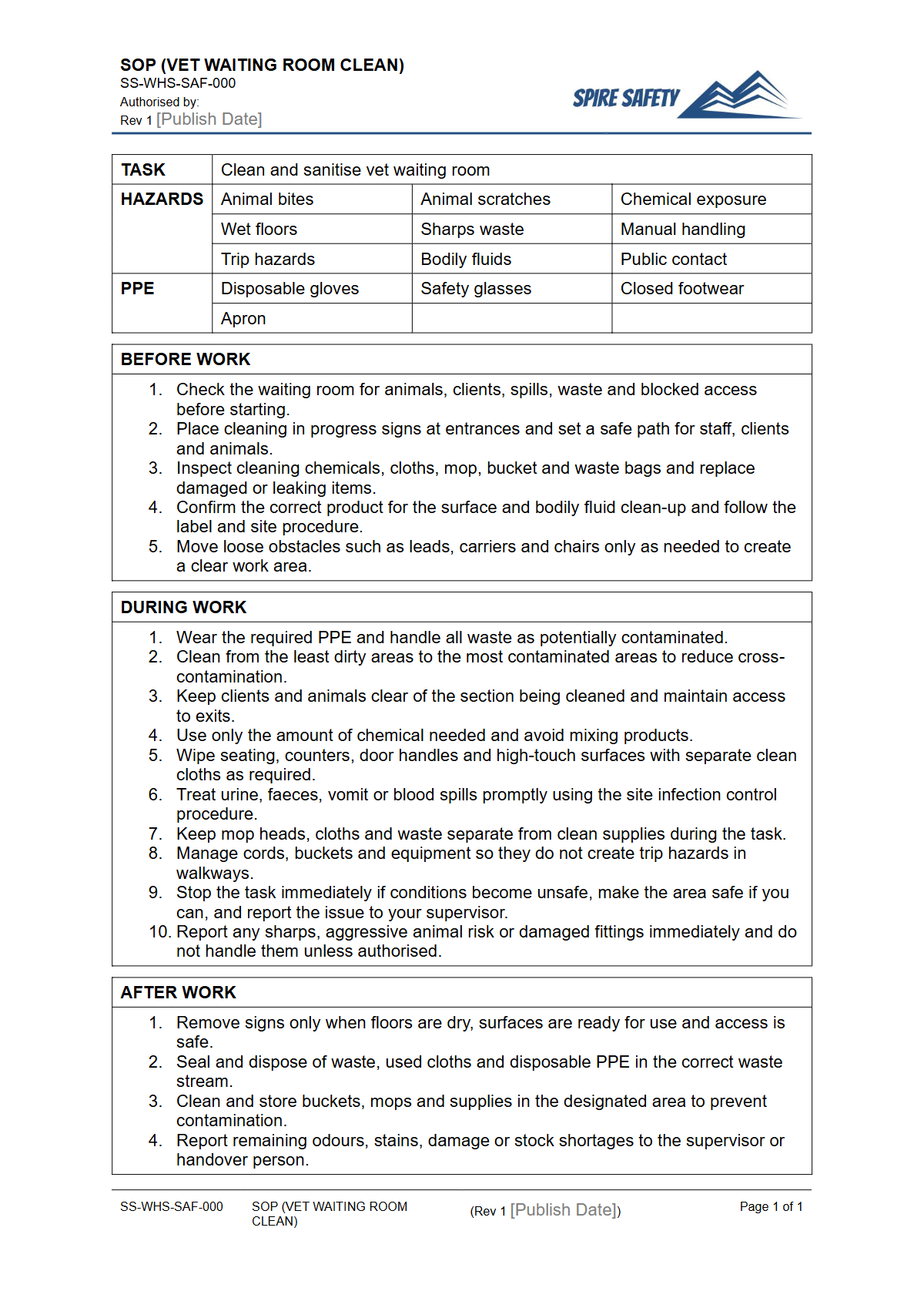
Purpose of the Free Safe Operating Procedure (Vet Waiting Room Clean) Template
Veterinary clinics face unique workplace health and safety challenges, particularly in high-traffic areas like waiting rooms. This free Safe Operating Procedure (Vet Waiting Room Clean) template provides a structured framework for documenting the cleaning process, ensuring consistency and safety for staff, clients, and animal patients.
A formal SOP helps manage risks associated with biological hazards (urine, faeces, vomit), chemical exposure from cleaning agents, and physical hazards like slips and falls on wet floors. It serves as a critical training tool for new and existing staff, ensuring everyone follows the same approved method every time.
Documenting procedures like this is a fundamental component of a robust safety framework. By clearly defining steps, required PPE, and emergency responses, you create a safer work environment and demonstrate due diligence.
Integrating this SOP into your clinic's broader WHS management systems helps build a proactive safety culture where risks are systematically controlled.
Video walkthrough
How to use the Free Safe Operating Procedure (Vet Waiting Room Clean) Template
This document is provided as a starting-point template in both DOCX and PDF formats. It is not a complete, ready-to-use procedure.
You must customise it to suit the specific circumstances of your veterinary clinic. Your process should involve downloading the DOCX file and adapting it to reflect the unique layout of your waiting area, the specific cleaning chemicals you use, the type of flooring, and the equipment available to your team.
To implement it effectively:
- Review and Customise: Edit the template to include your clinic’s specific details. Add brand names of cleaning products and refer to their Safety Data Sheets (SDS) for handling instructions.
- Consult with Workers: Discuss the draft procedure with the staff who perform the cleaning tasks. Their direct experience is invaluable for creating a practical and effective SOP.
- Approve and Train: Once finalised, the SOP should be formally approved by management. All relevant employees must be trained on the procedure before it is implemented.
- Schedule Regular Reviews: The SOP should be reviewed periodically (e.g., annually) or whenever there is a change in process, chemicals, or equipment.
Remember, we provide this as a starting point. You must adapt it to reflect the specific chemicals, equipment, and environment of your clinic.
The effectiveness of this document also relies on its correct implementation, which can be verified through processes like WHS compliance auditing to ensure procedures are being followed correctly on the ground.
Key Hazards to Consider
When customising your SOP, pay close attention to the primary hazards in a vet waiting room environment:
- Biological Hazards: Contact with animal body fluids like urine, faeces, blood, or vomit, which can carry zoonotic diseases.
- Chemical Hazards: Exposure to cleaning agents (disinfectants, detergents) through inhalation, skin contact, or splashes to the eyes.
- Physical Hazards: Slips, trips, and falls from wet floors, trailing electrical cords from vacuum cleaners, or obstacles in the cleaning area.
- Manual Tasks: Injuries from lifting heavy buckets, moving furniture, or using awkward postures while cleaning.
When to use this Safe Operating Procedure
This SOP should be used as the standard guide for all cleaning activities within the vet waiting room. This includes routine daily or end-of-shift cleaning to maintain general hygiene, as well as responsive cleaning required after an incident, such as an animal soiling the floor.
It can also be adapted to guide less frequent tasks like periodic deep cleaning. Having a documented procedure ensures that the correct level of sanitation is achieved consistently, which is crucial for infection control in a clinical setting.
While this SOP is specific to veterinary clinics, the principles of documenting procedures apply across all industries to manage task-specific risks. For example, a commercial kitchen would require a different but equally important Safe Operating Procedure for deep fryer operation to manage heat, oil, and fire hazards.
Who should use this Safe Operating Procedure
This SOP should be used by any person responsible for cleaning the waiting room in a veterinary practice. This may include veterinary nurses, animal care attendants, receptionists, or dedicated cleaning personnel.
It is the responsibility of the Person Conducting a Business or Undertaking (PCBU), typically the clinic owner or manager, to ensure that these individuals are provided with the SOP and are adequately trained in its use. Supervisors should also be familiar with the procedure to effectively oversee work and ensure it is being performed safely and correctly.
If you need assistance developing or implementing SOPs and other WHS documentation tailored to your specific business needs, engaging professional WHS consulting services can provide expert guidance and support. You can also find a wide range of other document templates in our free WHS resources library to help build out your safety management system.
Common mistakes
Common mistakes to avoid
- Using a generic template without customising it for specific cleaning agents and equipment.
- Forgetting to include procedures for managing biological waste like urine, faeces, or blood.
- Failing to train all relevant staff, including casual or new team members, on the procedure.
- Not providing or maintaining the correct Personal Protective Equipment (PPE) specified in the SOP.
Legal references
Legal considerations
The following legal requirements may be relevant to this type of work.
- Work Health and Safety Act (Harmonised) — Provides the primary duties for protecting workers and other people from work health and safety risks.
- Work Health and Safety Regulations (Harmonised) — Sets out requirements supporting the management of workplace hazards and risks.
The following codes may be relevant to this type of work.
- Managing WHS Risks Code of Practice — Provides practical guidance on identifying hazards, assessing risks and applying effective controls.
- Work Health and Safety Consultation, Cooperation and Coordination Code of Practice — Provides practical guidance on consulting workers and coordinating with other duty holders.
- Managing the Work Environment and Facilities Code of Practice — Provides practical guidance on safe work environments, workplace facilities and related controls.
Did you know
Zoonotic Disease Risk
Zoonotic diseases—illnesses that can be transmitted from animals to humans—can pose a significant risk in clinical settings. Stringent cleaning and disinfection protocols are a primary control measure against their transmission.
Slips, Trips, and Falls
According to Safe Work Australia, slips, trips, and falls are a leading cause of workplace injury, making proper 'wet floor' signage and procedures a critical part of any cleaning SOP.
FAQ
Frequently asked questions
01What hazards should a vet waiting room cleaning SOP address?
02How often should we review our cleaning SOP?
03Is this SOP template enough for WHS compliance?
04Who is responsible for training staff on this SOP?
Share this resource
Free Safe Operating Procedure (Vet Waiting Room Clean) Template
Browse Categories
How To Use It
- 1Download and open in Word or PDF.
- 2Replace the placeholders with your business details.
- 3Get it reviewed by a WHS specialist before rollout.
Need it customised?
Our WHS consultants can adapt this template to your site, run a gap analysis, or audit what you already have in place.
Book a Free Consultation WHS consulting servicesor call 1300 156 382
Related templates
- Free Safe Operating Procedure (Vet Waste Handling) Template
- Free Safe Operating Procedure (Vibrating Screed) Template
- Free Safe Operating Procedure (Vibrating Screen) Template
- Free Safe Operating Procedure (Vibration Logger) Template
- Free Safe Operating Procedure (Vibration Meter) Template
- Free Safe Operating Procedure (Vibratory Feeder) Template