
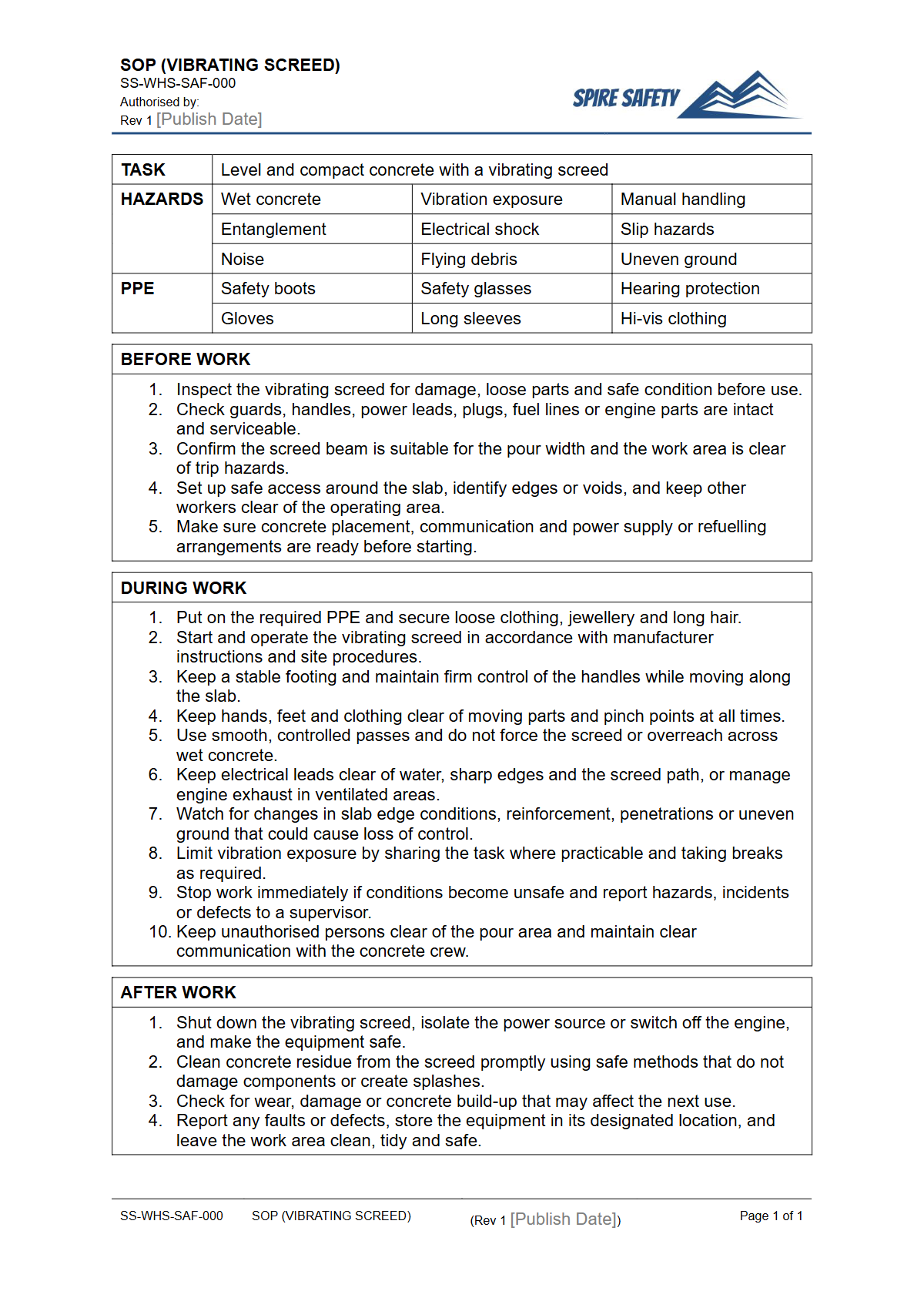
Free Safe Operating Procedure (Vibrating Screed) Template
Formalise your worksite safety with our free Safe Operating Procedure for vibrating screeds.
Free Safe Operating Procedure (Vibrating Screed) Template
DOCX • 126 KB + PDF
Updated Oct 2026
No signup required
Purpose of the Free Safe Operating Procedure (Vibrating Screed) Template
This Free Safe Operating Procedure (Vibrating Screed) Template provides a structured framework for documenting the safety requirements for operating concrete vibrating screeds on a worksite. Its primary purpose is to help Persons Conducting a Business or Undertaking (PCBUs) establish and communicate a safe system of work, thereby minimising risks to operators and others in the vicinity.
Using this template helps to systematically identify hazards such as hand-arm vibration, noise exposure, airborne contaminants like silica dust, manual handling strains, and potential entanglement.
The document serves as a crucial administrative control, forming a key part of your overall safety management approach. It is designed as a starting point, aligned with Australian WHS principles, to guide the creation of a site-specific procedure.
While this SOP addresses screeds, remember that other equipment on site requires similar documentation. For example, our free Air Compressor SOP template provides a comparable structure for managing another common piece of plant.
Hazards Associated with Vibrating Screeds
Operating a vibrating screed introduces several significant health and safety risks that must be controlled. This Safe Operating Procedure prompts you to consider and document controls for:
- Hand-Arm Vibration: Prolonged exposure can lead to Hand-Arm Vibration Syndrome (HAVS), a serious and irreversible condition.
- Noise: High noise levels from the engine and vibration can cause permanent hearing loss.
- Manual Handling: Lifting, lowering, and manoeuvring the screed can cause musculoskeletal injuries.
- Airborne Contaminants: Working with wet concrete can release dust containing respirable crystalline silica, a major long-term health hazard.
- Mechanical Hazards: Contact with moving parts or hot surfaces (engine/exhaust) can cause severe injuries or burns.
Just as screeds require specific procedures, so do larger pieces of plant like telehandlers; you can find a starting point with our FREE Telehandler SOP Template.
Video walkthrough
How to use the Free Safe Operating Procedure (Vibrating Screed) Template
To effectively implement this Safe Operating Procedure, download the DOCX file and adapt it to your specific operational context. It is not a one-size-fits-all solution.
The process should involve consultation with the workers who will be using the equipment, as their direct experience is invaluable for identifying practical risks and controls.
Follow these steps:
- Customise: Populate the template with details specific to the make and model of your vibrating screed, the types of jobs it's used for, and your unique site conditions. Always refer to the manufacturer’s operating manual.
- Consult: Discuss the draft SOP with operators and supervisors to ensure it is practical, clear, and comprehensive.
- Train: Induct and train all relevant personnel on the finalised SOP before they are permitted to operate the screed.
- Review: Schedule regular reviews of the SOP to ensure it remains current and effective.
Important: This document is a template and must be customised to your workplace. We provide a structured starting point, but you are responsible for ensuring the final document reflects your specific equipment, processes, and legal obligations under WHS legislation.
Integrating individual SOPs into a holistic safety framework is crucial for success. A well-structured WHS management system ensures all your safety documents work in concert to protect your team.
When to use it
A Safe Operating Procedure for a vibrating screed should be developed and implemented before the equipment is first used on site. It serves as a primary training document for new operators and a reference tool for experienced staff.
The SOP should be readily accessible in the work area and consulted during pre-start checks to remind operators of key safety steps.
It is also a critical document for supervisors to use during safety observations and for incident investigations to determine if procedures were followed. While this SOP covers screeds, other hazardous tools on site, like power saws, also require formal procedures, such as our FREE Circular Saw SOP Template.
Who should use it
This Safe Operating Procedure is intended for a range of personnel within an organisation:
- Operators: To understand the correct, safe method of operating the vibrating screed, including pre-start checks, operation, and shutdown procedures.
- Supervisors and Foremen: To train workers, enforce safe work practices, and conduct safety monitoring and inspections.
- WHS Managers/Officers: To ensure a formal, documented process for managing the risks of the equipment is in place as part of the broader safety system.
- Project Managers: To ensure that safety compliance is planned and resourced appropriately for all plant and equipment on site.
For businesses needing expert guidance on implementing these documents and fostering a strong safety culture, our WHS consulting services can provide tailored support. Regular reviews and audits ensure these procedures remain effective and are being followed correctly.
Furthermore, independent WHS compliance auditing can help identify gaps in your safety processes before an incident occurs. You can explore our entire collection of safety documents in our free WHS resources library to build out your safety management system.
Common mistakes
Common mistakes to avoid
- Failing to customise the template for the specific screed model and worksite.
- Neglecting to consult with operators during the SOP's development and review stages.
- Not providing adequate, practical training on the finalised SOP.
- Forgetting to review and update the SOP after an incident or process change.
Legal references
Legal considerations
The following legal requirements may be relevant to this type of work.
- Work Health and Safety Act (Harmonised) — Provides the primary duties for protecting workers and other people from work health and safety risks.
- Work Health and Safety Regulations (Harmonised) — Sets out requirements supporting the management of workplace hazards and risks.
The following codes may be relevant to this type of work.
- Managing WHS Risks Code of Practice — Provides practical guidance on identifying hazards, assessing risks and applying effective controls.
- Work Health and Safety Consultation, Cooperation and Coordination Code of Practice — Provides practical guidance on consulting workers and coordinating with other duty holders.
- Managing the Work Environment and Facilities Code of Practice — Provides practical guidance on safe work environments, workplace facilities and related controls.
Did you know
Hand-Arm Vibration Syndrome (HAVS)
Prolonged exposure to vibration from tools like screeds can lead to Hand-Arm Vibration Syndrome (HAVS), a painful and disabling condition affecting blood vessels, nerves, and joints. Effective controls and task rotation are essential to manage this risk.
Silica Dust Risk
The process of screeding and finishing concrete can generate respirable crystalline silica (RCS) dust as the surface dries and is worked. Inhaling RCS can cause silicosis, a serious and irreversible lung disease, making dust suppression methods vital.
FAQ
Frequently asked questions
01What are the main hazards of using a vibrating screed?
02Is a Safe Operating Procedure a legal requirement for a vibrating screed in Australia?
03How often should a vibrating screed SOP be reviewed?
04Can I use this template for any brand of vibrating screed?
Share this resource
Free Safe Operating Procedure (Vibrating Screed) Template
Browse Categories
How To Use It
- 1Download and open in Word or PDF.
- 2Replace the placeholders with your business details.
- 3Get it reviewed by a WHS specialist before rollout.
Need it customised?
Our WHS consultants can adapt this template to your site, run a gap analysis, or audit what you already have in place.
Book a Free Consultation WHS consulting servicesor call 1300 156 382
Related templates
- Free Safe Operating Procedure (Vibrating Screen) Template
- Free Safe Operating Procedure (Vibration Logger) Template
- Free Safe Operating Procedure (Vibration Meter) Template
- Free Safe Operating Procedure (Vibratory Feeder) Template
- Free Safe Operating Procedure (Vibro Hammer) Template
- Free Safe Operating Procedure (Vine Training) Template