
Free Safe Operating Procedure (Vet Animal Transfer) Template
Formalise your clinic's animal handling protocols with our customisable template. Download the Free Safe Operating Procedure for Vet Animal Transfer today.
Free Safe Operating Procedure (Vet Animal Transfer) Template
DOCX • 126 KB + PDF
Updated Oct 2026
No signup required
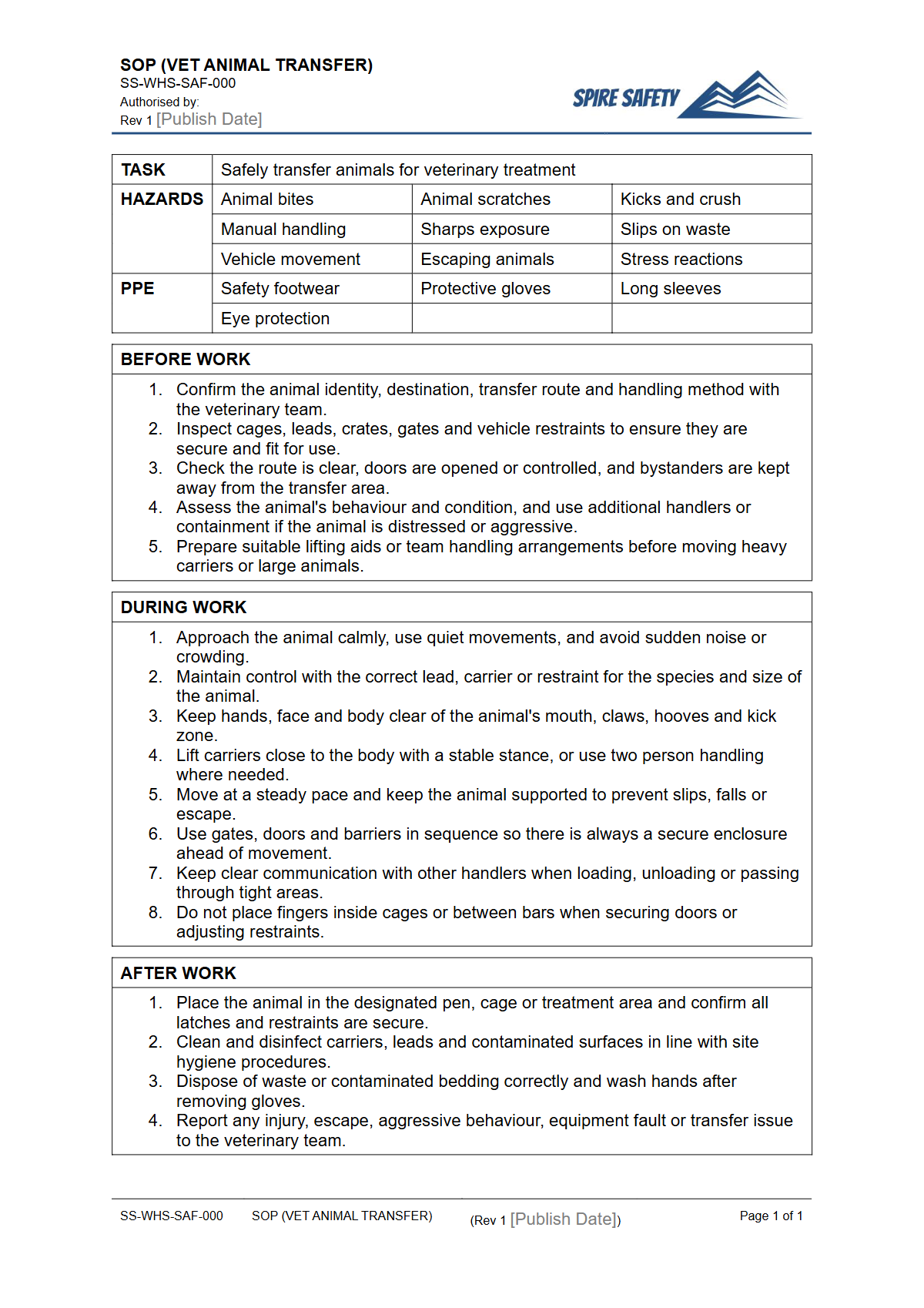
Purpose of the Free Safe Operating Procedure (Vet Animal Transfer) Template
The primary purpose of this Safe Operating Procedure (SOP) is to provide a clear, documented process for transferring animals, thereby minimising health and safety risks to workers. Key hazards in a veterinary setting include animal bites, scratches, musculoskeletal injuries from lifting or restraining, and exposure to zoonotic diseases.
A well-defined SOP helps control these risks by establishing best-practice techniques for handling, lifting, and communication. It ensures that all personnel perform the task consistently and safely, which also reduces stress and potential injury to the animal. Implementing this SOP supports your organisation's duty of care and forms a critical component of comprehensive WHS management systems.
Video walkthrough
How to use the Free Safe Operating Procedure (Vet Animal Transfer) Template
This template is provided in both DOCX and PDF formats for your convenience. The DOCX file is fully editable, allowing you to tailor the content to the specific needs of your clinic or animal hospital.
A successful SOP must reflect the real-world conditions of the workplace.
Note: It is crucial to adapt this template to the specific layout, equipment (e.g., slings, stretchers, cat carriers), and types of animals handled in your practice. We have provided a framework, but you must complete the site-specific risk assessment and procedural steps based on your unique operational context.
This includes adding details on different species, sizes, and temperaments. For complex environments, seeking guidance from WHS consultants can help ensure your procedures are robust and effective.
Customisation Steps:
- Site Details: Add your clinic's name, address, and the date of implementation.
- Risk Assessment: Identify all potential hazards associated with animal transfer in your facility. Consider the animal's behaviour, the environment, the equipment used, and the staff involved.
- Procedural Steps: Detail the pre-transfer checks, the step-by-step transfer process, and post-transfer actions. Be specific about communication cues, restraint methods, and the number of staff required for animals of different sizes.
- Training: Document the training requirements for staff who will perform this task.
- Review: Establish a schedule for reviewing and updating the SOP.
When to use the Vet Animal Transfer SOP
This Safe Operating Procedure should be the standard protocol for all non-routine and routine animal transfers within the facility. It applies whenever an animal needs to be moved from one area to another, including:
- From a client's vehicle into the clinic.
- Between holding cages, kennels, or enclosures.
- To and from consultation or examination rooms.
- To and from surgical theatres and recovery areas.
- Into and out of diagnostic imaging rooms (e.g., for X-rays).
The SOP should also be referenced during staff training and induction. Regularly reviewing its effectiveness should be part of your clinic's safety schedule, often prompted by regular WHS compliance audits to ensure ongoing suitability.
Who should use it
This procedure is intended for all personnel involved in the handling and movement of animals within a veterinary or animal care setting. This includes, but is not limited to:
- Veterinarians
- Veterinary Nurses
- Veterinary Technicians
- Animal Attendants
- Kennel Hands
All relevant staff must be trained on the contents of the finalised SOP to ensure they understand the risks and the required control measures. Competency should be verified before a staff member is permitted to undertake transfer tasks independently. For more tools to help formalise your workplace safety, browse our free WHS resources library.
Common mistakes
Common mistakes to avoid
- Failing to assess the animal's temperament and stress levels before handling.
- Using incorrect lifting techniques or failing to use available lifting aids like slings or stretchers.
- Poor communication between staff members during the transfer process, leading to confusion.
- Not having separate, clear procedures for different species, sizes, or medical conditions of animals.
Legal references
Legal considerations
The following legal requirements may be relevant to this type of work.
- Work Health and Safety Act (Harmonised) — Provides the primary duties for protecting workers and other people from work health and safety risks.
- Work Health and Safety Regulations (Harmonised) — Sets out requirements supporting the management of workplace hazards and risks.
The following codes may be relevant to this type of work.
- Managing WHS Risks Code of Practice — Provides practical guidance on identifying hazards, assessing risks and applying effective controls.
- Work Health and Safety Consultation, Cooperation and Coordination Code of Practice — Provides practical guidance on consulting workers and coordinating with other duty holders.
- Managing the Work Environment and Facilities Code of Practice — Provides practical guidance on safe work environments, workplace facilities and related controls.
Did you know
High-Risk Industry
The veterinary services industry has one of the highest rates of serious workers' compensation claims in Australia, with animal handling being a primary cause of injury.
Musculoskeletal Strain
Lifting and restraining animals are leading causes of musculoskeletal disorders (MSDs) among veterinary professionals, often resulting from awkward postures and unexpected animal movements.
FAQ
Frequently asked questions
01What are the main hazards when transferring animals in a vet clinic?
02Does this SOP template cover aggressive or unpredictable animals?
03How often should we review our Animal Transfer SOP?
04Is an SOP legally required for animal handling in Australia?
Share this resource
Free Safe Operating Procedure (Vet Animal Transfer) Template
Browse Categories
How To Use It
- 1Download and open in Word or PDF.
- 2Replace the placeholders with your business details.
- 3Get it reviewed by a WHS specialist before rollout.
Need it customised?
Our WHS consultants can adapt this template to your site, run a gap analysis, or audit what you already have in place.
Book a Free Consultation WHS consulting servicesor call 1300 156 382
Related templates
- Free Safe Operating Procedure (Vet Cage Cleaning) Template
- Free Safe Operating Procedure (Vet Cage Waste Cleanup) Template
- Free Safe Operating Procedure (Vet Kennel Cleaning) Template
- Free Safe Operating Procedure (Vet Laundry Handling) Template
- Free Safe Operating Procedure (Vet Room Cleaning) Template
- Free Safe Operating Procedure (Vet Waiting Room Clean) Template