
Free Safe Operating Procedure (Vertical Lifeline) Template
Manage risks associated with working at height using our structured template. Download your free Safe Operating Procedure (Vertical Lifeline) Template today.
Free Safe Operating Procedure (Vertical Lifeline) Template
DOCX • 126 KB + PDF
Updated Oct 2026
No signup required
Purpose of the Free Safe Operating Procedure (Vertical Lifeline) Template
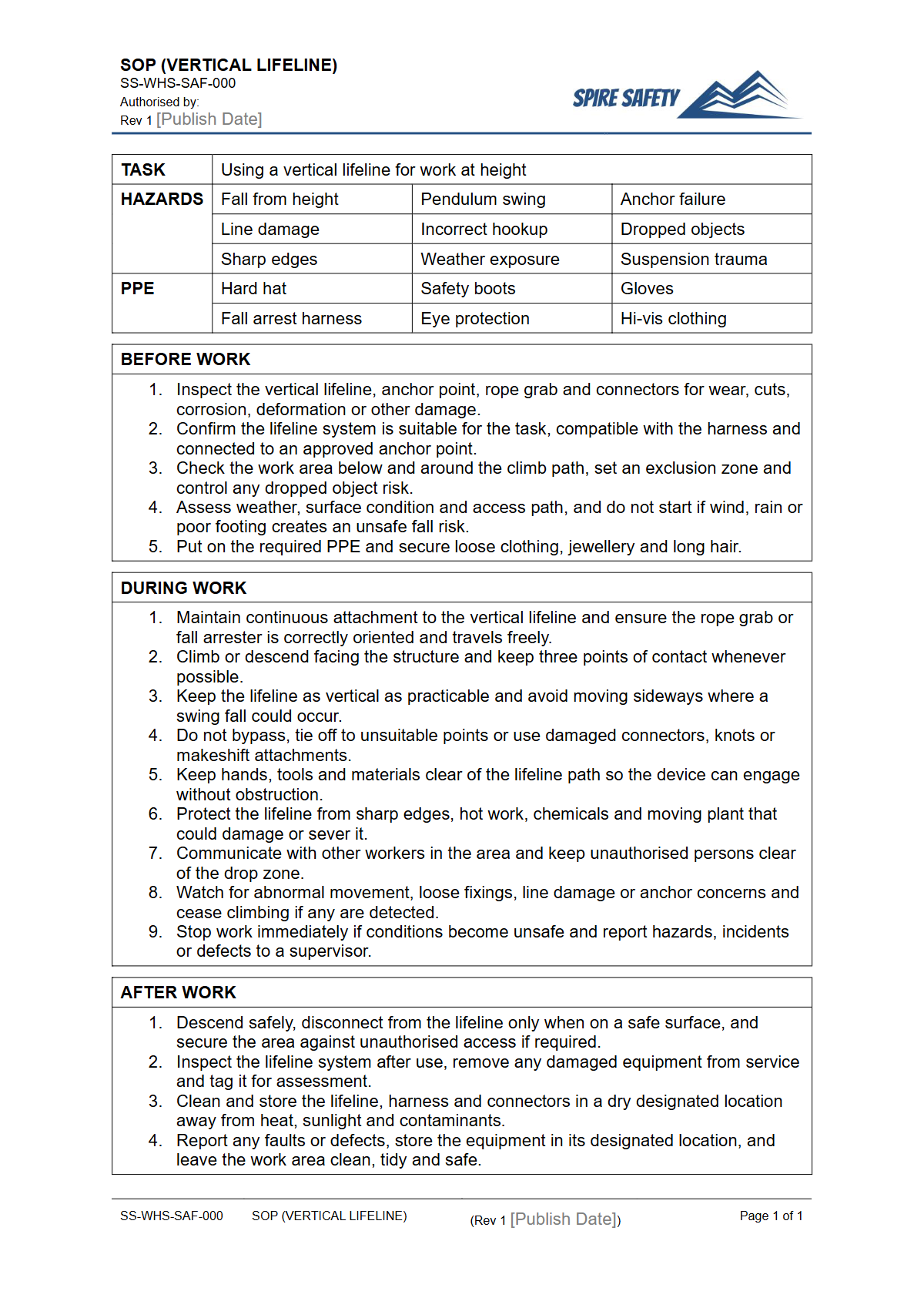
Working at height is a high-risk activity that demands rigorous safety protocols. This free Safe Operating Procedure (Vertical Lifeline) Template provides a structured framework for documenting the safe use of vertical lifeline systems in your workplace.
A well-defined SOP is a critical tool for training workers, guiding supervisors, and demonstrating a systematic approach to risk management. It outlines the required steps for pre-use inspection, setup, use, and emergency response, ensuring every user understands their responsibilities.
Using this template helps standardise procedures, reduce the likelihood of user error, and support your overall safety program.
Implementing robust SOPs is a cornerstone of effective WHS management systems, helping to formalise safe work practices and meet due diligence requirements. This document serves as a clear, instructional guide that can be integrated into worker inductions, toolbox talks, and refresher training sessions, reinforcing safe behaviour and organisational expectations.
Video walkthrough
How to use the Free Safe Operating Procedure (Vertical Lifeline) Template
This Safe Operating Procedure is available as a fully editable DOCX file, with a PDF version also provided for easy distribution. The template is designed as a comprehensive starting point, not a finished document.
To make it effective for your operations, it must be carefully customised.
Important: You must adapt this document to your specific circumstances. We are not familiar with your operational specifics, the exact make and model of your equipment, the environment it's used in, or the competency of your people.
This template must be updated with site-specific details, including the types of vertical lifelines in use, specific anchor points, and relevant emergency contacts. Always consult the manufacturer's instructions for the specific equipment being used and incorporate their recommendations directly into the procedure.
This process of customisation is vital for all high-risk equipment, whether you are developing procedures for fall arrest systems or creating a FREE Telehandler SOP Template for your mobile plant fleet.
When to use a Safe Operating Procedure for a Vertical Lifeline
An SOP for a vertical lifeline should be developed and implemented before any work that requires its use. It is a mandatory reference document for tasks involving potential falls from height where a vertical lifeline is the selected control measure. Common scenarios include:
- Construction and building maintenance, such as facade work, roofing, and structural steel erection.
- Accessing and working on telecommunication towers, poles, and masts.
- Maintenance and inspection tasks inside tanks, silos, and other confined spaces with vertical access.
- Work on elevated industrial structures, gantries, and platforms.
- Window cleaning and other high-rise building services.
These procedures should be readily accessible to all workers and supervisors involved in the task. Reviewing the SOP should be a standard part of the job planning phase, often alongside a risk assessment or a Safe Work Method Statement (SWMS).
Who should use this Safe Operating Procedure
This document is intended for use by multiple groups within an organisation to ensure a cohesive approach to safety:
- Persons Conducting a Business or Undertaking (PCBUs): To meet their primary duty of care by providing a safe system of work. Seeking external guidance from WHS consulting professionals can assist PCBUs in fulfilling these obligations.
- Managers and Supervisors: To train workers, monitor compliance with the procedure, and ensure all safety requirements are met before and during the work.
- Workers: As a step-by-step guide for safely inspecting and using vertical lifeline systems. Workers must be trained on the contents of the SOP and declared competent in its application.
- WHS and Safety Officers: To use as a baseline for workplace inspections, incident investigations, and continuous improvement of safety protocols. Regular reviews, similar to those conducted during WHS compliance auditing, ensure the SOP remains relevant and effective.
Developing SOPs for your equipment, such as an industrial FREE Conveyer System SOP, requires consultation with the workers who will actually be performing the tasks. This collaboration ensures the procedures are practical, accurate, and reflect the real-world conditions of the job, which increases the likelihood of them being followed.
This document is just one of many resources designed to help you build a safer workplace. You can explore our complete free WHS resources library for more templates, checklists, and guides to support your safety management efforts.
Common mistakes
Common mistakes to avoid
- Failing to conduct and document a pre-use inspection of all components (harness, lanyard, rope grab, lifeline, anchor).
- Selecting non-rated or inappropriate anchor points that are not capable of sustaining the forces generated in a fall.
- Allowing more users on a single lifeline system than it has been designed and rated for.
- Having no documented or practiced rescue plan to retrieve a suspended worker quickly and safely after a fall.
Legal references
Legal considerations
The following legal requirements may be relevant to this type of work.
- Work Health and Safety Act (Harmonised) — Provides the primary duties for protecting workers and other people from work health and safety risks.
- Work Health and Safety Regulations (Harmonised) — Sets out requirements supporting the management of workplace hazards and risks.
The following codes may be relevant to this type of work.
- Managing WHS Risks Code of Practice — Provides practical guidance on identifying hazards, assessing risks and applying effective controls.
- Work Health and Safety Consultation, Cooperation and Coordination Code of Practice — Provides practical guidance on consulting workers and coordinating with other duty holders.
- Managing the Work Environment and Facilities Code of Practice — Provides practical guidance on safe work environments, workplace facilities and related controls.
Did you know
Shock Absorption is Key
Many personal fall arrest systems connected to lifelines include a personal energy absorber. In the event of a fall, this component deploys and can extend by up to 1.75 metres, significantly reducing the deceleration forces exerted on the user's body.
Suspension Trauma
A worker suspended in a harness after a fall is at risk of suspension trauma (orthostatic intolerance), which can become life-threatening in minutes. This is why every SOP for fall arrest must include a detailed and practiced rescue plan.
FAQ
Frequently asked questions
01What should a Safe Operating Procedure for a vertical lifeline include?
02Is an SOP a legal requirement for using vertical lifelines in Australia?
03How often should vertical lifeline equipment be inspected?
04Who is a 'competent person' for inspecting fall arrest equipment?
Share this resource
Free Safe Operating Procedure (Vertical Lifeline) Template
Browse Categories
How To Use It
- 1Download and open in Word or PDF.
- 2Replace the placeholders with your business details.
- 3Get it reviewed by a WHS specialist before rollout.
Need it customised?
Our WHS consultants can adapt this template to your site, run a gap analysis, or audit what you already have in place.
Book a Free Consultation WHS consulting servicesor call 1300 156 382
Related templates
- Free Safe Operating Procedure (Vet Animal Bedding) Template
- Free Safe Operating Procedure (Vet Animal Transfer) Template
- Free Safe Operating Procedure (Vet Cage Cleaning) Template
- Free Safe Operating Procedure (Vet Cage Waste Cleanup) Template
- Free Safe Operating Procedure (Vet Kennel Cleaning) Template
- Free Safe Operating Procedure (Vet Laundry Handling) Template