
Free Safe Operating Procedure (Ventilation Blower) Template
Formalise safety around ventilation blowers with our structured Safe Operating Procedure template. Download the free DOCX or PDF to start customising now.
Free Safe Operating Procedure (Ventilation Blower) Template
DOCX • 126 KB + PDF
Updated Oct 2026
No signup required
Purpose of the Free Safe Operating Procedure (Ventilation Blower) Template
A ventilation blower is essential for managing air quality, from purging confined spaces to extracting dust and fumes. However, its operation involves risks such as electrical hazards, noise exposure, and entanglement in moving parts.
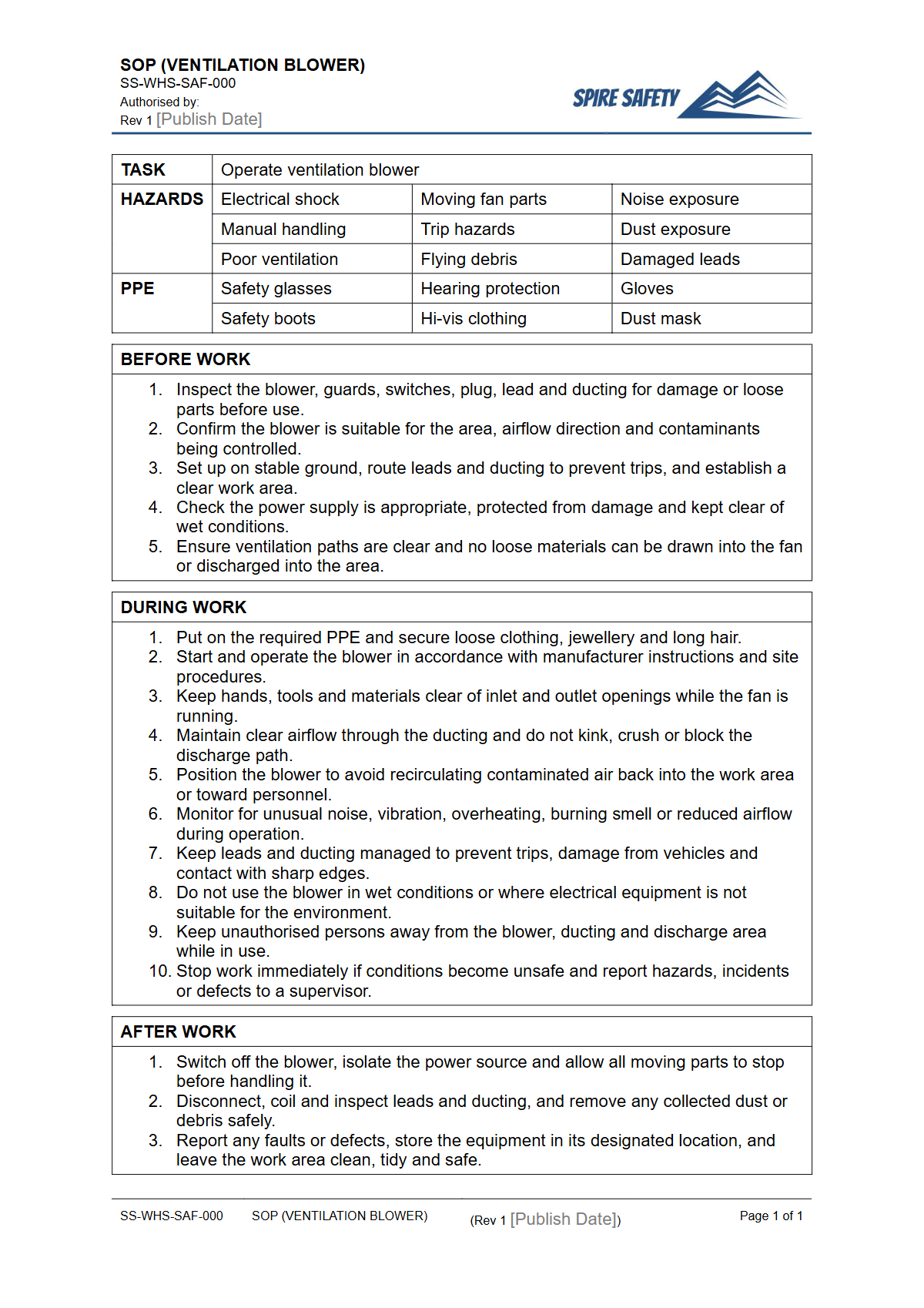
This Free Safe Operating Procedure (Ventilation Blower) Template provides a structured framework for documenting the required steps to use this equipment safely and effectively. By implementing a clear SOP, you establish a consistent, safe method of work that minimises operator error and reduces the risk of incidents.
A documented procedure is a critical component of robust WHS management systems, helping to demonstrate your organisation’s commitment to providing a safe working environment.
Video walkthrough
How to use the Free Safe Operating Procedure (Ventilation Blower) Template
This template is available for immediate download as a DOCX file, allowing for easy editing and customisation. A PDF version is also provided for straightforward printing and distribution.
The document is logically structured to cover pre-start checks, operational steps, shutdown procedures, and maintenance requirements. It serves as a comprehensive starting point, guiding you to consider all key aspects of the blower’s use.
Similar to our other equipment-specific documents, like the free Air Compressor SOP, this template is designed to be adapted to your specific context.
Important: This is a template only. We have provided a comprehensive framework, but you must adapt the content to reflect the specific make and model of your ventilation blower, your unique site conditions, the tasks it is used for (e.g., dust extraction vs.
confined space ventilation), and your organisation's existing safety policies and procedures. A generic document is not sufficient for compliance.
When to use this Safe Operating Procedure
A well-defined SOP for a ventilation blower should be used in several key situations. It is an essential tool for inducting and training new operators, ensuring they understand the approved method of operation from the outset.
It also serves as a checklist for pre-start inspections, helping workers verify the equipment is safe to use each time. The SOP can be referenced during routine safety observations or after an incident to review and reinforce correct procedures.
Furthermore, having such documented processes readily available is vital when preparing for and undergoing WHS compliance auditing, as it provides clear evidence of a formalised safe system of work.
Who should use it
This Safe Operating Procedure is intended for anyone who interacts with ventilation blowers in the workplace. This includes:
- Operators: To follow a step-by-step guide for safe and efficient operation.
- Supervisors and Managers: To enforce safety standards, conduct training, and perform competency assessments.
- WHS Personnel: To integrate the procedure into the broader safety management system and use it as a basis for risk assessments.
- Maintenance Staff: To understand isolation, lockout/tagout, and cleaning procedures required to maintain the equipment safely.
For high-risk tasks such as providing ventilation during hot work in enclosed areas, this SOP should be used in conjunction with other key safety documents, such as a FREE Oxy Acetylene SOP (Safe Operating Procedure) Template and a hot work permit.
Key Hazards to Address
When customising this template, pay close attention to the specific hazards your ventilation blower presents. These commonly include electrical risks from damaged cords or use in wet areas, manual handling injuries from moving portable units, and the risk of fire or explosion if the blower is not rated for use in flammable atmospheres.
Ensure the SOP clearly outlines control measures for these risks, such as the mandatory use of RCDs, team lifting techniques, and verifying the equipment's suitability for the environment. If you need expert help in conducting a thorough risk assessment, our WHS consulting team can provide specialised guidance.
By thoroughly customising this SOP, you create more than just a document; you build a practical tool that actively contributes to a safer workplace culture. Explore our complete free WHS resources library for more templates to support your safety management system.
Common mistakes
Common mistakes to avoid
- Failing to customise the template for the specific blower model and work environment.
- Neglecting to check the blower's intake is clear of debris or loose materials that could be drawn in.
- Using an electrically powered blower in wet or damp conditions without RCD protection.
- Not verifying that ventilation ducting is secure, undamaged, and correctly positioned before starting.
Legal references
Legal considerations
The following legal requirements may be relevant to this type of work.
- Work Health and Safety Act (Harmonised) — Provides the primary duties for protecting workers and other people from work health and safety risks.
- Work Health and Safety Regulations (Harmonised) — Sets out requirements supporting the management of workplace hazards and risks.
The following codes may be relevant to this type of work.
- Managing WHS Risks Code of Practice — Provides practical guidance on identifying hazards, assessing risks and applying effective controls.
- Work Health and Safety Consultation, Cooperation and Coordination Code of Practice — Provides practical guidance on consulting workers and coordinating with other duty holders.
- Managing the Work Environment and Facilities Code of Practice — Provides practical guidance on safe work environments, workplace facilities and related controls.
Did you know
Noise Hazard
Industrial ventilation blowers can easily generate noise levels exceeding the 85 dB(A) exposure standard. This requires the use of hearing protection and the implementation of other noise control measures under WHS Regulations.
Confined Space Lifeline
In confined space work, ventilation blowers are a critical control for purging hazardous atmospheres and providing breathable air, forming a key part of the risk assessment and emergency rescue plan.
FAQ
Frequently asked questions
01What should be included in an SOP for a ventilation blower?
02Is a Safe Operating Procedure a legal requirement in Australia?
03How often should a ventilation blower SOP be reviewed?
04Can this template be used for all types of ventilation blowers?
Share this resource
Free Safe Operating Procedure (Ventilation Blower) Template
Browse Categories
How To Use It
- 1Download and open in Word or PDF.
- 2Replace the placeholders with your business details.
- 3Get it reviewed by a WHS specialist before rollout.
Need it customised?
Our WHS consultants can adapt this template to your site, run a gap analysis, or audit what you already have in place.
Book a Free Consultation WHS consulting servicesor call 1300 156 382
Related templates
- Free Safe Operating Procedure (Venue Seating Setup) Template
- Free Safe Operating Procedure (Vertical Lifeline) Template
- Free Safe Operating Procedure (Vet Animal Bedding) Template
- Free Safe Operating Procedure (Vet Animal Transfer) Template
- Free Safe Operating Procedure (Vet Cage Cleaning) Template
- Free Safe Operating Procedure (Vet Cage Waste Cleanup) Template