
Free Safe Operating Procedure (Veneer Lathe) Template
Download our free Safe Operating Procedure (Veneer Lathe) template to manage hazards in your woodworking or manufacturing workplace. Get your DOCX and PDF now.
Free Safe Operating Procedure (Veneer Lathe) Template
DOCX • 126 KB + PDF
Updated Oct 2026
No signup required
Purpose of the Free Safe Operating Procedure (Veneer Lathe) Template
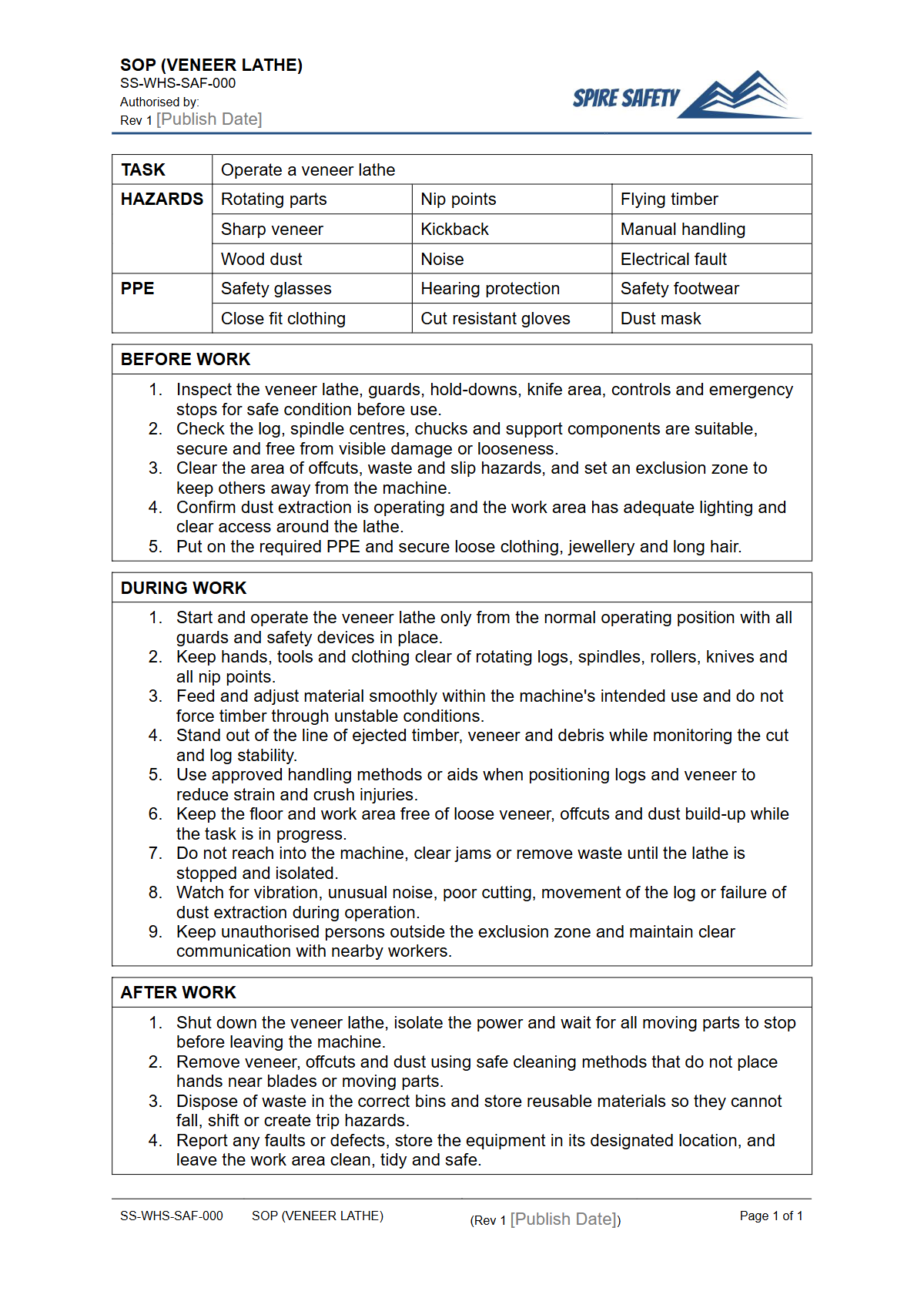
Operating a veneer lathe involves significant risks, including entanglement with rotating parts, contact with sharp blades, and exposure to wood dust. This free Safe Operating Procedure (Veneer Lathe) template provides a structured starting point for your business to formally document the safest way to perform this task.
An effective SOP standardises procedures, identifies key hazards, and outlines the control measures required to mitigate risk. It serves as a crucial tool for worker training and competency assessment, helping to ensure everyone understands how to operate the machinery safely and consistently.
A well-drafted SOP is a fundamental component of a safe system of work. It helps your organisation meet its duty of care under Australian WHS laws by demonstrating a proactive approach to risk management.
This process is similar to managing risks for other high-hazard equipment, as detailed in our free circular saw SOP template.
Video walkthrough
How to use the Free Safe Operating Procedure (Veneer Lathe) Template
Begin by downloading the template in the format that suits you best, either DOCX for easy editing or PDF. The next step is critical: you must adapt the document to the specific context of your workplace.
This involves consulting with the workers who actually operate the veneer lathes to ensure the procedure reflects reality.
Your customisation should include details such as:
- The specific make and model of the veneer lathe(s) in use.
- Site-specific pre-start checks, operational steps, and shutdown procedures.
- Required Personal Protective Equipment (PPE), such as safety glasses, hearing protection, and respiratory protection.
- Lock-out Tag-out (LOTO) procedures for maintenance and cleaning.
- Emergency procedures, including stop button locations and first aid contacts.
Important: This is a template only. We've provided a solid framework aligned with Australian WHS principles, but you must customise it to reflect the specific machinery, workplace layout, and established procedures at your site to ensure it is effective.
When to Use a Veneer Lathe Safe Operating Procedure
A Safe Operating Procedure for a veneer lathe should be a living document integrated into your daily operations. It is essential during the induction of new employees to establish safe work habits from the start.
It should also be used for refresher training to reinforce correct procedures and for any worker transitioning to operating the lathe for the first time. Supervisors can use the SOP as a checklist to conduct safety observations and verify that tasks are being performed as required.
Furthermore, in the unfortunate event of an incident or near miss, the SOP becomes a vital reference for investigation and review.
Who Should Use This SOP
This SOP is primarily for the workers who are trained and authorised to operate veneer lathes. They should have easy access to it in their work area and be able to refer to it whenever needed.
Supervisors and team leaders must also be thoroughly familiar with the SOP to effectively oversee operations and enforce safety standards. WHS managers and personnel will use the document as part of the broader risk management framework, ensuring it is reviewed and updated as necessary.
It is also a valuable resource for maintenance staff who need to understand the correct procedures for isolating and securing the equipment before undertaking work.
Key Hazards of Veneer Lathe Operation
A comprehensive SOP must clearly identify the principal hazards. For a veneer lathe, these include mechanical, electrical, and health hazards.
The primary mechanical risk comes from the large, rotating log (the 'peeler bolt') and the knife assembly, creating serious entanglement and cutting dangers. Guarding must be in place and effective.
Logs are often loaded onto the lathe using automated systems. Properly managing these feed mechanisms is crucial, as documented in a Conveyer System SOP. Failure of these systems can lead to catastrophic accidents involving falling or ejected logs.
Additionally, veneer lathes often utilise pneumatic or hydraulic systems for clamping and movement. These energy sources must be isolated during maintenance. Compressed air is also used for cleaning, which has its own set of risks that should be managed, much like those covered in a general Air Compressor SOP.
Integrating SOPs into Your WHS System
An SOP is not a standalone solution; it is one part of a comprehensive safety framework. For maximum effectiveness, it must be integrated into your organisation's overall WHS management systems. This means the process documented in the SOP should align with your broader policies on risk assessment, training, incident reporting, and emergency preparedness.
Regular reviews of all SOPs should be scheduled to ensure they remain current and effective.
The effectiveness and implementation of your SOPs are often key focus areas during a formal WHS compliance auditing process. Keeping these documents current and ensuring workers are trained on them provides clear evidence of your commitment to safety. For complex machinery or processes, engaging external expertise through WHS consulting can provide valuable insight and ensure your procedures are robust. Explore our full free WHS resources library for more templates to support your safety management system.
Common mistakes
Common mistakes to avoid
- Using a generic template without customising it with site-specific machine models and procedures.
- Failing to consult with experienced lathe operators during the drafting and review process.
- Not providing adequate training on the finalised SOP, assuming workers will simply read it.
- Forgetting to schedule and conduct regular reviews, allowing the procedure to become outdated.
Legal references
Legal considerations
The following legal requirements may be relevant to this type of work.
- Work Health and Safety Act (Harmonised) — Provides the primary duties for protecting workers and other people from work health and safety risks.
- Work Health and Safety Regulations (Harmonised) — Sets out requirements supporting the management of workplace hazards and risks.
The following codes may be relevant to this type of work.
- Managing WHS Risks Code of Practice — Provides practical guidance on identifying hazards, assessing risks and applying effective controls.
- Work Health and Safety Consultation, Cooperation and Coordination Code of Practice — Provides practical guidance on consulting workers and coordinating with other duty holders.
- Managing the Work Environment and Facilities Code of Practice — Provides practical guidance on safe work environments, workplace facilities and related controls.
Did you know
Wood Dust Hazards
Veneer lathes can produce significant amounts of fine wood dust, which is classified as a carcinogen. Effective dust extraction systems are a critical engineering control to protect worker health.
The Peeling Process
Before being peeled on a lathe, logs are often heated in steam vats or hot water. This process, known as 'conditioning', softens the wood fibres, resulting in a smoother, more flexible veneer sheet with fewer cracks.
FAQ
Frequently asked questions
01What is a Safe Operating Procedure (SOP)?
02Is this veneer lathe SOP template enough for WHS compliance?
03Who is responsible for writing and approving SOPs?
04How often should a veneer lathe SOP be reviewed?
Share this resource
Free Safe Operating Procedure (Veneer Lathe) Template
Browse Categories
How To Use It
- 1Download and open in Word or PDF.
- 2Replace the placeholders with your business details.
- 3Get it reviewed by a WHS specialist before rollout.
Need it customised?
Our WHS consultants can adapt this template to your site, run a gap analysis, or audit what you already have in place.
Book a Free Consultation WHS consulting servicesor call 1300 156 382
Related templates
- Free Safe Operating Procedure (Vent Bag Installation) Template
- Free Safe Operating Procedure (Ventilation Blower) Template
- Free Safe Operating Procedure (Venue Seating Setup) Template
- Free Safe Operating Procedure (Vertical Lifeline) Template
- Free Safe Operating Procedure (Vet Animal Bedding) Template
- Free Safe Operating Procedure (Vet Animal Transfer) Template