
Free Safe Operating Procedure (Vehicle Service Handover) Template
Standardise the handover process for serviced vehicles to minimise risks and ensure clear communication.
Free Safe Operating Procedure (Vehicle Service Handover) Template
DOCX • 126 KB + PDF
Updated Oct 2026
No signup required
Purpose of the Free Safe Operating Procedure (Vehicle Service Handover) Template
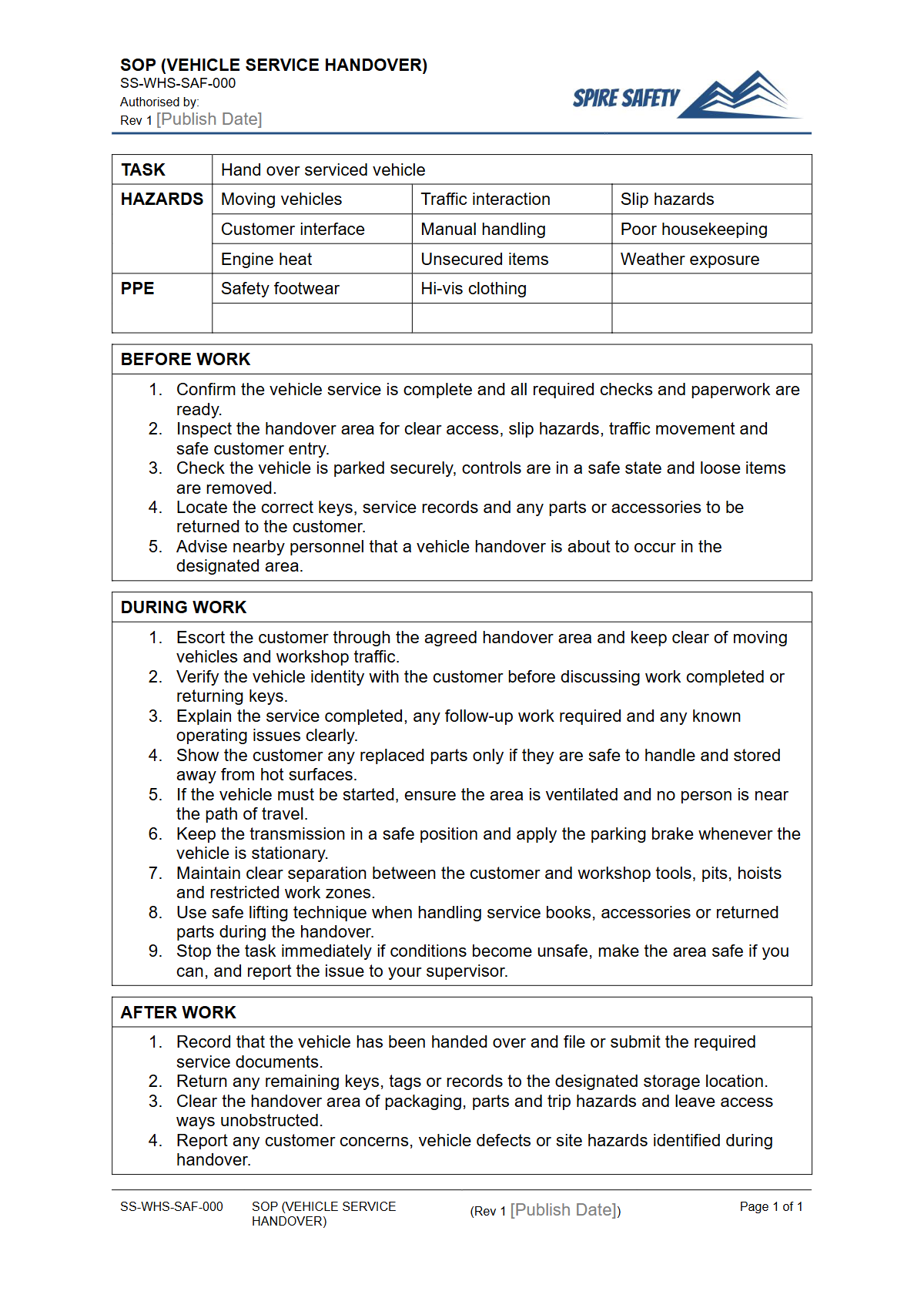
The handover of a vehicle after service or repair is a critical control point where miscommunication can lead to serious incidents. This Free Safe Operating Procedure (Vehicle Service Handover) Template provides a structured framework to ensure this process is conducted safely and consistently.
Using a standardised procedure helps your organisation manage risks associated with vehicle maintenance, such as uncontrolled movement, unexpected operation of components, or failure to communicate outstanding defects. It formalises the transfer of control from the maintenance team back to the operator, confirming that the vehicle is safe for use and that the operator is aware of its current state.
Implementing documented procedures like this is a fundamental part of effective WHS management systems. It creates a clear, auditable record that demonstrates due diligence in managing plant safety. This SOP helps verify that all necessary checks have been completed, safety features are functional, and all relevant information about the work performed has been clearly communicated, reducing the likelihood of accidents and operational downtime.
Video walkthrough
How to use the Free Safe Operating Procedure (Vehicle Service Handover) Template
This Safe Operating Procedure is provided as a starting point in both DOCX and PDF formats. The DOCX version is fully editable, allowing you to adapt the content to the specific types of vehicles, tasks, and hazards present in your workplace.
A robust handover procedure should be customised to reflect your operational realities, including the specific roles and responsibilities of your team members, from mechanics to fleet managers and operators.
Important: We have designed this template to be a comprehensive starting point, but it must be customised to suit the unique context of your workplace. You should consult with your workers and other relevant stakeholders during the drafting and review process to ensure the final procedure is practical, effective, and understood by everyone who will use it.
Consider integrating it with other procedures, such as your workshop's free Air Compressor SOP or other plant-specific documents.
Key Elements of a Vehicle Handover SOP
A thorough handover procedure should cover several key stages to be effective. This template prompts you to consider:
- Pre-Handover Inspection: A final check by the technician to confirm all work is complete, tools and workshop equipment are removed, guards are replaced, and any required lockouts have been taken off.
- Documentation and Communication: Ensuring the job card or service report accurately reflects the work done, parts used, and importantly, any identified faults that were not rectified. This section is critical for clear communication between the service team and the operator.
- The Physical Handover: A joint inspection involving both the service technician and the operator. This should include a walk-around, a check of key controls (e.g., brakes, lights, horns), and a verbal summary of the service performed.
- Operator Acknowledgement: A formal sign-off where the operator confirms they have received the handover, understand the work that was completed, and accept responsibility for the vehicle.
Developing these detailed steps can be complex. If you require assistance in creating tailored safety documents that integrate seamlessly into your operations, our WHS consulting team can provide expert guidance.
When to use it
This Safe Operating Procedure should be used every time a vehicle is returned to service following any form of maintenance, repair, or inspection. This applies to a wide range of scenarios, from routine scheduled servicing of a company car to major repairs on heavy vehicles or mobile plant.
Consistent application is key; the procedure should be a non-negotiable step before any operator is permitted to use the vehicle. This creates a predictable and safe routine that becomes embedded in your organisation's safety culture.
Regularly reviewing its application is also important. The consistent use of documented procedures like this SOP is often a key focus during a WHS compliance auditing process, as it provides evidence of a systematic approach to managing plant safety.
Who should use it
This procedure involves multiple roles, and each has a specific responsibility. It should be used by:
- Service Technicians/Mechanics: To ensure they complete all safety checks and communicate their work effectively before releasing a vehicle.
- Workshop Supervisors/Managers: To oversee the process, ensure procedures are followed correctly, and verify that documentation is complete.
- Vehicle Operators: To actively participate in the handover, ask questions, and confirm they understand the vehicle's status before accepting it. For operators of specific equipment, this SOP should be used alongside task-specific procedures, like a FREE Telehandler SOP Template.
- Fleet Managers: To ensure that maintenance records are updated and that the entire fleet is managed according to safe and compliant processes.
Ultimately, a safe handover is a shared responsibility. You can find more templates and safety guides to support your team in our free WHS resources library.
Common mistakes
Common mistakes to avoid
- Assuming the operator will 'just know' what work was done or how the vehicle might behave differently.
- Failing to clearly document faults that were identified during service but not rectified.
- Handing over the keys without conducting a joint walk-around inspection with the operator.
- Not removing workshop-specific safety measures like lockouts or steering wheel tags before returning the vehicle to service.
Legal references
Legal considerations
The following legal requirements may be relevant to this type of work.
- Work Health and Safety Act (Harmonised) — Provides the primary duties for protecting workers and other people from work health and safety risks.
- Work Health and Safety Regulations (Harmonised) — Sets out requirements supporting the management of workplace hazards and risks.
The following codes may be relevant to this type of work.
- Managing WHS Risks Code of Practice — Provides practical guidance on identifying hazards, assessing risks and applying effective controls.
- Work Health and Safety Consultation, Cooperation and Coordination Code of Practice — Provides practical guidance on consulting workers and coordinating with other duty holders.
- Managing the Work Environment and Facilities Code of Practice — Provides practical guidance on safe work environments, workplace facilities and related controls.
Did you know
Chain of Responsibility
Under Australia's Chain of Responsibility (CoR) laws, legal liability for safety breaches can extend to anyone who has influence over a heavy vehicle's transport task, including those who service and maintain the vehicle.
Uncontrolled Movement
Uncontrolled movement of vehicles is a leading cause of serious incidents and fatalities in workshops and transport yards. A formal handover process that includes brake tests and wheel chocking protocols is a critical control measure.
FAQ
Frequently asked questions
01What is the difference between a Safe Operating Procedure (SOP) and a Safe Work Method Statement (SWMS)?
02Does this vehicle handover SOP cover mobile plant?
03Who is responsible for signing off on the vehicle handover?
04How often should we review our Vehicle Service Handover SOP?
Share this resource
Free Safe Operating Procedure (Vehicle Service Handover) Template
Browse Categories
How To Use It
- 1Download and open in Word or PDF.
- 2Replace the placeholders with your business details.
- 3Get it reviewed by a WHS specialist before rollout.
Need it customised?
Our WHS consultants can adapt this template to your site, run a gap analysis, or audit what you already have in place.
Book a Free Consultation WHS consulting servicesor call 1300 156 382
Related templates
- Free Safe Operating Procedure (Vehicle Unloading Check) Template
- Free Safe Operating Procedure (Vehicle Washing) Template
- Free Safe Operating Procedure (Veneer Lathe) Template
- Free Safe Operating Procedure (Vent Bag Installation) Template
- Free Safe Operating Procedure (Ventilation Blower) Template
- Free Safe Operating Procedure (Venue Seating Setup) Template