
Free Safe Operating Procedure (Vehicle Jacking) Template
Manage vehicle lifting risks with our free Safe Operating Procedure for vehicle jacking. This customisable template helps you document safe work methods.
Free Safe Operating Procedure (Vehicle Jacking) Template
DOCX • 126 KB + PDF
Updated Oct 2026
No signup required
Purpose of the Free Safe Operating Procedure (Vehicle Jacking) Template
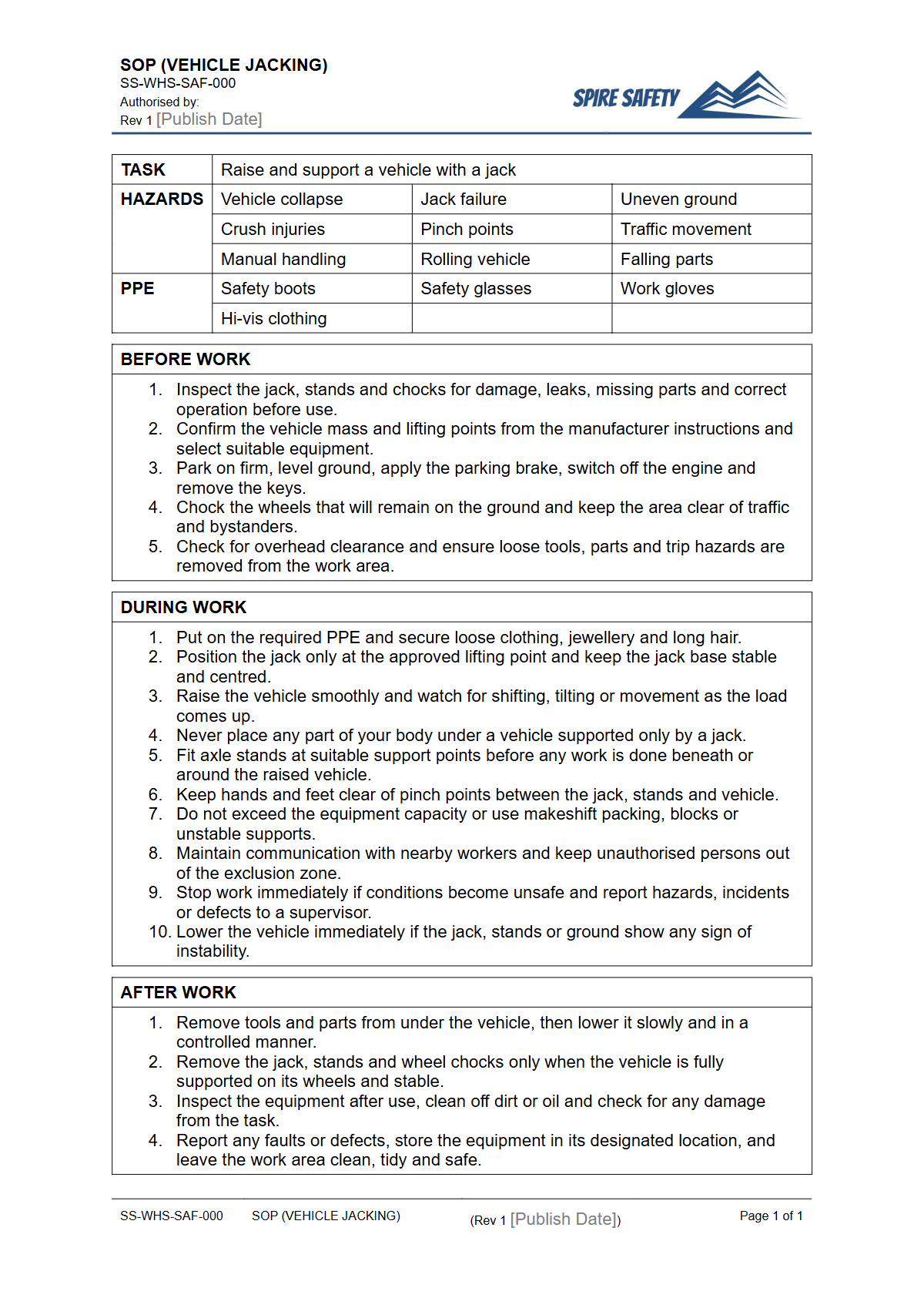
Effectively managing the risks of vehicle maintenance starts with clear, documented processes. Our Free Safe Operating Procedure (Vehicle Jacking) Template provides a structured starting point for workshops, mechanics, and any business where vehicles are lifted.
Its primary purpose is to help you create a formal document that outlines the step-by-step process for safely jacking and supporting a vehicle, minimising the risk of serious incidents such as crush injuries, hydraulic failures, or vehicle collapse.
A well-developed Safe Operating Procedure (SOP) is a key administrative control and a fundamental part of a comprehensive WHS management system. This template guides you in defining required personal protective equipment (PPE), pre-start checks for equipment, and the correct sequence of actions for lifting, securing, and lowering a vehicle. By implementing this procedure, you provide workers with clear instructions, promote consistent safe work practices, and demonstrate a commitment to workplace safety.
Video walkthrough
How to use the Free Safe Operating Procedure (Vehicle Jacking) Template
This resource is designed to be a foundational document that you adapt to your specific operational context. After downloading the DOCX or PDF file, you will need to review and customise each section to align with the equipment, vehicles, and environment at your workplace.
It is vital to incorporate details specific to your trolley jacks, bottle jacks, or other lifting devices, including their load ratings and inspection requirements. A generic procedure is not sufficient; it must reflect your reality.
Important: We provide this template as a guide to assist you in meeting your safety obligations. It is essential that you customise this document to reflect the specific hazards and control measures relevant to your workplace.
You are responsible for ensuring the final procedure is accurate, complete, and effectively communicated to all relevant personnel. In a typical workshop environment, this procedure would be used alongside others, such as an Air Compressor SOP, to cover all key tasks.
When to use it
A vehicle jacking SOP should be used as a primary reference tool for any task that involves lifting a vehicle off the ground. It is not a document to be filed away; it should be an active part of your safety process.
Its primary applications include worker training and induction for new employees, pre-task planning and risk assessment before a job begins, and as a reference guide available in the work area. Regular toolbox talks can also use the SOP to reinforce correct procedures and discuss any recent near-misses or incidents.
The procedure is also a critical document during safety reviews and incident investigations. Having a clear, established standard of work makes it easier to identify deviations that may have contributed to an unsafe situation.
For supervisors and managers, the SOP serves as the benchmark against which worker performance and compliance can be measured as part of a robust WHS compliance auditing program.
Who should use it
This Safe Operating Procedure is intended for a range of personnel within any organisation that services or maintains vehicles. This includes qualified mechanics, automotive technicians, apprentices, and trade assistants who perform the physical task of jacking.
Workshop managers and supervisors must also use the SOP to ensure they are providing adequate supervision and enforcing safe work standards. WHS managers and advisors will use this template to develop and integrate standardised procedures into the organisation's overall safety framework.
Key Elements of a Vehicle Jacking SOP
A robust SOP for vehicle jacking should always contain several key sections to ensure all stages of the task are covered. These typically include:
- Associated Risks: Identifying potential hazards such as vehicle collapse, hydraulic failure, instability, and crush injuries.
- Required PPE: Specifying necessary personal protective equipment, such as steel-capped boots, high-visibility clothing, safety glasses, and gloves.
- Pre-Operational Checks: A detailed checklist for inspecting the jack, axle stands, wheel chocks, and the work area (e.g., ensuring firm, level ground) before starting.
- Safe Operating Sequence: A step-by-step guide for positioning the vehicle, chocking the wheels, identifying the correct jacking points, lifting the vehicle, correctly placing axle stands, and confirming stability before work begins. This sequence is vital for many workshop tasks, similar to how one might follow our free Oxy Acetylene SOP template for hot work.
- Lowering Procedure: A controlled process for removing axle stands and safely lowering the vehicle back to the ground.
- Emergency Response: Clear instructions on what to do in case of jack failure, vehicle slippage, or injury.
By standardising procedures for common equipment, you create a safer and more predictable work environment. Whether the task involves a vehicle jack or requires a different procedure like a Telehandler SOP for materials handling, the principle of documenting safe steps remains the same.
You can explore our full free WHS resources library to find more templates to support your business.
Common mistakes
Common mistakes to avoid
- Working under a vehicle supported only by the jack.
- Using a jack on soft, uneven, or sloping ground.
- Failing to use wheel chocks to prevent the vehicle from rolling.
- Using a jack or axle stands that are not rated for the vehicle's weight.
Legal references
Legal considerations
The following legal requirements may be relevant to this type of work.
- Work Health and Safety Act (Harmonised) — Provides the primary duties for protecting workers and other people from work health and safety risks.
- Work Health and Safety Regulations (Harmonised) — Sets out requirements supporting the management of workplace hazards and risks.
The following codes may be relevant to this type of work.
- Managing WHS Risks Code of Practice — Provides practical guidance on identifying hazards, assessing risks and applying effective controls.
- Work Health and Safety Consultation, Cooperation and Coordination Code of Practice — Provides practical guidance on consulting workers and coordinating with other duty holders.
- Managing the Work Environment and Facilities Code of Practice — Provides practical guidance on safe work environments, workplace facilities and related controls.
Did you know
The Danger of Hydraulic Jacks
Hydraulic jacks can fail without warning due to internal seal degradation or fluid leaks. This is why Australian safety standards mandate that a vehicle must always be supported by fixed mechanical supports, like axle stands, before anyone works underneath it.
Load Capacity is Key
A jack's stated capacity (e.g., 2 tonnes) is its maximum lifting limit. Exceeding this, or placing the load off-centre, can cause the jack to fail or the vehicle to become unstable.
FAQ
Frequently asked questions
01What is the most important step when jacking a vehicle?
02Can I use this template for any type of vehicle jack?
03How often should a Safe Operating Procedure for vehicle jacking be reviewed?
04Do I need a licence to use a vehicle jack in Australia?
Share this resource
Free Safe Operating Procedure (Vehicle Jacking) Template
Browse Categories
How To Use It
- 1Download and open in Word or PDF.
- 2Replace the placeholders with your business details.
- 3Get it reviewed by a WHS specialist before rollout.
Need it customised?
Our WHS consultants can adapt this template to your site, run a gap analysis, or audit what you already have in place.
Book a Free Consultation WHS consulting servicesor call 1300 156 382
Related templates
- Free Safe Operating Procedure (Vehicle Loading Check) Template
- Free Safe Operating Procedure (Vehicle Loading Ramp) Template
- Free Safe Operating Procedure (Vehicle Recovery Winch) Template
- Free Safe Operating Procedure (Vehicle Service Handover) Template
- Free Safe Operating Procedure (Vehicle Unloading Check) Template
- Free Safe Operating Procedure (Vehicle Washing) Template