
Free Safe Operating Procedure (Vehicle Recovery Winch) Template
Establish safe work methods for using vehicle recovery winches with our free template. Download this customisable document to formalise your procedures.
Free Safe Operating Procedure (Vehicle Recovery Winch) Template
DOCX • 126 KB + PDF
Updated Oct 2026
No signup required
Purpose of the Free Safe Operating Procedure (Vehicle Recovery Winch) Template
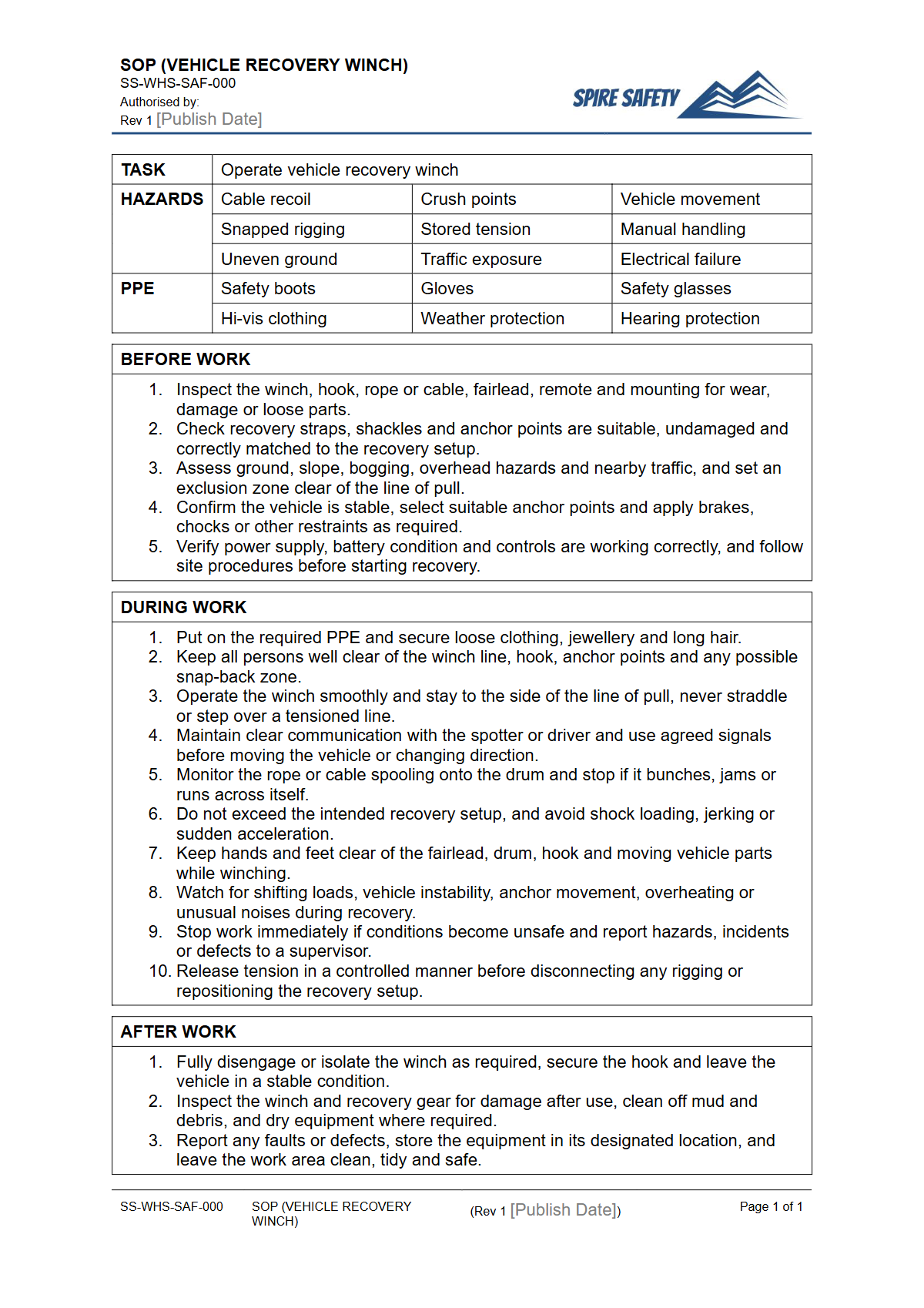
Using a vehicle recovery winch involves significant forces and potential hazards, including cable snap, equipment failure, and vehicle movement. This Free Safe Operating Procedure (Vehicle Recovery Winch) Template provides a structured starting point for organisations to document the required steps for performing this task safely.
It helps you outline pre-operational checks, the step-by-step recovery process, and post-operation requirements to minimise risks to operators and bystanders. Formalising these instructions is a critical step in fulfilling your duty of care under Australian WHS laws.
A documented Safe Operating Procedure (SOP) serves as a vital training tool for new and existing workers, ensuring everyone follows a consistent, approved method. It promotes a systematic approach to hazard identification and risk control, specifically addressing common dangers like incorrect rigging, winch overloading, and the creation of exclusion zones.
Implementing a clear SOP demonstrates a commitment to workplace health and safety and provides a reference point for incident investigations and operational reviews.
Video walkthrough
How to use the Free Safe Operating Procedure (Vehicle Recovery Winch) Template
This template is available for download in both DOCX and PDF formats. The DOCX version is fully editable, allowing you to tailor the content to your specific equipment, vehicles, and operational environment.
It is essential that you adapt the document to reflect the unique hazards and control measures relevant to your workplace.
Important: This is a template only. You must customise it to align with your specific machinery, risk assessments, and operational context.
We recommend consulting with operators and supervisors during the customisation process to ensure the final SOP is practical and effective. An SOP is a fundamental document within broader WHS management systems, linking risk assessments to daily work practices.
When to use a Vehicle Recovery Winch SOP
A Safe Operating Procedure for a vehicle recovery winch should be used every time the equipment is deployed. It is particularly critical in non-routine situations or challenging environments where the risk of error is higher.
Key scenarios include recovering a bogged or stranded vehicle in an off-road setting, repositioning vehicles on a work site, or loading/unloading vehicles from a trailer or transport platform. The SOP should be readily accessible to operators, either in the vehicle or as part of their pre-start documentation.
Who should use this Safe Operating Procedure
This SOP should be used by all personnel authorised to operate vehicle-mounted winches. This includes 4WD operators, fleet mechanics, transport and logistics workers, and any other employees involved in vehicle recovery tasks.
It is also a valuable resource for supervisors and WHS managers who are responsible for providing training, ensuring competency, and overseeing safe work practices. Competency should be verified for all operators using plant, which can be formalised using documents like our FREE Telehandler SOP Template for other types of mobile equipment.
Risk Assessment and Review
Before implementing this SOP, a thorough risk assessment must be conducted for all vehicle recovery activities. The SOP should be developed based on the findings of that assessment.
It is not a substitute for a risk assessment. Furthermore, the SOP should be reviewed regularly—typically annually, or after any incident, near miss, or change in equipment or procedures. Regular reviews are a key focus of safety evaluations like WHS compliance auditing.
Documenting procedures for all high-risk plant is a key part of managing workplace safety. Similar to this winch SOP, you may need procedures for other heavy equipment, such as the processes detailed in our FREE Scraper SOP Template.
The principles of pre-start checks, controlled operation, and post-use inspections apply to a wide range of machinery. If your workplace uses other specialised plant, you may find our FREE Trencher SOP Template a useful reference for developing consistent documentation.
By establishing clear and consistent procedures across all your plant and equipment, you build a more robust safety culture. You can find more templates and guides in our complete free WHS resources library to support your safety management efforts.
Common mistakes
Common mistakes to avoid
- Using a tow ball as an anchor point, as they are not designed for recovery loads and can shear off.
- Failing to place a winch damper or heavy blanket over the cable to absorb energy if it snaps.
- Allowing personnel to stand inside the 'danger zone'—the area within the length and arc of a potential cable failure.
- Not inspecting the winch rope or cable for damage, kinks, or fraying before each use.
Legal references
Legal considerations
The following legal requirements may be relevant to this type of work.
- Work Health and Safety Act (Harmonised) — Provides the primary duties for protecting workers and other people from work health and safety risks.
- Work Health and Safety Regulations (Harmonised) — Sets out requirements supporting the management of workplace hazards and risks.
The following codes may be relevant to this type of work.
- Managing WHS Risks Code of Practice — Provides practical guidance on identifying hazards, assessing risks and applying effective controls.
- Work Health and Safety Consultation, Cooperation and Coordination Code of Practice — Provides practical guidance on consulting workers and coordinating with other duty holders.
- Managing the Work Environment and Facilities Code of Practice — Provides practical guidance on safe work environments, workplace facilities and related controls.
Did you know
Synthetic vs. Steel
Modern synthetic winch ropes are up to 80% lighter than steel cables of the same strength. In the event of a failure, a synthetic rope stores less kinetic energy, significantly reducing the danger from a snapping line.
Mechanical Advantage
Using a snatch block or pulley to double the winch line back to the vehicle can nearly double the winch's pulling power. This technique, however, also halves the speed of the recovery.
FAQ
Frequently asked questions
01What should a vehicle recovery winch SOP include?
02Is a Safe Operating Procedure a legal requirement in Australia?
03How is an SOP different from a Safe Work Method Statement (SWMS)?
04Who is responsible for training workers on this SOP?
Share this resource
Free Safe Operating Procedure (Vehicle Recovery Winch) Template
Browse Categories
How To Use It
- 1Download and open in Word or PDF.
- 2Replace the placeholders with your business details.
- 3Get it reviewed by a WHS specialist before rollout.
Need it customised?
Our WHS consultants can adapt this template to your site, run a gap analysis, or audit what you already have in place.
Book a Free Consultation WHS consulting servicesor call 1300 156 382
Related templates
- Free Safe Operating Procedure (Vehicle Service Handover) Template
- Free Safe Operating Procedure (Vehicle Unloading Check) Template
- Free Safe Operating Procedure (Vehicle Washing) Template
- Free Safe Operating Procedure (Veneer Lathe) Template
- Free Safe Operating Procedure (Vent Bag Installation) Template
- Free Safe Operating Procedure (Ventilation Blower) Template