
Free Safe Operating Procedure (Vehicle Loading Ramp) Template
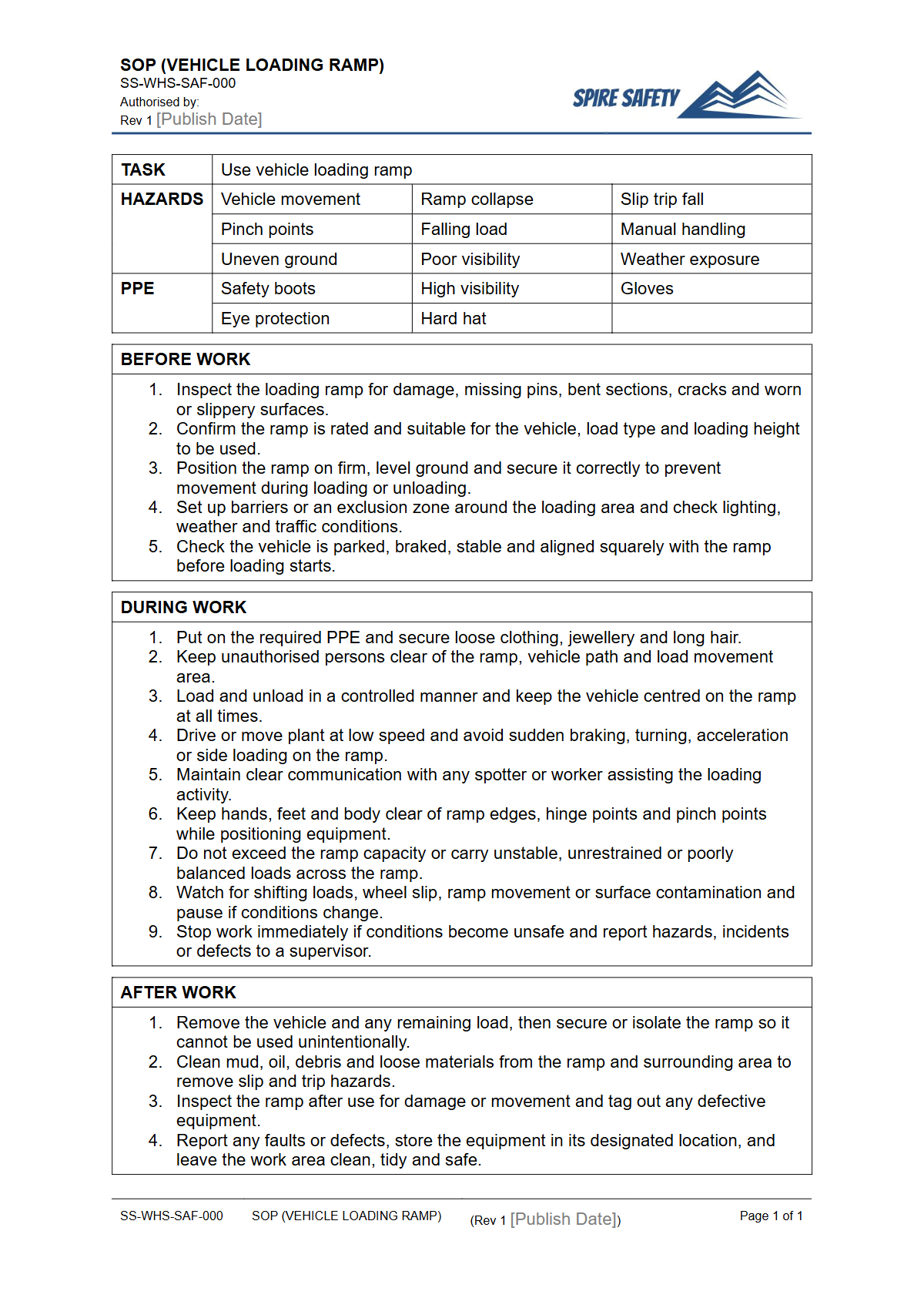
Download our Free Safe Operating Procedure (Vehicle Loading Ramp) Template to formalise safety protocols for loading and unloading.
Free Safe Operating Procedure (Vehicle Loading Ramp) Template
DOCX • 126 KB + PDF
Updated Oct 2026
No signup required
Purpose of the Free Safe Operating Procedure (Vehicle Loading Ramp) Template
Effectively managing workplace risks associated with loading and unloading vehicles is critical for preventing serious incidents. This Free Safe Operating Procedure (Vehicle Loading Ramp) Template provides a structured framework for documenting the required safety controls and step-by-step processes for using vehicle loading ramps.
Using a formalised SOP helps standardise operations, train workers, and demonstrate due diligence in managing hazards such as falls, structural collapse, and uncontrolled vehicle movement. It is a vital tool for any organisation involved in logistics, transport, warehousing, or agriculture.
A well-developed SOP identifies specific hazards like unsecured ramps, exceeding load capacity, and poor surface conditions. By outlining pre-operational checks, safe positioning, and emergency procedures, this template helps you mitigate these risks systematically.
It serves as a practical guide for workers and a reference point for supervisors, ensuring everyone understands their responsibilities. For related high-risk plant, you may also require a FREE Telehandler SOP Template to cover all aspects of your loading operations.
Video walkthrough
How to use the Free Safe Operating Procedure (Vehicle Loading Ramp) Template
This document is a template and must be customised to reflect the specific equipment, environment, and tasks at your workplace. Download the DOCX file and adapt it by adding site-specific details, including the make and model of your ramps, the types of vehicles they service, and your specific workplace layout.
You should consult with workers and supervisors who use the ramps daily to ensure the procedure is practical and addresses all relevant hazards they face. We cannot provide a universally applicable document because we don't know the unique context of your business.
After customisation, the SOP should be integrated into your broader safety framework. This means including it in induction programs, regular toolbox talks, and competency assessments.
Effective implementation is key to its success and forms a crucial part of holistic WHS management systems that protect your people and your business. Ensure the final document is approved by a competent person, version-controlled, and made easily accessible to all relevant personnel.
The customisation process should include:
- A detailed risk assessment specific to your loading and unloading tasks.
- Inclusion of manufacturer’s instructions for your specific loading ramp.
- Details of required Personal Protective Equipment (PPE), such as high-visibility clothing and safety footwear.
- Clear emergency procedures, including contact numbers and assembly points.
- A section for workers to sign, acknowledging they have read and understood the procedure.
When to use a Safe Operating Procedure for a Vehicle Loading Ramp
An SOP for a vehicle loading ramp should be used consistently as a reference before, during, and after any loading or unloading task involving the ramp. It is not a document to be filed away; it is an active tool for daily operations.
Workers should refer to it during pre-start inspections to ensure the ramp and surrounding area are safe for use. It should also be a primary training document for new employees or those unfamiliar with the task, ensuring they learn the correct, safe method from the outset.
Furthermore, the SOP is a critical reference during incident investigations and regular safety audits. It establishes the benchmark for expected safe behaviour and performance.
The procedures for setting up, securing, and inspecting the ramp are particularly important to review before every use to prevent common incidents like ramp slippage. In workplaces with complex logistics, it can be used alongside other documents like a FREE Conveyer System SOP to create a comprehensive safety plan for your entire materials handling process.
Who should use it
This Safe Operating Procedure should be used by several key groups within an organisation. Primarily, operators and workers who physically set up and use the vehicle loading ramps must be thoroughly trained on its contents.
They are responsible for following the step-by-step instructions to ensure their own safety and that of others in the vicinity. Supervisors and line managers must also use the SOP to oversee operations, enforce safety standards, and conduct spot-checks to verify compliance.
WHS managers and safety officers will use this template as a foundational element of their risk management strategy for logistics and vehicle operations. They are typically responsible for developing, reviewing, and updating the SOP in consultation with the workforce.
The document also serves as key evidence during safety audits, helping to demonstrate that systematic processes are in place. Conducting regular reviews of your procedures is a core component of effective WHS compliance auditing to identify any gaps or needs for improvement.
You can find more templates in our free WHS resources library to build out your documentation.
Common mistakes
Common mistakes to avoid
- Failing to confirm the ramp's Safe Working Load (SWL) and exceeding its capacity.
- Not properly securing the ramp to the truck or loading dock, leading to slippage.
- Using ramps on unstable or uneven ground.
- Neglecting to perform and document pre-use inspections to check for damage or defects.
Legal references
Legal considerations
The following legal requirements may be relevant to this type of work.
- Work Health and Safety Act (Harmonised) — Provides the primary duties for protecting workers and other people from work health and safety risks.
- Work Health and Safety Regulations (Harmonised) — Sets out requirements supporting the management of workplace hazards and risks.
The following codes may be relevant to this type of work.
- Managing WHS Risks Code of Practice — Provides practical guidance on identifying hazards, assessing risks and applying effective controls.
- Work Health and Safety Consultation, Cooperation and Coordination Code of Practice — Provides practical guidance on consulting workers and coordinating with other duty holders.
- Managing the Work Environment and Facilities Code of Practice — Provides practical guidance on safe work environments, workplace facilities and related controls.
Did you know
A Common Cause of Incidents
A significant number of transport-related workplace incidents occur during loading and unloading. Unsecured or improperly placed ramps are a leading contributor to falls and crush injuries.
Ramp Gradient is Critical
The gradient (slope) of a loading ramp should be as shallow as possible. A steep gradient increases the risk of rollovers, loss of traction, and makes it difficult for both machinery and people to move safely.
FAQ
Frequently asked questions
01What should be included in a vehicle loading ramp SOP?
02Are vehicle loading ramps considered 'plant' under WHS law?
03How often should we review our Safe Operating Procedure for vehicle loading ramps?
04Who is responsible for enforcing the SOP for a vehicle loading ramp?
Share this resource
Free Safe Operating Procedure (Vehicle Loading Ramp) Template
Browse Categories
How To Use It
- 1Download and open in Word or PDF.
- 2Replace the placeholders with your business details.
- 3Get it reviewed by a WHS specialist before rollout.
Need it customised?
Our WHS consultants can adapt this template to your site, run a gap analysis, or audit what you already have in place.
Book a Free Consultation WHS consulting servicesor call 1300 156 382
Related templates
- Free Safe Operating Procedure (Vehicle Recovery Winch) Template
- Free Safe Operating Procedure (Vehicle Service Handover) Template
- Free Safe Operating Procedure (Vehicle Unloading Check) Template
- Free Safe Operating Procedure (Vehicle Washing) Template
- Free Safe Operating Procedure (Veneer Lathe) Template
- Free Safe Operating Procedure (Vent Bag Installation) Template