
Free Safe Operating Procedure (Vehicle Loading Check) Template
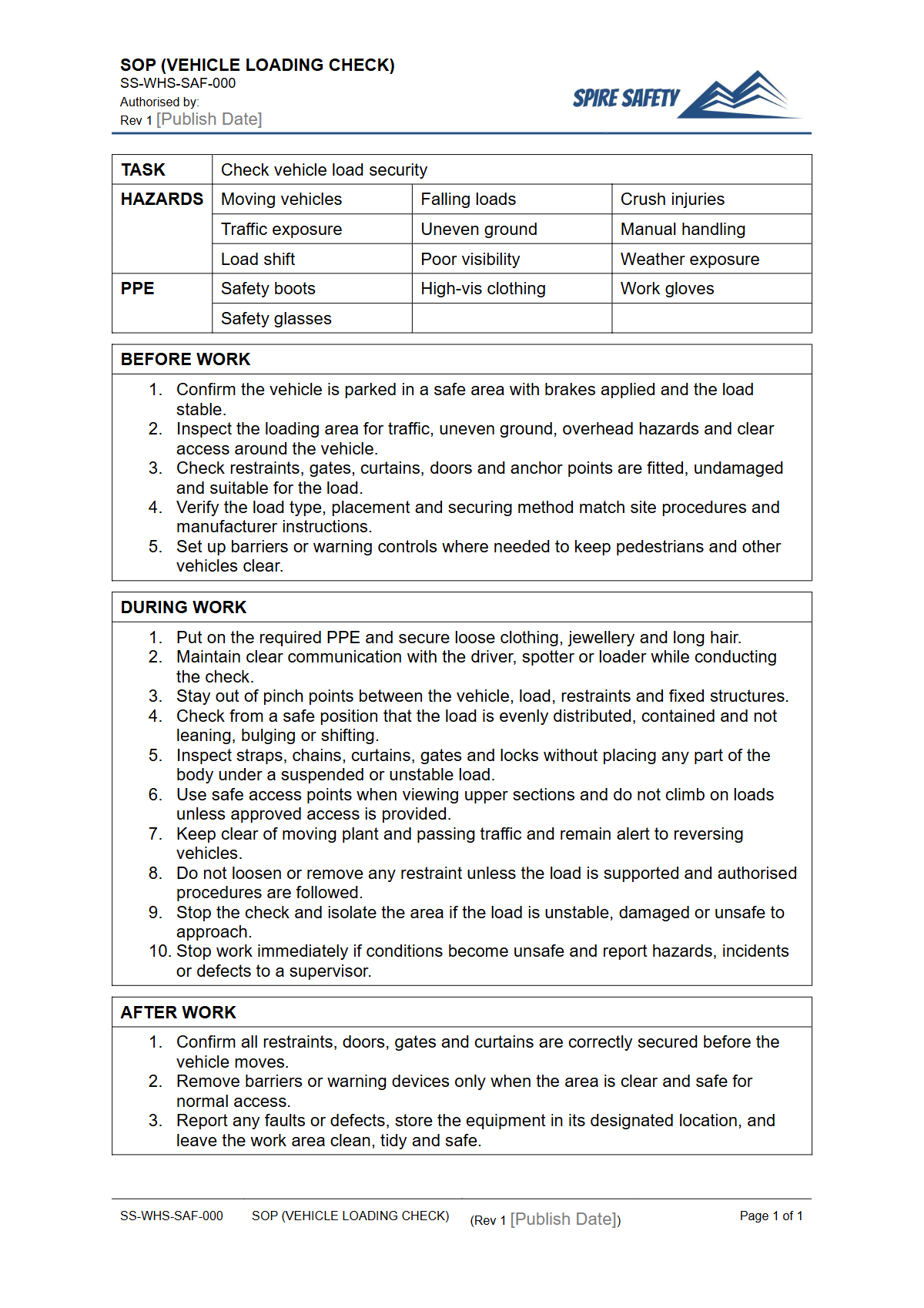
Streamline your transport safety with our free Safe Operating Procedure (Vehicle Loading Check) template. It provides a structured guide for your team.
Free Safe Operating Procedure (Vehicle Loading Check) Template
DOCX • 126 KB + PDF
Updated Oct 2026
No signup required
Purpose of the Free Safe Operating Procedure (Vehicle Loading Check) Template
Loading and unloading vehicles are high-risk activities present in many Australian industries, from transport and logistics to construction and agriculture. This Free Safe Operating Procedure (Vehicle Loading Check) Template provides a structured starting point for documenting the steps required to perform these tasks safely.
A documented procedure helps standardise your approach to managing critical risks such as vehicle roll-aways, shifting loads, falls from height, and collisions between pedestrians and mobile plant.
By establishing a clear, step-by-step guide, you can significantly reduce the likelihood of incidents, injuries, and damage to goods or equipment. This SOP template is designed to be integrated into your broader safety framework, forming a key component of your overall WHS management system. It provides a clear reference for workers and a tangible record of the control measures your organisation has implemented to manage transport-related hazards.
Video walkthrough
How to use the Free Safe Operating Procedure (Vehicle Loading Check) Template
This template is available in both DOCX and PDF formats for your convenience. The DOCX version is fully editable, allowing you to tailor the content to the specific requirements of your workplace.
To use it effectively, download the file and systematically work through each section, adding or removing steps to align with your unique operational context. This includes detailing the specific types of vehicles, loads, and equipment used on your site.
It is crucial to remember that this is a template, not a finished document. We have provided a solid framework aligned with Australian WHS principles, but you must adapt it to reflect the specific machinery and environment at your worksite.
For example, your procedure would need to detail controls for the specific equipment used, such as the operational checks found in our FREE Telehandler SOP Template. Involve your workers, supervisors, and any relevant specialists in the customisation process to ensure the final document is practical, accurate, and effective.
When to use it
A Safe Operating Procedure for vehicle loading should be used every time a loading or unloading task is performed. It serves as both a pre-task checklist and a procedural guide.
Workers should refer to it before commencing work to ensure all safety preconditions are met, such as chocking wheels, checking the loading area is clear, and confirming the vehicle's load capacity. The procedure should also be followed throughout the loading process to ensure correct load placement, weight distribution, and securing methods are used.
The SOP is also an essential tool for worker training, inductions, and refresher courses. It provides a consistent basis for instruction on safe work practices.
When working with specific machinery for loading, such as earthmoving equipment, the process should align with the safe operation of that plant, similar to the steps outlined in a FREE Scraper SOP Template. Regular use reinforces safe behaviours and helps maintain a high standard of safety awareness across all relevant personnel.
Who should use it
This Safe Operating Procedure should be used by all personnel involved in or supervising vehicle loading and unloading activities. This includes truck drivers, forklift operators, crane operators, warehouse staff, and yard personnel.
Each person has a role to play in the chain of responsibility, and the SOP helps clarify their specific duties for ensuring the task is completed safely. It acts as a primary reference document to guide their actions and decisions.
Supervisors and managers should use the SOP to induct and train workers, monitor compliance, and conduct workplace inspections. It provides a clear benchmark against which to measure performance and identify any procedural gaps or non-conformances.
The effectiveness of this and other procedures can be verified through routine WHS compliance auditing, ensuring the controls are consistently applied and remain effective over time.
Review and Improvement
Safe Operating Procedures are living documents and should be reviewed regularly to ensure they remain current and effective. A review should be scheduled at least annually, or more frequently if triggered by an incident, a near miss, or a significant change in the workplace. Changes that might prompt a review include the introduction of new vehicles, different types of loads, or new loading equipment like that detailed in our FREE Conveyer System SOP.
Continuous improvement is a core tenet of modern WHS management. Feedback from workers who use the SOP daily is invaluable for identifying practical improvements.
By fostering an open culture where feedback is encouraged, you can refine your procedures to be even more effective at controlling risks. For more templates and safety resources to support your processes, browse our complete free WHS resources library.
Common mistakes
Common mistakes to avoid
- Failing to check the vehicle's Gross Vehicle Mass (GVM) and axle load limits.
- Using damaged, underrated, or inappropriate load restraint equipment.
- Poor communication and a lack of coordination between the driver and the plant operator during loading.
- Neglecting to properly chock wheels or stabilise the vehicle before loading or unloading begins.
Legal references
Legal considerations
The following legal requirements may be relevant to this type of work.
- Work Health and Safety Act (Harmonised) — Provides the primary duties for protecting workers and other people from work health and safety risks.
- Work Health and Safety Regulations (Harmonised) — Sets out requirements supporting the management of workplace hazards and risks.
The following codes may be relevant to this type of work.
- Managing WHS Risks Code of Practice — Provides practical guidance on identifying hazards, assessing risks and applying effective controls.
- Work Health and Safety Consultation, Cooperation and Coordination Code of Practice — Provides practical guidance on consulting workers and coordinating with other duty holders.
- Managing the Work Environment and Facilities Code of Practice — Provides practical guidance on safe work environments, workplace facilities and related controls.
Did you know
Chain of Responsibility
In Australia, the Heavy Vehicle National Law's 'Chain of Responsibility' means that multiple parties, not just the driver, can be held legally liable for safety breaches such as insecure or overloaded vehicles.
Centre of Gravity
When loading a vehicle, heavy items should be placed as low as possible and centred over the axles to maintain a low centre of gravity, which is crucial for preventing vehicle instability and rollovers.
FAQ
Frequently asked questions
01What should be included in a vehicle loading checklist SOP?
02Who is responsible for ensuring loads are secure on a vehicle in Australia?
03How often should a Safe Operating Procedure for vehicle loading be reviewed?
04Is a Safe Operating Procedure a legal requirement for vehicle loading in Australia?
Share this resource
Free Safe Operating Procedure (Vehicle Loading Check) Template
Browse Categories
How To Use It
- 1Download and open in Word or PDF.
- 2Replace the placeholders with your business details.
- 3Get it reviewed by a WHS specialist before rollout.
Need it customised?
Our WHS consultants can adapt this template to your site, run a gap analysis, or audit what you already have in place.
Book a Free Consultation WHS consulting servicesor call 1300 156 382
Related templates
- Free Safe Operating Procedure (Vehicle Loading Ramp) Template
- Free Safe Operating Procedure (Vehicle Recovery Winch) Template
- Free Safe Operating Procedure (Vehicle Service Handover) Template
- Free Safe Operating Procedure (Vehicle Unloading Check) Template
- Free Safe Operating Procedure (Vehicle Washing) Template
- Free Safe Operating Procedure (Veneer Lathe) Template