
Free Safe Operating Procedure (Vegetation Removal) Template
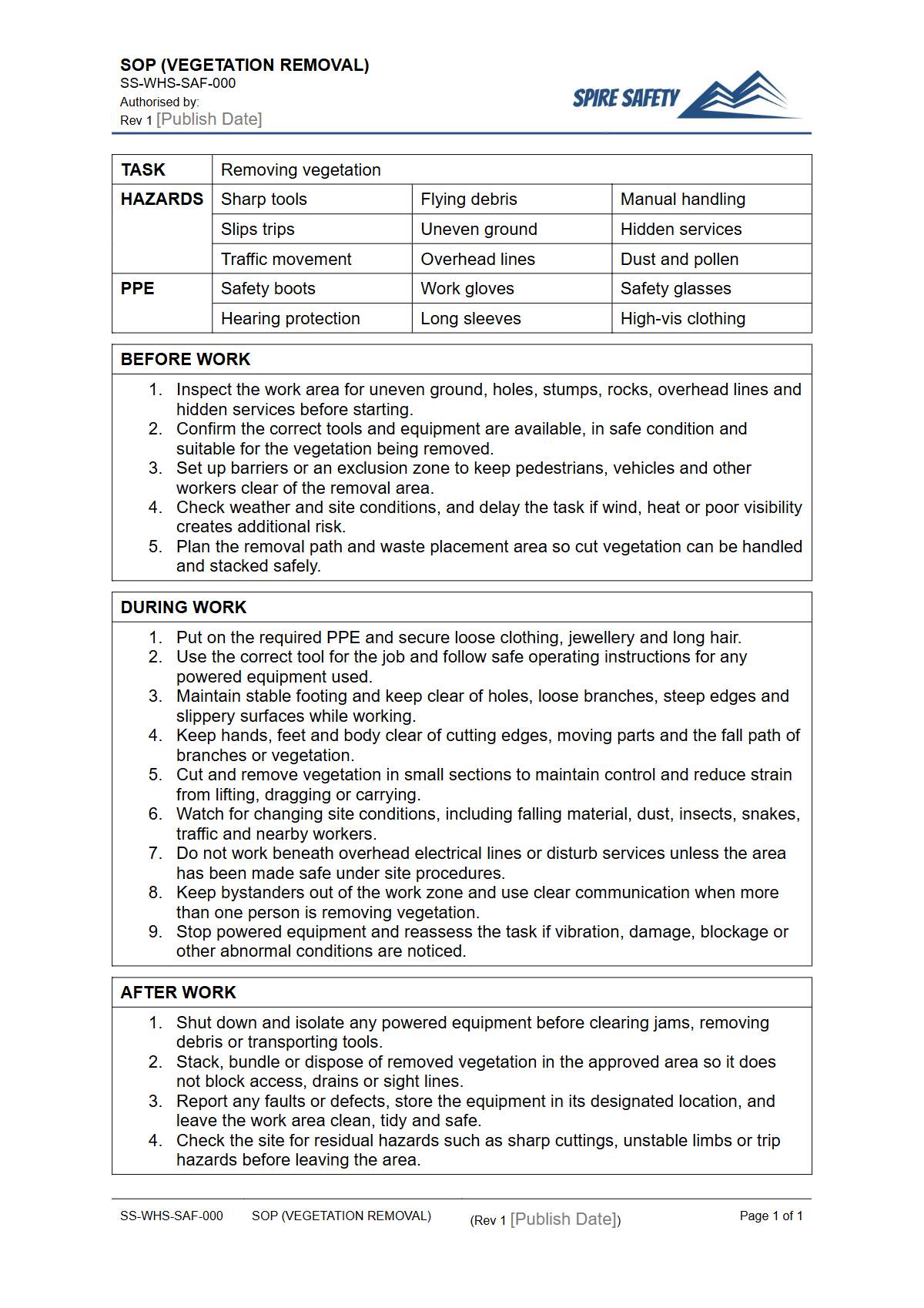
Download our free Safe Operating Procedure (Vegetation Removal) Template to formalise your safety processes. Start building a safer workplace today.
Free Safe Operating Procedure (Vegetation Removal) Template
DOCX • 126 KB + PDF
Updated Oct 2026
No signup required
Purpose of the Free Safe Operating Procedure (Vegetation Removal) Template
Managing the risks associated with clearing trees, shrubs, and undergrowth is a critical part of maintaining a safe worksite. Our Free Safe Operating Procedure (Vegetation Removal) Template provides a structured framework to document your processes, identify hazards, and implement control measures.
This downloadable resource helps you establish a clear, repeatable system of work for your team, covering everything from pre-start checks to task completion and cleanup.
The primary purpose of this Safe Operating Procedure is to provide a clear and consistent set of instructions for performing vegetation removal tasks safely. These activities expose workers to numerous serious hazards, including cuts from chainsaws and other powered tools, impact from falling branches, musculoskeletal injuries from manual handling, and risks from uneven or unstable ground.
This document formalises the steps required to control these risks. It serves as a vital training tool for new workers and a reference for experienced operators, ensuring everyone understands the recognised safe method for the job.
Documenting your procedures also helps in demonstrating how your organisation meets its duty of care.
Vegetation removal tasks often require a variety of handheld and mobile plant. This SOP provides a general framework, but specific high-risk tools benefit from their own detailed procedure.
For example, if your team frequently uses saws for cutting fallen timber or trimming branches, you should supplement this document with our FREE Circular Saw SOP (Safe Operating Procedure) Template to cover the unique hazards of that equipment.
Video walkthrough
How to use the Free Safe Operating Procedure (Vegetation Removal) Template
To effectively use this free Safe Operating Procedure for vegetation removal, download the DOCX or PDF file and begin integrating your site-specific information. This includes listing the exact makes and models of equipment used (e.g., chainsaws, wood chippers, brush cutters), detailing the types of Personal Protective Equipment (PPE) required, and outlining the emergency procedures relevant to your location.
When dealing with ground disturbance as part of larger clearing projects, having documented processes for all equipment is essential; our FREE Trencher SOP (Safe Operating Procedure) Template can assist with related activities.
It's crucial to remember that this template is a starting point. We have developed it to be adapted; you must customise it to reflect the specific equipment, environment, and risks present in your workplace. A well-customised SOP becomes a key component of your broader safety framework, forming part of your overall WHS management systems.
When to use this Safe Operating Procedure
An SOP for vegetation removal should be used consistently as part of your daily operations. It is not a document to be filed away and forgotten.
Use it during worker induction and training to establish baseline safety standards from day one. It should also be a key reference document during pre-start meetings or toolbox talks before any vegetation removal job commences, allowing the team to review hazards and controls specific to the day's task.
Furthermore, the SOP serves as a benchmark during safety observations and can be a critical piece of evidence during an incident investigation to understand if procedures were followed. Regularly reviewing the SOP against actual work practices is a core part of proactive safety management and is often a key focus during a WHS compliance auditing process.
Who should use this Safe Operating Procedure
This SOP is intended for use by multiple people within an organisation. Workers and operators performing vegetation removal are the primary users, as it directs their actions to ensure their own safety and the safety of those around them.
Supervisors and team leaders must use the SOP to supervise work, deliver training, and enforce safety standards on site. Safety officers and managers should use the SOP as part of the risk management process, ensuring it is comprehensive, current, and effectively implemented across all relevant projects.
For particularly complex sites or operations, it may be necessary to seek specialist advice to ensure all risks are adequately addressed, which is where expert WHS consulting can provide valuable support.
By implementing and consistently following a robust Safe Operating Procedure, your organisation takes a significant step towards preventing injuries and fostering a strong safety culture. This template provides a solid foundation for you to build upon. For more tools to support your safety management system, explore our complete free WHS resources library.
Common mistakes
Common mistakes to avoid
- Failing to check for overhead powerlines and underground services before starting work.
- Using poorly maintained equipment, especially chainsaws with dull chains or faulty safety features.
- Neglecting to establish clear exclusion zones, putting other workers and the public at risk.
- Underestimating the risks of manual handling when moving logs, branches, or heavy equipment.
Legal references
Legal considerations
The following legal requirements may be relevant to this type of work.
- Work Health and Safety Act (Harmonised) — Provides the primary duties for protecting workers and other people from work health and safety risks.
- Work Health and Safety Regulations (Harmonised) — Sets out requirements supporting the management of workplace hazards and risks.
The following codes may be relevant to this type of work.
- Managing WHS Risks Code of Practice — Provides practical guidance on identifying hazards, assessing risks and applying effective controls.
- Work Health and Safety Consultation, Cooperation and Coordination Code of Practice — Provides practical guidance on consulting workers and coordinating with other duty holders.
- Managing the Work Environment and Facilities Code of Practice — Provides practical guidance on safe work environments, workplace facilities and related controls.
Did you know
Hidden Hazards
Up to 80% of chainsaw injuries affect the hands and legs. Using appropriate cut-resistant chaps and gloves is a critical, non-negotiable control measure for operators.
Australian Standard
AS 2727-1997 Chainsaws - Guide to safe working practices provides detailed guidance on the safe use and maintenance of chainsaws, a key tool in many vegetation removal tasks.
FAQ
Frequently asked questions
01What should be included in an SOP for vegetation removal?
02How often should a Safe Operating Procedure be reviewed?
03Is a Safe Operating Procedure a legal requirement in Australia?
04Can this template be used for commercial tree felling?
Share this resource
Free Safe Operating Procedure (Vegetation Removal) Template
Browse Categories
How To Use It
- 1Download and open in Word or PDF.
- 2Replace the placeholders with your business details.
- 3Get it reviewed by a WHS specialist before rollout.
Need it customised?
Our WHS consultants can adapt this template to your site, run a gap analysis, or audit what you already have in place.
Book a Free Consultation WHS consulting servicesor call 1300 156 382
Related templates
- Free Safe Operating Procedure (Vehicle Access Control) Template
- Free Safe Operating Procedure (Vehicle Battery Change) Template
- Free Safe Operating Procedure (Vehicle Detailing) Template
- Free Safe Operating Procedure (Vehicle Interior Cleaning) Template
- Free Safe Operating Procedure (Vehicle Jacking) Template
- Free Safe Operating Procedure (Vehicle Loading Check) Template