
Free Safe Operating Procedure (Vehicle Battery Change) Template
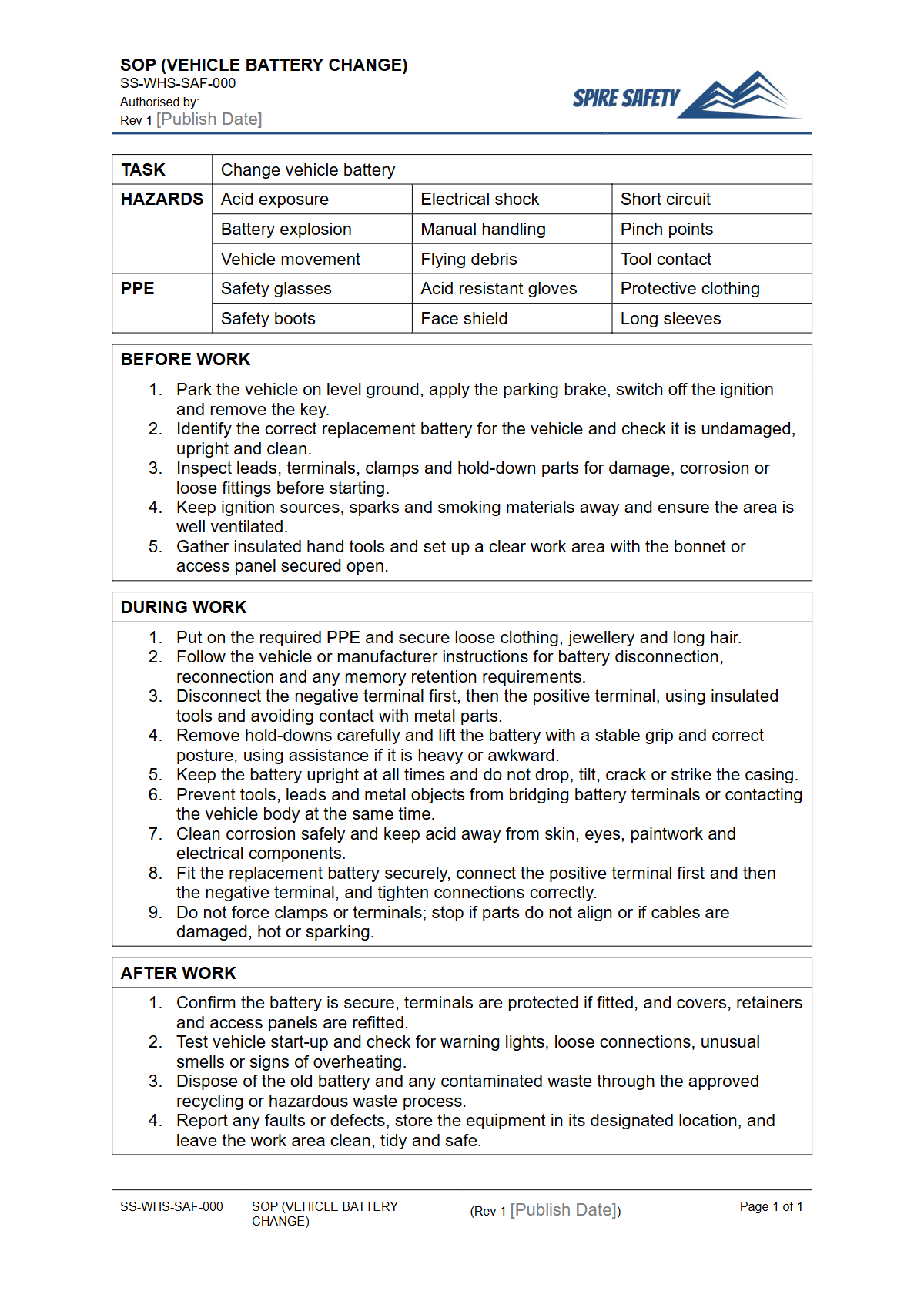
Download our Free Safe Operating Procedure (Vehicle Battery Change) Template to formalise your safety processes. Customise this structured DOCX or PDF today.
Free Safe Operating Procedure (Vehicle Battery Change) Template
DOCX • 126 KB + PDF
Updated Oct 2026
No signup required
Purpose of the Free Safe Operating Procedure (Vehicle Battery Change) Template
Changing a vehicle battery seems like a simple task, but it involves significant hazards, including electrical risks, exposure to corrosive chemicals, and manual handling strains. This Free Safe Operating Procedure (Vehicle Battery Change) Template provides a structured framework for documenting a safe and repeatable process for this common maintenance activity.
Implementing a formal SOP helps your organisation meet its duties under WHS legislation by controlling risks associated with battery handling. It establishes a clear, step-by-step guide that minimises the chance of short circuits, acid spills, or musculoskeletal injuries, ensuring workers perform the task safely and consistently every time.
This document serves as a critical training tool for new employees and a vital refresher for experienced mechanics. By outlining required personal protective equipment (PPE), pre-work checks, the correct disconnection and reconnection sequence, and emergency procedures, it forms a key part of your overall safety management system.
It's designed to be a practical, on-the-ground resource that promotes a proactive safety culture in any workshop or maintenance environment. For broader safety frameworks, consider how this procedure fits within your overall WHS management systems.
Video walkthrough
How to use the Free Safe Operating Procedure (Vehicle Battery Change) Template
This Safe Operating Procedure for vehicle battery changes is available for immediate download in both DOCX and PDF formats. The DOCX version is fully editable, allowing you to tailor the content to the specific vehicles, battery types, and equipment used in your workplace.
It's crucial to adapt this template to reflect your unique operational context and risk profile.
Customisation is Essential
Before use, you must review and customise this template. We recommend a Person Conducting a Business or Undertaking (PCBU) or a manager consults with workers who regularly perform this task.
Add site-specific details, such as the location of spill kits, specific tools required, and internal emergency contacts. This collaborative process ensures the final SOP is practical, relevant, and effectively controls the actual risks present in your workplace.
Remember, a generic document offers limited protection; a site-specific one is a powerful risk control measure. The goal is to create a document that your team genuinely uses.
When to use it
A formalised SOP for changing vehicle batteries should be used in several key situations. It is essential during the induction and training of new mechanics or apprentices to ensure they learn the correct, safe method from the outset.
It also serves as a mandatory pre-task reference for any worker who performs the job infrequently, reinforcing the correct sequence and safety precautions. This procedure should be integrated into your scheduled maintenance programs and readily accessible in the workshop.
For complex jobs involving other workshop equipment, you may need additional procedures, such as our FREE Oxy Acetylene SOP Template for related metalwork.
Who should use it
This template is designed for use by any person involved in vehicle maintenance. This includes qualified mechanics, apprentices, workshop supervisors, and fleet managers.
Supervisors can use it to verify correct procedure and conduct competency assessments. PCBUs and Health and Safety Representatives (HSRs) can also use it as a benchmark when developing and reviewing workplace safety policies.
Ensuring workers are trained and competent in the SOP is a critical step, and regular reviews of its effectiveness can be part of your safety audit process. Integrating procedures for all workshop equipment, such as our Free Air Compressor SOP Template, creates a more comprehensive safety system.
Ultimately, anyone responsible for ensuring tasks are performed safely will find this template valuable. A well-documented procedure is a cornerstone of a safe system of work, providing clarity and reducing ambiguity for everyone involved.
For organisations looking to formalise their safety documentation further, exploring our full free WHS resources library can provide templates for a wide range of tasks and equipment.
Common mistakes
Common mistakes to avoid
- Connecting or disconnecting cables in the wrong order, risking a spark and potential explosion.
- Using metal tools that bridge the gap between the positive terminal and the vehicle's frame, causing a dangerous short circuit.
- Not wearing appropriate PPE, especially safety glasses and gloves, leaving workers exposed to acid.
- Working in a poorly ventilated space where flammable hydrogen gas can accumulate.
Legal references
Legal considerations
The following legal requirements may be relevant to this type of work.
- Work Health and Safety Act (Harmonised) — Provides the primary duties for protecting workers and other people from work health and safety risks.
- Work Health and Safety Regulations (Harmonised) — Sets out requirements supporting the management of workplace hazards and risks.
The following codes may be relevant to this type of work.
- Managing WHS Risks Code of Practice — Provides practical guidance on identifying hazards, assessing risks and applying effective controls.
- Work Health and Safety Consultation, Cooperation and Coordination Code of Practice — Provides practical guidance on consulting workers and coordinating with other duty holders.
- Managing the Work Environment and Facilities Code of Practice — Provides practical guidance on safe work environments, workplace facilities and related controls.
Did you know
Explosive Potential
A lead-acid battery can produce flammable hydrogen gas, especially when charging. A single spark from a tool accidentally shorting the terminals can ignite this gas, causing the battery to explode and spray acid.
A Heavy Hazard
The average car battery weighs between 15 and 25 kilograms. Lifting this weight in an awkward, bent-over position is a common cause of serious back and shoulder injuries in workshops, highlighting the importance of correct manual handling technique.
FAQ
Frequently asked questions
01What are the main hazards when changing a vehicle battery?
02What PPE is required for changing a car battery?
03How do you correctly dispose of an old car battery?
04Why is a Safe Operating Procedure better than just verbal instructions?
Share this resource
Free Safe Operating Procedure (Vehicle Battery Change) Template
Browse Categories
How To Use It
- 1Download and open in Word or PDF.
- 2Replace the placeholders with your business details.
- 3Get it reviewed by a WHS specialist before rollout.
Need it customised?
Our WHS consultants can adapt this template to your site, run a gap analysis, or audit what you already have in place.
Book a Free Consultation WHS consulting servicesor call 1300 156 382
Related templates
- Free Safe Operating Procedure (Vehicle Detailing) Template
- Free Safe Operating Procedure (Vehicle Interior Cleaning) Template
- Free Safe Operating Procedure (Vehicle Jacking) Template
- Free Safe Operating Procedure (Vehicle Loading Check) Template
- Free Safe Operating Procedure (Vehicle Loading Ramp) Template
- Free Safe Operating Procedure (Vehicle Recovery Winch) Template