
Free Safe Operating Procedure (Vegetation Hand Cutting) Template
Formalise safety protocols for manual land clearing, gardening, and landscaping tasks. Download our free Safe Operating Procedure for vegetation hand cutting.
Free Safe Operating Procedure (Vegetation Hand Cutting) Template
DOCX • 126 KB + PDF
Updated Oct 2026
No signup required
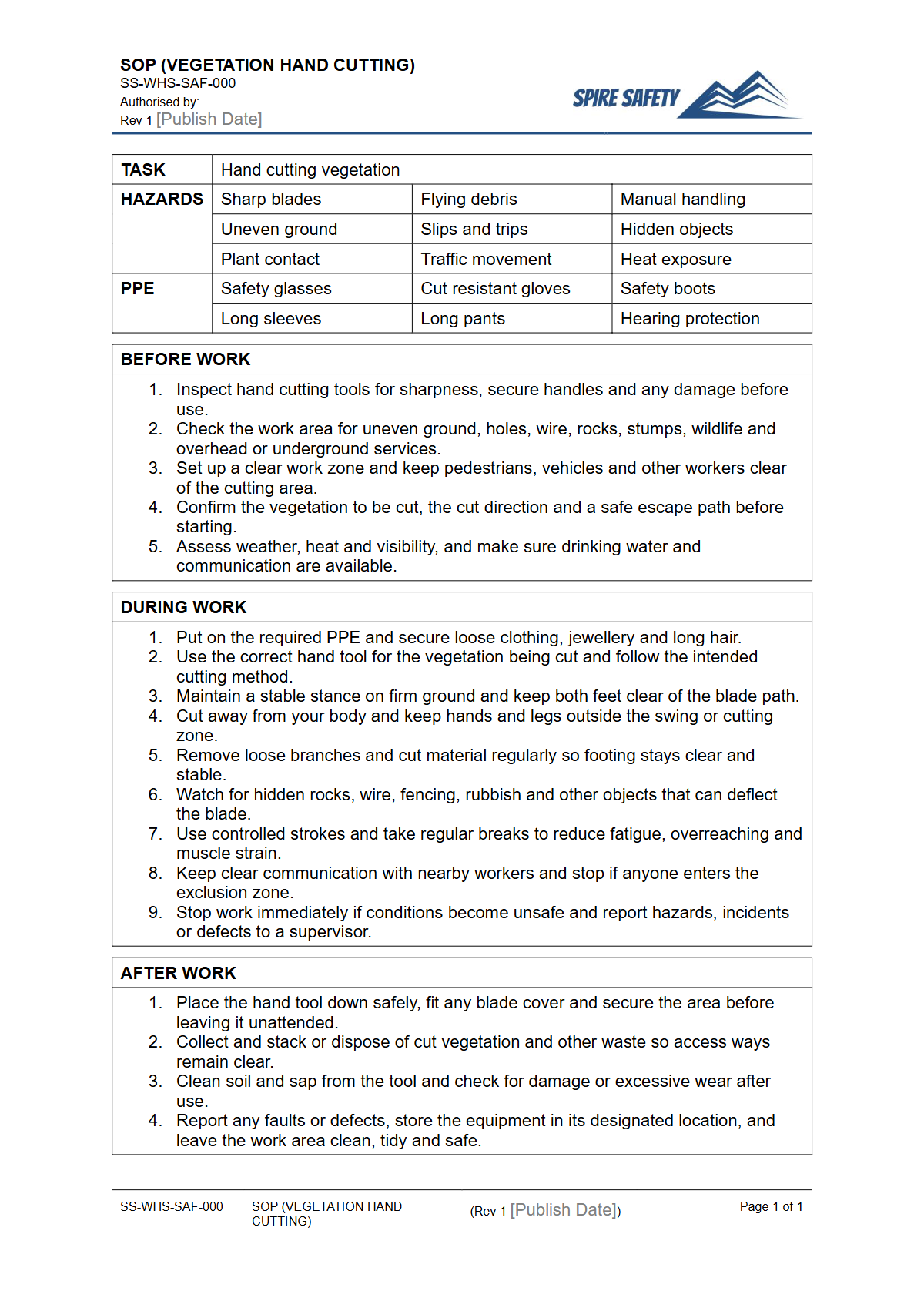
Purpose of the Free Safe Operating Procedure (Vegetation Hand Cutting) Template
Managing workplace safety during land clearing, landscaping, or grounds maintenance requires clear, documented processes. Our Free Safe Operating Procedure (Vegetation Hand Cutting) Template provides a structured starting point for organisations to formalise their safety guidelines for tasks involving non-powered and powered hand tools.
This Safe Operating Procedure helps you systematically identify hazards and implement control measures to protect your workers. It prompts consideration of risks such as cuts and lacerations from sharp tools, musculoskeletal injuries from repetitive or forceful movements, trips and falls on uneven terrain, and exposure to environmental hazards like sun, insects, and wildlife.
Using a standardised SOP ensures that every worker performs the task according to the same safe method, reducing variability and the likelihood of incidents. It forms a critical component of a compliant safety framework, demonstrating that your organisation has taken practicable steps to manage foreseeable risks associated with vegetation management. Implementing robust procedures like this is a cornerstone of effective WHS management systems.
Video walkthrough
How to use the Free Safe Operating Procedure (Vegetation Hand Cutting) Template
This document is provided in both DOCX and PDF formats for your convenience. The DOCX file is fully editable, allowing you to tailor the content to the specific tools, environments, and tasks performed by your workers.
To use the template effectively, download the file and work through each section, replacing the placeholder text with information relevant to your worksite.
Important: This is a template, not a finished document. We have provided a comprehensive framework, but you must customise it to reflect the unique hazards and control measures of your specific workplace.
This includes listing the exact makes and models of equipment used, detailing the types of terrain encountered, specifying the required Personal Protective Equipment (PPE), and outlining your site-specific emergency procedures. A generic procedure is not sufficient to meet your WHS obligations.
You should also consider developing separate SOPs for more complex or higher-risk equipment. For example, while this template covers general hand tools, a powerful tool like a circular saw requires more detailed instructions, which you can base on our FREE Circular Saw SOP (Safe Operating Procedure) Template.
When to use a Safe Operating Procedure
A Safe Operating Procedure for vegetation hand cutting should be developed and implemented before any worker undertakes the task. It is a proactive tool used to prevent incidents, not a reactive document created after one occurs.
The SOP should be a central part of worker induction and training, ensuring everyone understands the approved safe method from day one. It serves as a practical, on-the-job reference for workers and a training guide for supervisors.
It should also be integrated into your risk management process. The SOP is developed from a risk assessment, and in turn, it becomes a key control measure for the identified hazards.
Regular reviews are essential. The procedure must be updated following any incident, when new equipment is introduced, if the work environment changes, or as part of a scheduled review process.
These reviews are often a key focus during WHS compliance auditing to verify that safety documentation is current and effective.
Who should use it
This template is designed for use by Persons Conducting a Business or Undertaking (PCBUs), managers, and supervisors in industries such as landscaping, horticulture, agriculture, local government, and facilities management. It provides a framework for management to fulfil their duty of care by establishing a safe system of work.
Key Roles and Responsibilities
- Managers/Supervisors: Responsible for ensuring the SOP is customised correctly, implemented effectively, and that all relevant workers are trained in its use. They must also monitor compliance and initiate reviews when necessary.
- Workers: Responsible for following the procedure as trained. They have a duty to report any hazards they identify and can provide valuable feedback for improving the SOP based on their hands-on experience.
- WHS Professionals: Can use this template as a foundation for developing comprehensive safety documentation as part of the broader organisational safety system.
For organisations that lack the internal expertise to adapt and implement safety procedures effectively, engaging external support can provide clarity and assurance. Expert guidance ensures your documentation is not only well-written but also practical and integrated into your daily operations, which is a core focus of our WHS consulting services. You can find more templates and guides like this one in our complete free WHS resources library.
Common mistakes
Common mistakes to avoid
- Using the template 'as is' without customising it with site-specific hazards and controls.
- Failing to adequately train workers on the final procedure and confirm their understanding.
- Neglecting to specify the correct type and standard of Personal Protective Equipment (PPE) for each task.
- Omitting emergency procedures for common incidents like cuts, sprains, insect stings, or snake bites.
Legal references
Legal considerations
The following legal requirements may be relevant to this type of work.
- Work Health and Safety Act (Harmonised) — Provides the primary duties for protecting workers and other people from work health and safety risks.
- Work Health and Safety Regulations (Harmonised) — Sets out requirements supporting the management of workplace hazards and risks.
The following codes may be relevant to this type of work.
- Managing WHS Risks Code of Practice — Provides practical guidance on identifying hazards, assessing risks and applying effective controls.
- Work Health and Safety Consultation, Cooperation and Coordination Code of Practice — Provides practical guidance on consulting workers and coordinating with other duty holders.
- Managing the Work Environment and Facilities Code of Practice — Provides practical guidance on safe work environments, workplace facilities and related controls.
Did you know
Vibration Exposure
Prolonged use of powered hand tools like brush cutters can lead to Hand-Arm Vibration Syndrome (HAVS). Rotating tasks between workers and selecting low-vibration tools are key control measures.
Hidden Hazards
Musculoskeletal disorders from hazardous manual tasks are the most common injuries in landscaping and grounds maintenance. Sprains and strains from lifting, carrying, and repetitive motions are more frequent than cuts from tools.
FAQ
Frequently asked questions
01What should be included in a Safe Operating Procedure for vegetation hand cutting?
02Is this SOP template suitable for using chainsaws?
03How often should an SOP for vegetation hand cutting be reviewed?
04Do I still need a risk assessment if I use this SOP?
Share this resource
Free Safe Operating Procedure (Vegetation Hand Cutting) Template
Browse Categories
How To Use It
- 1Download and open in Word or PDF.
- 2Replace the placeholders with your business details.
- 3Get it reviewed by a WHS specialist before rollout.
Need it customised?
Our WHS consultants can adapt this template to your site, run a gap analysis, or audit what you already have in place.
Book a Free Consultation WHS consulting servicesor call 1300 156 382
Related templates
- Free Safe Operating Procedure (Vegetation Removal) Template
- Free Safe Operating Procedure (Vehicle Access Control) Template
- Free Safe Operating Procedure (Vehicle Battery Change) Template
- Free Safe Operating Procedure (Vehicle Detailing) Template
- Free Safe Operating Procedure (Vehicle Interior Cleaning) Template
- Free Safe Operating Procedure (Vehicle Jacking) Template