
Free Safe Operating Procedure (Vegetable Peeler) Template
Create clear, consistent safety instructions for using a vegetable peeler in your commercial kitchen. Download our free Safe Operating Procedure template now.
Free Safe Operating Procedure (Vegetable Peeler) Template
DOCX • 126 KB + PDF
Updated Oct 2026
No signup required
Purpose of the Free Safe Operating Procedure (Vegetable Peeler) Template
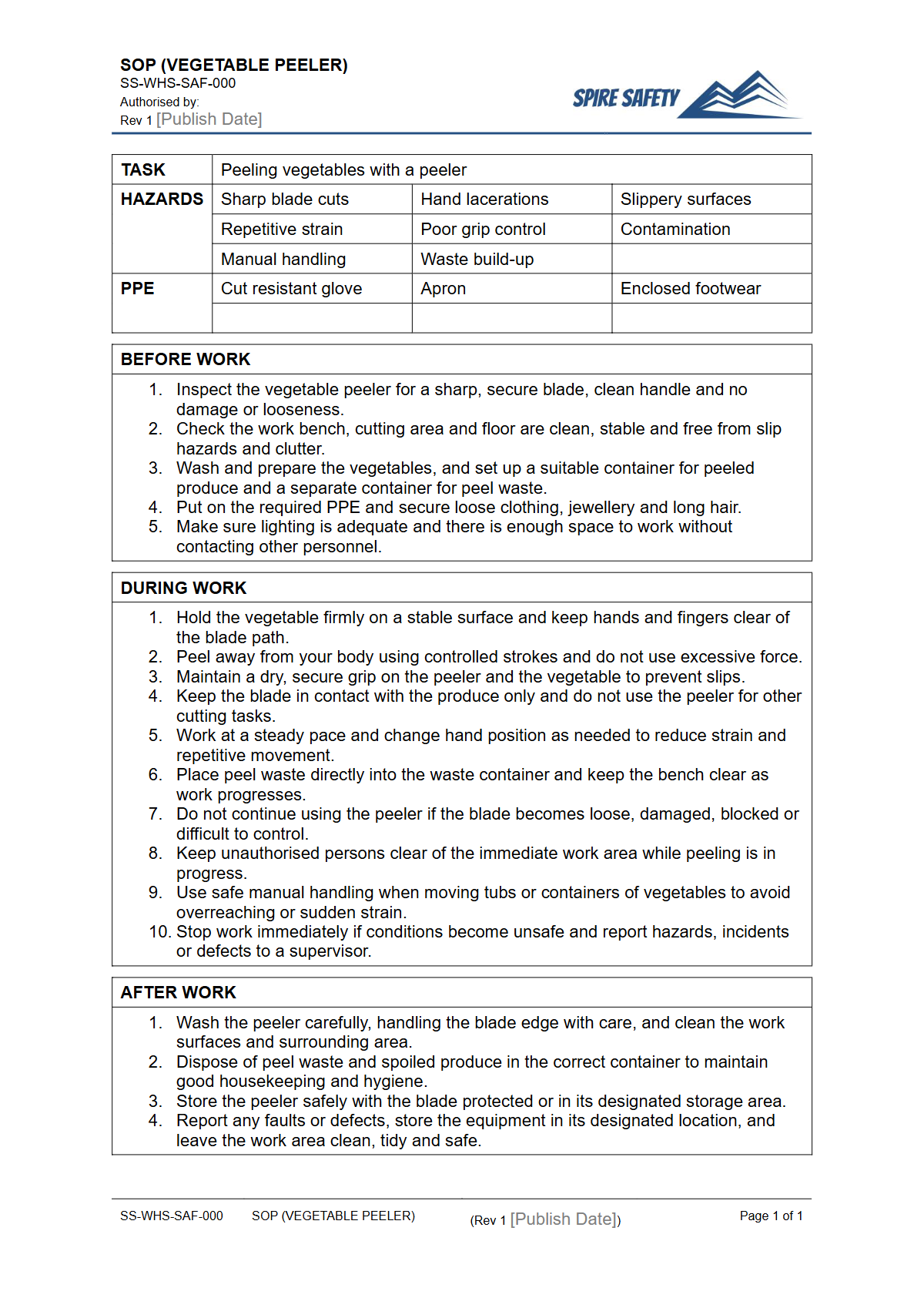
Even simple tools require clear safety guidelines, especially in a busy commercial kitchen. This free Safe Operating Procedure (Vegetable Peeler) Template provides a structured framework for documenting the safe use of manual and electric vegetable peelers.
Its purpose is to minimise the risk of common injuries, such as cuts and lacerations, while promoting a consistent and hygienic work method across all staff. By formalising this process, you create an essential training tool for new employees and a reliable reference for experienced kitchen hands.
A documented procedure ensures everyone understands the expected safety standards, from pre-operational checks to cleaning and storage. While a peeler may seem less hazardous than heavy machinery, establishing strong safety habits with basic tools builds a positive safety culture. This foundational approach is just as important for a simple peeler as it is for a high-risk tool covered by our free Circular Saw SOP.
Video walkthrough
How to use the Free Safe Operating Procedure (Vegetable Peeler) Template
This template is provided in both DOCX and PDF formats for your convenience. The DOCX file is fully editable, allowing you to adapt the content to the specific equipment and environment of your workplace.
To use it effectively, download the document and begin populating the sections with your site-specific information. This includes identifying the exact models of peelers used, outlining unique environmental hazards in your kitchen, and listing the appropriate personal protective equipment (PPE), such as cut-resistant gloves if deemed necessary by your risk assessment.
Remember, a single SOP is one component of a larger safety framework. To ensure procedures like this are effectively implemented, managed, and reviewed, they should be integrated into your organisation's comprehensive WHS management systems. This ensures safety documentation remains current, accessible, and aligned with your overall health and safety objectives.
Customisation is Key
To be effective, this document must be customised for your specific workplace, equipment, and processes. We have provided a structured starting point based on Australian WHS principles, but you are responsible for ensuring the final document accurately reflects your operational risks and control measures.
Add your company name and logo, specify review dates, and list the names or roles of workers who must follow the procedure.
When to use a Vegetable Peeler SOP
A Safe Operating Procedure for a vegetable peeler should be a readily accessible document in any food preparation area. It is not a document to be filed and forgotten. It should be actively used in several key situations:
- New Staff Onboarding: Use the SOP as a checklist to ensure all new kitchen hands, apprentices, and casual workers are trained on the correct, safe method from their first day.
- Refresher Training: Periodically review the SOP with all relevant staff to reinforce safe work habits and communicate any changes to the procedure.
- Following an Incident: If a cut or other injury occurs, the SOP should be reviewed as part of the incident investigation to determine if the procedure was adequate and if it was being followed.
- During Safety Audits: The SOP serves as evidence of a formalised process for managing a common workplace hazard. The effectiveness of this and other procedures can be verified through regular WHS compliance auditing.
Who should use it
This procedure is primarily intended for workers who perform food preparation tasks. This includes a range of roles within the hospitality and food service industries:
- Kitchen Hands
- Chefs and Cooks
- Apprentices and Trainees
- Catering Staff
- Food Production Workers
Additionally, supervisors, managers, and WHS personnel should use the document to guide their training, supervision, and safety management responsibilities. It provides a clear benchmark for correct work behaviour, making it easier to monitor performance and provide corrective instruction when necessary.
Integrating SOPs into your Kitchen Safety Program
A safe kitchen is one where procedures are clear, consistent, and understood by everyone. This vegetable peeler SOP can be used alongside other equipment-specific procedures to build a complete safety library for your team.
For example, it complements procedures for more complex equipment, such as a Safe Operating Procedure for a Deep Fryer, creating a holistic approach to kitchen safety that covers tasks of all risk levels. In larger food processing facilities, this same methodology applies, scaling up to include procedures for equipment like a Conveyer System SOP. The principle remains the same: document the safe way, train your people, and supervise the process.
By standardising procedures for all types of equipment, you reduce confusion and create a predictable, safe working environment. You can find more templates to support your organisation’s safety management in our free WHS resources library.
Common mistakes
Common mistakes to avoid
- Using a dull, damaged, or dirty peeler, which requires more force and increases the risk of slipping.
- Failing to train new or temporary staff, assuming the task is 'common sense'.
- Not specifying the required cleaning and sanitising steps, leading to hygiene risks.
- Storing the completed SOP in an office instead of making it easily accessible to workers in the food preparation area.
Legal references
Legal considerations
The following legal requirements may be relevant to this type of work.
- Work Health and Safety Act (Harmonised) — Provides the primary duties for protecting workers and other people from work health and safety risks.
- Work Health and Safety Regulations (Harmonised) — Sets out requirements supporting the management of workplace hazards and risks.
The following codes may be relevant to this type of work.
- Managing WHS Risks Code of Practice — Provides practical guidance on identifying hazards, assessing risks and applying effective controls.
- Work Health and Safety Consultation, Cooperation and Coordination Code of Practice — Provides practical guidance on consulting workers and coordinating with other duty holders.
- Managing the Work Environment and Facilities Code of Practice — Provides practical guidance on safe work environments, workplace facilities and related controls.
Did you know
A Common Injury
According to Safe Work Australia, cuts and lacerations are one of the most common types of injuries in the hospitality industry, often resulting from knives and other sharp kitchen tools like peelers.
Swiss Invention
The iconic Y-shaped vegetable peeler was invented in Switzerland in 1947 by Alfred Neweczerpal. Its ergonomic design and efficiency made it a staple in kitchens worldwide.
FAQ
Frequently asked questions
01What is a Safe Operating Procedure (SOP) for a vegetable peeler?
02Why is an SOP necessary for a simple tool like a vegetable peeler?
03How do I train staff on a new Vegetable Peeler SOP?
04Does this template cover both manual and electric vegetable peelers?
Share this resource
Free Safe Operating Procedure (Vegetable Peeler) Template
Browse Categories
How To Use It
- 1Download and open in Word or PDF.
- 2Replace the placeholders with your business details.
- 3Get it reviewed by a WHS specialist before rollout.
Need it customised?
Our WHS consultants can adapt this template to your site, run a gap analysis, or audit what you already have in place.
Book a Free Consultation WHS consulting servicesor call 1300 156 382
Related templates
- Free Safe Operating Procedure (Vegetable Slicer) Template
- Free Safe Operating Procedure (Vegetation Around Signs) Template
- Free Safe Operating Procedure (Vegetation Hand Cutting) Template
- Free Safe Operating Procedure (Vegetation Removal) Template
- Free Safe Operating Procedure (Vehicle Access Control) Template
- Free Safe Operating Procedure (Vehicle Battery Change) Template