
Free Safe Operating Procedure (Valve Actuator Test) Template
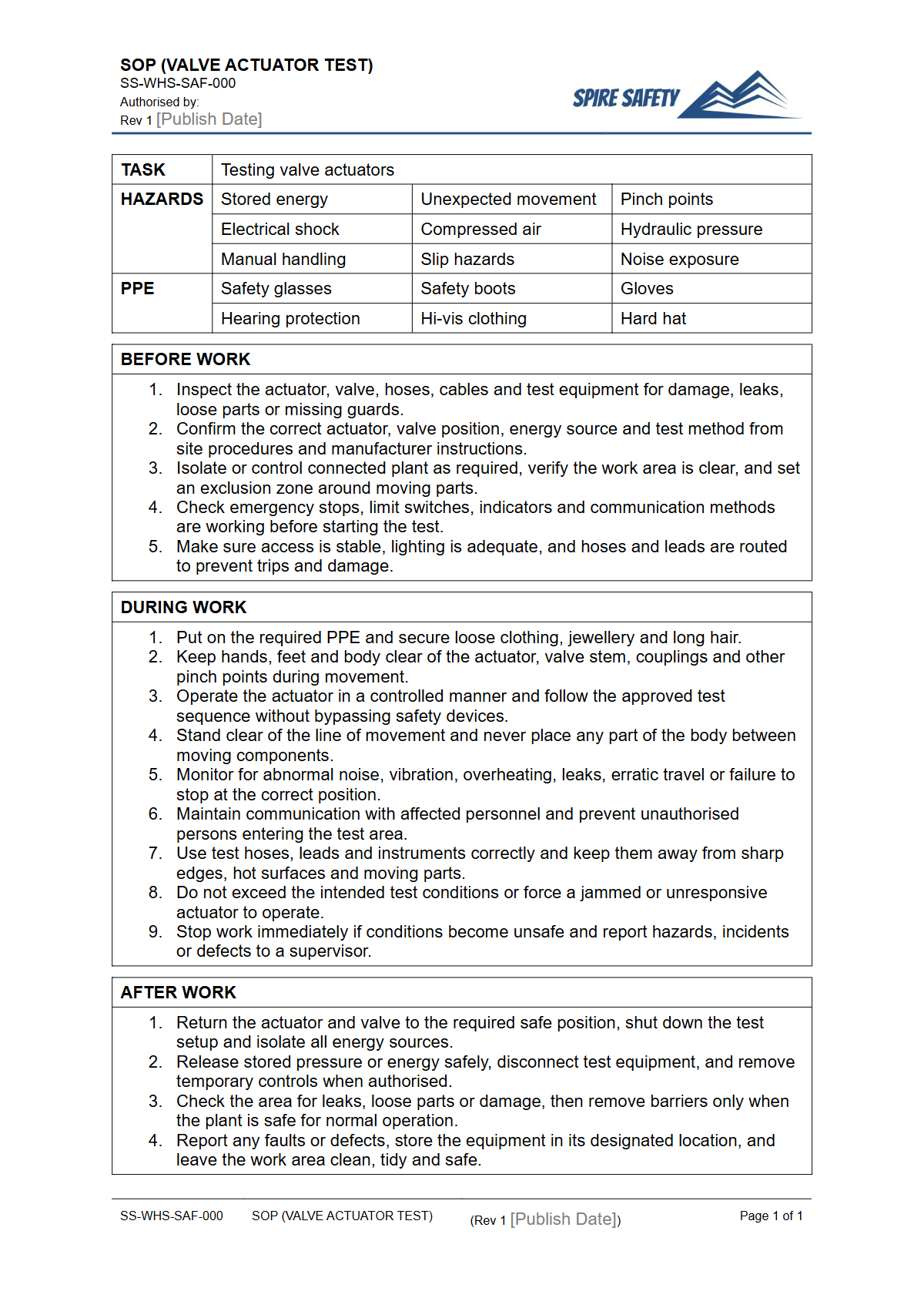
Download our free Safe Operating Procedure (Valve Actuator Test) template. This resource provides a structured framework for documenting safety steps.
Free Safe Operating Procedure (Valve Actuator Test) Template
DOCX • 126 KB + PDF
Updated Oct 2026
No signup required
Purpose of the Free Safe Operating Procedure (Valve Actuator Test) Template
This free Safe Operating Procedure (Valve Actuator Test) template provides a structured starting point for organisations to document the required safety measures for testing valve actuators. Properly testing these critical components is essential for ensuring plant integrity and preventing uncontrolled releases of energy or substances.
Using a standardised SOP helps to manage risks associated with stored energy (pneumatic, hydraulic, or electrical), unexpected equipment movement, and potential exposure to hazardous materials.
A well-developed SOP formalises a safe system of work, which is a key requirement under Australian WHS laws. It assists in training workers, provides a clear benchmark for performance, and demonstrates a commitment to proactive safety management.
By outlining step-by-step instructions, required personal protective equipment (PPE), and emergency procedures, this template helps organisations systematically address hazards before they lead to an incident. This is similar in principle to the procedural controls outlined in our Free Air Compressor SOP (Safe Operating Procedure) Template, which also deals with pressurised systems.
Video walkthrough
How to use the Free Safe Operating Procedure (Valve Actuator Test) Template
To effectively implement this Safe Operating Procedure (Valve Actuator Test) template, follow these steps:
- Download: Select your preferred format, either DOCX for easy editing or PDF for straightforward printing.
- Customise: This is the most critical step. The downloaded document is a general template and must be adapted to your specific workplace. Review every section and modify it to reflect the exact make and model of your valve actuators, the types of energy used, site-specific hazards, and your organisation's existing safety protocols.
- Consult: Engage the workers who will actually perform the tests. Their practical knowledge is invaluable for creating a procedure that is both safe and workable. Consultation is a mandatory part of the risk management process.
- Approve: Once customised, the SOP should be reviewed and approved by a competent person, such as a manager or safety officer, before being officially issued.
- Train: Use the finalised SOP as a training tool for all relevant personnel. Ensure everyone understands the steps, the risks, and the required controls.
Note: We have developed this template as a foundational guide. You must customise it to your specific equipment, context, and legal obligations.
Spire Safety accepts no liability for any loss or damage arising from the use of this template. A generic document cannot cover all hazards for all workplaces. The ongoing review and maintenance of such documents are crucial components of effective WHS management systems.
When to use it
An SOP for valve actuator testing should be used whenever the task is performed. This ensures consistency and safety every time. Specific scenarios include:
- Routine Maintenance: During scheduled preventative maintenance cycles to verify actuator functionality and identify potential wear or degradation.
- Commissioning: When installing new equipment or putting a system back into service after major modifications, to ensure the actuator operates as per design specifications.
- Post-Repair: After any maintenance or repair work on the valve or actuator itself, to confirm the repair was successful and the unit is safe to return to operation.
- Fault-Finding: As a structured guide when troubleshooting operational issues to safely diagnose problems without introducing new hazards. For complex systems, this process is as important as having a procedure for tasks like using gas cylinders, as detailed in our FREE Oxy Acetylene SOP (Safe Operating Procedure) Template.
Who should use it
This SOP is intended for competent and authorised personnel tasked with industrial maintenance and operations. Key roles include:
- Maintenance Technicians: Individuals directly responsible for carrying out the inspection, testing, and maintenance of plant equipment.
- Instrument and Electrical (I&E) Technicians: Specialists who work on the control and electrical systems that govern modern valve actuators.
- System Operators: Personnel who may need to perform basic function tests as part of their operational duties, particularly in process-driven industries.
- Supervisors and Engineers: Those responsible for overseeing work, planning maintenance schedules, and ensuring that safety procedures are followed correctly.
All personnel using the SOP must be trained not only on the procedure itself but also on the specific hazards of the equipment they are working on, including lock-out tag-out (LOTO) protocols. The effectiveness of these procedures should be periodically reviewed, a process that can be supported through professional WHS compliance auditing.
The principles of standardising safe work apply across many types of machinery, not just static plant. For example, similar procedural discipline is required when operating mobile plant, as shown in our FREE Conveyer System SOP (Safe Operating Procedure) Template. You can find more examples across various industries in our free WHS resources library.
Common mistakes
Common mistakes to avoid
- Failing to correctly isolate all energy sources (lock-out tag-out) before commencing work.
- Using the generic template without customising it for the specific make, model, and application of the valve actuator.
- Neglecting to re-verify the work area is clear of personnel and tools before re-energising the system for testing.
- Developing the procedure in an office without consulting the experienced technicians who perform the task.
Legal references
Legal considerations
The following legal requirements may be relevant to this type of work.
- Work Health and Safety Act (Harmonised) — Provides the primary duties for protecting workers and other people from work health and safety risks.
- Work Health and Safety Regulations (Harmonised) — Sets out requirements supporting the management of workplace hazards and risks.
The following codes may be relevant to this type of work.
- Managing WHS Risks Code of Practice — Provides practical guidance on identifying hazards, assessing risks and applying effective controls.
- Work Health and Safety Consultation, Cooperation and Coordination Code of Practice — Provides practical guidance on consulting workers and coordinating with other duty holders.
- Managing the Work Environment and Facilities Code of Practice — Provides practical guidance on safe work environments, workplace facilities and related controls.
Did you know
Actuator Failure Modes
Actuators are often designed to 'fail-safe'—either 'fail-open' or 'fail-close'—depending on which position is safer for the process. Testing confirms the actuator will move to its designated safe state upon loss of power or signal.
FAQ
Frequently asked questions
01What are the key risks during a valve actuator test?
02How often should valve actuators be tested?
03Is an SOP legally required in Australia for this task?
04What is the difference between an SOP and a SWMS?
Share this resource
Free Safe Operating Procedure (Valve Actuator Test) Template
Browse Categories
How To Use It
- 1Download and open in Word or PDF.
- 2Replace the placeholders with your business details.
- 3Get it reviewed by a WHS specialist before rollout.
Need it customised?
Our WHS consultants can adapt this template to your site, run a gap analysis, or audit what you already have in place.
Book a Free Consultation WHS consulting servicesor call 1300 156 382
Related templates
- Free Safe Operating Procedure (Valve Grinder) Template
- Free Safe Operating Procedure (Valve Lapping) Template
- Free Safe Operating Procedure (Vapour Degreaser) Template
- Free Safe Operating Procedure (Vegetable Peeler) Template
- Free Safe Operating Procedure (Vegetable Slicer) Template
- Free Safe Operating Procedure (Vegetation Around Signs) Template