
Free Safe Operating Procedure (Vacuum Packer) Template
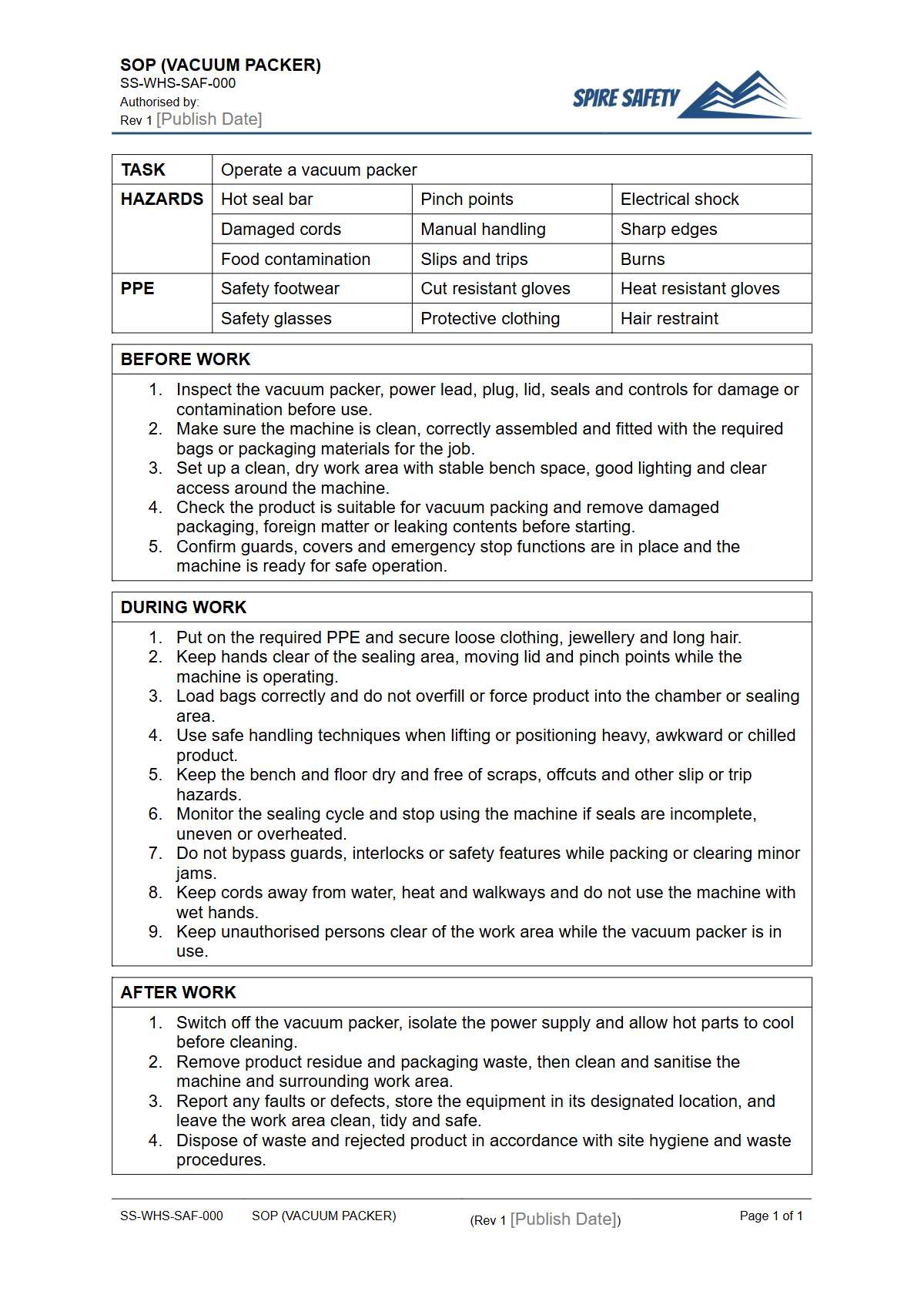
Download our free Safe Operating Procedure (Vacuum Packer) Template to formalise safe work practices.
Free Safe Operating Procedure (Vacuum Packer) Template
DOCX • 126 KB + PDF
Updated Oct 2026
No signup required
Purpose of the Free Safe Operating Procedure (Vacuum Packer) Template
Operating a vacuum packer, whether in a commercial kitchen, food processing plant, or manufacturing facility, involves specific risks that must be managed. Our Free Safe Operating Procedure (Vacuum Packer) Template provides a structured starting point for documenting the safest way to use this equipment.
This document helps your organisation meet its duty of care by identifying hazards, outlining risk control measures, and establishing clear, step-by-step instructions for operators. Using a formal SOP helps standardise work practices, reduces the likelihood of incidents, and provides a crucial training resource for new and existing employees.
This template is designed to cover key WHS considerations, including pre-operational checks, safe operation steps, cleaning procedures, and emergency responses. By implementing a comprehensive SOP, you create a safer work environment and a clear reference point for correct procedure.
Integrating this document into your broader WHS management systems is crucial for achieving a holistic and proactive approach to workplace safety.
Video walkthrough
How to use the Free Safe Operating Procedure (Vacuum Packer) Template
This Free Safe Operating Procedure (Vacuum Packer) Template is a foundational document that must be adapted to your specific workplace. Every model of vacuum packer has unique features, controls, and safety requirements.
To use this template effectively, download the DOCX file and consult with operators, supervisors, and the equipment manufacturer's manual to add site-specific details. Pay close attention to the specific make and model, the types of products being packaged, and your unique work environment.
Important: We have drafted this document as a template based on the model WHS framework and common industry practices. You must customise it with your own company branding, site-specific information, and the specific hazards and controls relevant to your operations.
Un-customised, generic documents may not adequately control risks. Regular reviews and WHS compliance auditing can verify that the procedures are effective and being followed correctly by all personnel.
What is included in this Safe Operating Procedure?
Our template provides a clear structure for you to build upon, including sections for:
- Designated responsible persons
- Required Personal Protective Equipment (PPE)
- A step-by-step risk assessment matrix
- Pre-operational safety checks
- Step-by-step operating instructions
- Post-operation and cleaning procedures
- Emergency shutdown and response instructions
- A section for worker consultation and sign-off
When to use a Vacuum Packer SOP
A Safe Operating Procedure for a vacuum packer should be a living document, used consistently throughout the equipment's lifecycle. It is essential during the induction and training of new staff to ensure they understand the correct and safe methods from the beginning.
It should also be readily available near the equipment as a quick reference for all operators. Furthermore, the SOP is a critical tool during incident investigations, helping to determine if procedural deviations contributed to the event.
Regular toolbox talks and safety meetings are ideal opportunities to review the SOP and reinforce safe work practices, particularly if there are any changes to the equipment or process. Similar equipment, such as that detailed in our free deep fryer SOP, also benefits from this consistent approach to documentation and training.
Who should use this Safe Operating Procedure
This SOP is intended for a range of personnel within an organisation. Primarily, it is for the equipment operators who need clear, unambiguous instructions to perform their tasks safely.
Supervisors and managers must use the SOP to enforce safe practices, conduct training, and perform competency assessments. WHS managers and safety officers will use the document as a key part of the overall safety management system, ensuring it is properly developed, reviewed, and implemented.
Finally, maintenance and cleaning staff should refer to the relevant sections to ensure they perform their duties without exposing themselves or others to harm. In larger food processing facilities, the process may be part of a larger production line that might also require a conveyer system SOP to ensure seamless and safe integration.
By ensuring everyone who interacts with the equipment understands and follows the SOP, you significantly strengthen your organisation's safety culture. For a wider selection of safety templates and guides, feel free to browse our complete free WHS resources library for documents covering other plant and equipment.
Common mistakes
Common mistakes to avoid
- Failing to customise the template with machine-specific details and workplace hazards.
- Neglecting to train all operators on the finalised SOP, including practical demonstrations.
- Not making the SOP easily accessible to operators near the equipment.
- Forgetting to schedule and document regular reviews and updates of the procedure.
Legal references
Legal considerations
The following legal requirements may be relevant to this type of work.
- Work Health and Safety Act (Harmonised) — Provides the primary duties for protecting workers and other people from work health and safety risks.
- Work Health and Safety Regulations (Harmonised) — Sets out requirements supporting the management of workplace hazards and risks.
The following codes may be relevant to this type of work.
- Managing WHS Risks Code of Practice — Provides practical guidance on identifying hazards, assessing risks and applying effective controls.
- Work Health and Safety Consultation, Cooperation and Coordination Code of Practice — Provides practical guidance on consulting workers and coordinating with other duty holders.
- Managing the Work Environment and Facilities Code of Practice — Provides practical guidance on safe work environments, workplace facilities and related controls.
Did you know
The Science of Sealing
Vacuum packing works by removing oxygen from the package before sealing. This dramatically slows the growth of aerobic bacteria and fungi, extending the shelf life and maintaining the quality of perishable foods.
Not Just for Food
While most commonly used for food, vacuum sealing technology is also used to package sterile medical instruments, protect sensitive electronics from moisture, and compress clothing for compact storage.
FAQ
Frequently asked questions
01What are the main hazards of using a vacuum packer?
02Is an SOP a legal requirement for a vacuum packer in Australia?
03How often should a vacuum packer SOP be reviewed?
04What training should accompany a vacuum packer SOP?
Share this resource
Free Safe Operating Procedure (Vacuum Packer) Template
Browse Categories
How To Use It
- 1Download and open in Word or PDF.
- 2Replace the placeholders with your business details.
- 3Get it reviewed by a WHS specialist before rollout.
Need it customised?
Our WHS consultants can adapt this template to your site, run a gap analysis, or audit what you already have in place.
Book a Free Consultation WHS consulting servicesor call 1300 156 382
Related templates
- Free Safe Operating Procedure (Vacuum Pump) Template
- Free Safe Operating Procedure (Valve Actuator Test) Template
- Free Safe Operating Procedure (Valve Grinder) Template
- Free Safe Operating Procedure (Valve Lapping) Template
- Free Safe Operating Procedure (Vapour Degreaser) Template
- Free Safe Operating Procedure (Vegetable Peeler) Template