
Free Safe Operating Procedure (Vacuum Pump) Template
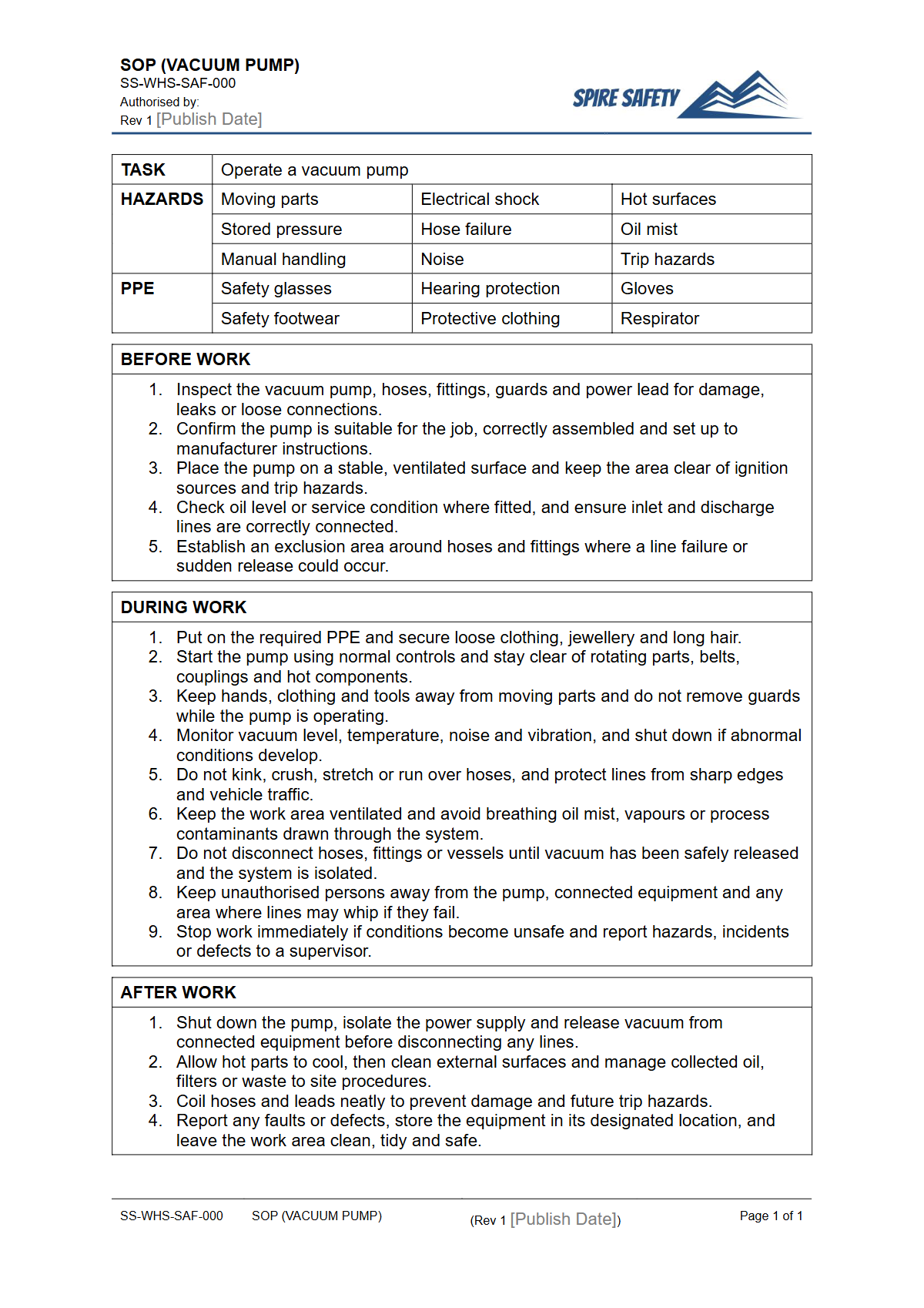
Download our free Safe Operating Procedure template for vacuum pumps. This document provides a structured guide for outlining safe work practices.
Free Safe Operating Procedure (Vacuum Pump) Template
DOCX • 126 KB + PDF
Updated Oct 2026
No signup required
Purpose of the Free Safe Operating Procedure (Vacuum Pump) Template
Operating industrial equipment like vacuum pumps requires clear, consistent instructions to minimise the risk of injury or damage. This free Safe Operating Procedure (Vacuum Pump) Template provides a structured starting point for your business to document safe work methods.
A well-developed SOP serves as a critical training tool for workers, ensures operational consistency, and forms a key part of your overall safety management system. It outlines the required steps for pre-start checks, operation, shutdown, and emergency response, helping to control hazards associated with pressure, electricity, and moving parts.
By formalising these processes, you create a clear standard for performance and safety. An SOP is a practical demonstration of your organisation's commitment to managing workplace risks.
Integrating this document into your daily operations helps build a proactive safety culture and supports your legal obligations as a PCBU. These procedures are foundational elements within comprehensive WHS management systems, providing the detailed instructions that bring high-level policies to life on the workshop floor.
Video walkthrough
How to use the Free Safe Operating Procedure (Vacuum Pump) Template
This resource is available for download in both DOCX and PDF formats. We recommend using the DOCX version, as it is fully editable.
You can add your company logo, site-specific details, and modify the content to suit your exact operational needs. The template is structured with clear headings covering key areas like hazards and risks, personal protective equipment (PPE), and step-by-step instructions for safe use.
It is crucial to understand that this is a template, not a finished, universally document. You must customise the content to reflect the specific vacuum pump models, workplace environment, unique risks, and control measures present at your site.
We've included prompts and sections to guide you, but the final responsibility for its accuracy and suitability rests with the PCBU and relevant stakeholders in your organisation.
Adopting a consistent format for all your plant and equipment documentation can streamline training and improve worker comprehension. For example, the structure used here can be adapted for other equipment, such as the machinery covered in our free Air Compressor SOP template, creating a standardised approach to safety across your workplace.
When to use a Safe Operating Procedure
An SOP for a vacuum pump should be developed and implemented before the equipment is first used in your workplace. It is an essential document for onboarding and training new operators, ensuring they understand the approved method of operation from day one.
It also serves as a valuable resource for refresher training and for verifying competency.
SOPs should be reviewed and updated whenever there is a change to the equipment, the process in which it is used, or the surrounding work environment. They are also critical reference documents following an incident or near miss, helping to identify whether a deviation from the established procedure contributed to the event.
Regular reviews ensure the SOP remains relevant and effective as a risk control measure.
For any machinery involving hazardous energy, a documented procedure is vital. The principles of identifying risks and outlining step-by-step controls apply broadly across different types of industrial equipment.
You can see a similar approach in our Oxy Acetylene SOP template, which also deals with controlling pressure and chemical hazards.
Who should use it
The development and implementation of an SOP is a collaborative effort. WHS managers, supervisors, and team leaders are typically responsible for drafting the procedure, ensuring it aligns with Australian WHS principles and the manufacturer's instructions.
They must ensure the identified controls are reasonably practicable and effective.
Operators and workers who use the vacuum pump are the primary end-users of the SOP. They must be trained on its contents and are responsible for following the procedure during their work.
Their direct experience is invaluable, and they should be consulted during the drafting and review process to ensure the SOP is practical and reflects the realities of the task.
The document is also a key piece of evidence during safety inspections and audits. Internal and external auditors will use the SOP as a benchmark to assess whether safe work practices are being consistently applied. This verification process is a core component of routine WHS compliance auditing.
Creating a library of SOPs for all significant plant is a best-practice approach to managing risk. Documenting procedures for equipment like the machines detailed in our Conveyer System SOP ensures every team member has access to clear, safe work instructions.
If your workplace uses a variety of plant and equipment, you can find more templates in our free WHS resources library to help build out your documentation.
Common mistakes
Common mistakes to avoid
- Failing to conduct and document pre-start checks before every use.
- Neglecting to customise the template for the specific pump model and process chemicals.
- Using the incorrect type or grade of vacuum pump oil, leading to poor performance or equipment failure.
- Inadequate training on emergency shutdown procedures or response to system leaks.
Legal references
Legal considerations
The following legal requirements may be relevant to this type of work.
- Work Health and Safety Act (Harmonised) — Provides the primary duties for protecting workers and other people from work health and safety risks.
- Work Health and Safety Regulations (Harmonised) — Sets out requirements supporting the management of workplace hazards and risks.
The following codes may be relevant to this type of work.
- Managing WHS Risks Code of Practice — Provides practical guidance on identifying hazards, assessing risks and applying effective controls.
- Work Health and Safety Consultation, Cooperation and Coordination Code of Practice — Provides practical guidance on consulting workers and coordinating with other duty holders.
- Managing the Work Environment and Facilities Code of Practice — Provides practical guidance on safe work environments, workplace facilities and related controls.
Did you know
A Powerful Void
The first vacuum pump, a piston and cylinder pump, was invented by German scientist Otto von Guericke in 1650 to study the properties of vacuums. His famous Magdeburg hemispheres experiment demonstrated the immense power of atmospheric pressure.
Implosion Hazard
Unlike explosions that push outwards, a failure in a vacuum system can cause a violent implosion. The surrounding atmospheric pressure rushes in to fill the void, which can cause equipment to shatter and propel fragments inwards with dangerous force.
FAQ
Frequently asked questions
01What should be included in a vacuum pump Safe Operating Procedure?
02Who is responsible for writing a Safe Operating Procedure?
03How often should SOPs for equipment like vacuum pumps be reviewed?
04Is training required after an SOP is created?
Share this resource
Free Safe Operating Procedure (Vacuum Pump) Template
Browse Categories
How To Use It
- 1Download and open in Word or PDF.
- 2Replace the placeholders with your business details.
- 3Get it reviewed by a WHS specialist before rollout.
Need it customised?
Our WHS consultants can adapt this template to your site, run a gap analysis, or audit what you already have in place.
Book a Free Consultation WHS consulting servicesor call 1300 156 382
Related templates
- Free Safe Operating Procedure (Valve Actuator Test) Template
- Free Safe Operating Procedure (Valve Grinder) Template
- Free Safe Operating Procedure (Valve Lapping) Template
- Free Safe Operating Procedure (Vapour Degreaser) Template
- Free Safe Operating Procedure (Vegetable Peeler) Template
- Free Safe Operating Procedure (Vegetable Slicer) Template