
Free Safe Operating Procedure (Vacuum Leak Test) Template
Download our free Safe Operating Procedure for vacuum leak testing. This template provides a structured guide for your workplace safety documentation.
Free Safe Operating Procedure (Vacuum Leak Test) Template
DOCX • 126 KB + PDF
Updated Oct 2026
No signup required
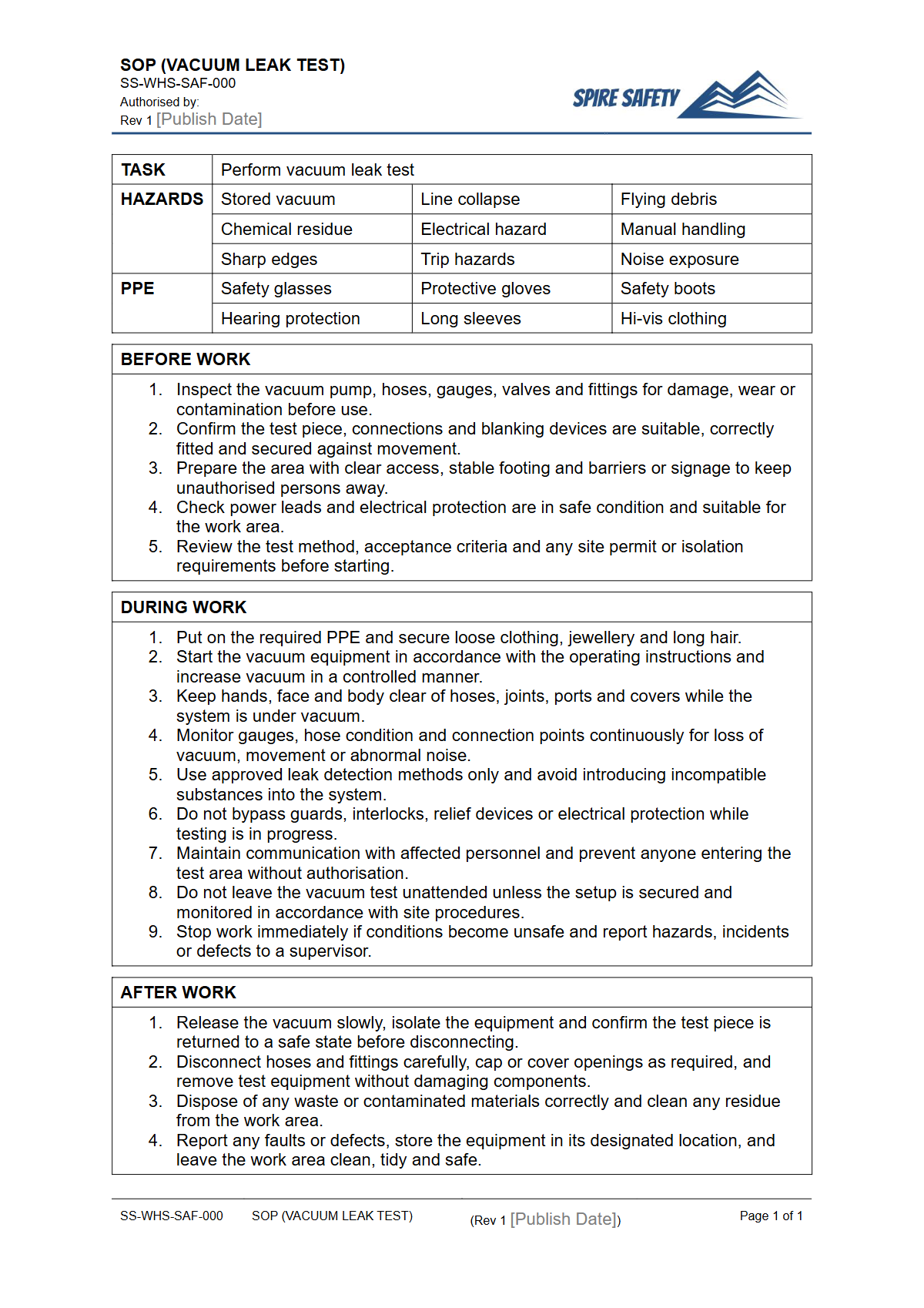
Purpose of the Free Safe Operating Procedure (Vacuum Leak Test) Template
This Free Safe Operating Procedure (Vacuum Leak Test) Template provides a comprehensive framework for documenting the steps required to safely perform vacuum leak tests on equipment and systems. Implementing a formal Safe Operating Procedure (SOP) is crucial for managing risks associated with pressurised or vacuum systems, ensuring procedural consistency, and meeting your WHS obligations.
It helps standardise the task, reduces the likelihood of errors, and provides a clear training tool for workers.
This template helps your organisation define pre-operational checks, the step-by-step testing process, and post-operational procedures. A well-defined SOP is a cornerstone of effective WHS management systems, demonstrating a proactive approach to workplace safety.
Video walkthrough
How to use the Free Safe Operating Procedure (Vacuum Leak Test) Template
To effectively implement this Safe Operating Procedure (Vacuum Leak Test) Template, you must customise it to reflect the specific equipment, environment, and hazards present in your workplace. This is not a 'one-size-fits-all' document.
We have provided a structured starting point in DOCX format for easy editing. Follow these steps to adapt the template:
- Consult with workers who perform the task to ensure the procedure is practical and reflects actual practice.
- Conduct a thorough risk assessment for the specific vacuum leak testing task to identify all relevant hazards and control measures.
- Incorporate the equipment manufacturer's instructions, specifications, and safety warnings.
- Detail the specific Personal Protective Equipment (PPE) required, such as safety glasses, gloves, or hearing protection.
- Add site-specific emergency procedures, including contact information and shutdown sequences.
Once customised, the SOP should be used as part of worker training and induction processes. Similar to procedures for other pressurised equipment, such as our free Air Compressor SOP, regular review and updates are essential to ensure it remains current and effective.
When to use a Vacuum Leak Test SOP
A vacuum leak test SOP should be used whenever a worker is required to test a system for leaks by creating a vacuum. This includes a variety of scenarios:
- Commissioning new plant or equipment before it enters service.
- Following maintenance or repairs on vacuum systems, pipework, or vessels.
- As part of a scheduled preventative maintenance program to ensure system integrity.
- Troubleshooting poor system performance or investigating suspected leaks.
Using a standardised procedure ensures that the test is performed correctly and safely every time, minimising risks to both the operator and the equipment. For systems involving potentially hazardous substances, such as those covered in an Oxy Acetylene SOP, having a documented leak testing procedure is critically important.
Who should use this Safe Operating Procedure
This Safe Operating Procedure is intended for use by Persons Conducting a Business or Undertaking (PCBUs), site managers, supervisors, and the workers who perform vacuum leak tests.
For PCBUs and managers, it serves as a tool to fulfil their primary duty of care by providing a safe system of work. It helps ensure that all legal and procedural requirements are considered and documented.
Regular reviews of such documents can be part of a broader WHS compliance auditing program to verify safety practices on site.
For workers, the SOP is a practical, step-by-step guide for performing the task safely. It outlines the required training, competencies, PPE, and emergency responses.
Ensuring workers are familiar with SOPs for all relevant equipment, like a Conveyer System SOP, is key to preventing incidents.
Proper documentation is a vital part of a comprehensive safety framework. You can find many other useful templates and guides in our free WHS resources library to support your safety management efforts.
Common mistakes
Common mistakes to avoid
- Using incorrect test pressures or vacuum levels that can damage equipment.
- Failing to properly isolate the section of the system being tested, leading to inaccurate results.
- Not allowing sufficient time for the pressure or vacuum to stabilise before taking readings.
- Overlooking personal protective equipment (PPE) requirements, especially eye protection.
Legal references
Legal considerations
The following legal requirements may be relevant to this type of work.
- Work Health and Safety Act (Harmonised) — Provides the primary duties for protecting workers and other people from work health and safety risks.
- Work Health and Safety Regulations (Harmonised) — Sets out requirements supporting the management of workplace hazards and risks.
The following codes may be relevant to this type of work.
- Managing WHS Risks Code of Practice — Provides practical guidance on identifying hazards, assessing risks and applying effective controls.
- Work Health and Safety Consultation, Cooperation and Coordination Code of Practice — Provides practical guidance on consulting workers and coordinating with other duty holders.
- Managing the Work Environment and Facilities Code of Practice — Provides practical guidance on safe work environments, workplace facilities and related controls.
Did you know
Helium Leak Detection
Helium is often used as a tracer gas in sensitive vacuum leak tests. Its small atomic size allows it to penetrate tiny leaks, where a mass spectrometer can then detect it, pinpointing leaks far too small to be found by other methods.
The Cost of Leaks
Even a small leak in a vacuum system can significantly increase pump-down times and energy consumption, leading to reduced production efficiency and higher operational costs over time.
FAQ
Frequently asked questions
01What are the key components of a vacuum leak test SOP?
02Why is customising a generic SOP template important for our business?
03How often should a vacuum leak test SOP be reviewed?
04Who is competent to conduct a vacuum leak test?
Share this resource
Free Safe Operating Procedure (Vacuum Leak Test) Template
Browse Categories
How To Use It
- 1Download and open in Word or PDF.
- 2Replace the placeholders with your business details.
- 3Get it reviewed by a WHS specialist before rollout.
Need it customised?
Our WHS consultants can adapt this template to your site, run a gap analysis, or audit what you already have in place.
Book a Free Consultation WHS consulting servicesor call 1300 156 382
Related templates
- Free Safe Operating Procedure (Vacuum Lifter) Template
- Free Safe Operating Procedure (Vacuum Lifting Beam) Template
- Free Safe Operating Procedure (Vacuum Packer) Template
- Free Safe Operating Procedure (Vacuum Pump) Template
- Free Safe Operating Procedure (Valve Actuator Test) Template
- Free Safe Operating Procedure (Valve Grinder) Template