
Free Safe Operating Procedure (Vacuum Lifter) Template
Safely operate vacuum lifters with our detailed template. This free Safe Operating Procedure provides a structured guide for your workplace. Download now.
Free Safe Operating Procedure (Vacuum Lifter) Template
DOCX • 126 KB + PDF
Updated Oct 2026
No signup required
Purpose of the Free Safe Operating Procedure (Vacuum Lifter) Template
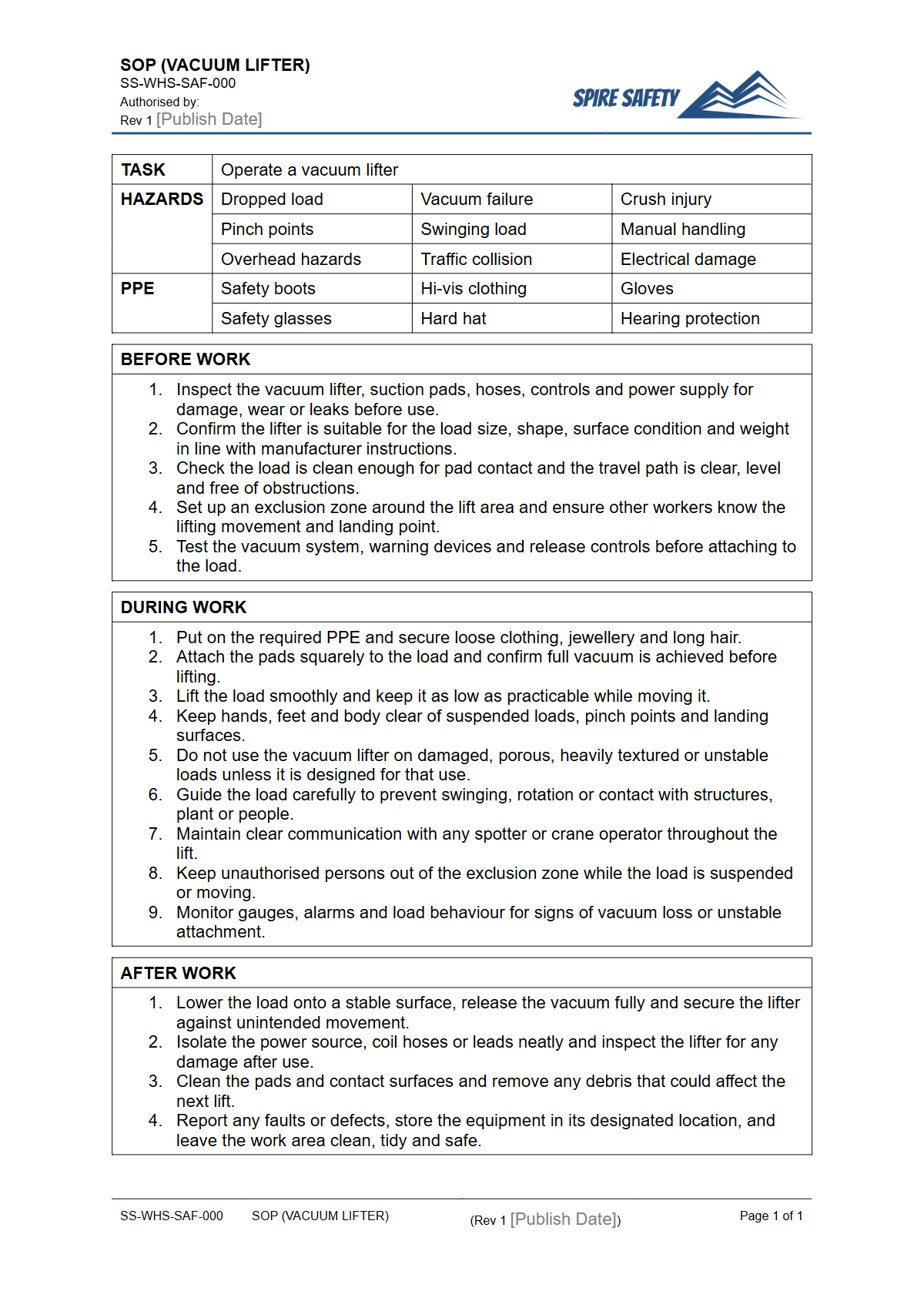
Using a vacuum lifter introduces significant risks if not managed correctly. This free Safe Operating Procedure (Vacuum Lifter) template provides a structured framework to document the step-by-step process for the safe use of this equipment.
Its primary purpose is to help your organisation minimise the risk of incidents, such as unexpected load release, which can lead to serious injury or costly damage to materials. A well-developed SOP is a fundamental component of a safe system of work, demonstrating a commitment to operator safety and workplace compliance.
By outlining hazards, control measures, and clear operational steps, this document serves as a critical tool for training, daily use, and supervision. Implementing documented procedures like this is a key part of developing robust WHS management systems that protect both your workers and your business.
It formalises expectations and ensures a consistent, safe approach is followed every time the equipment is used.
Video walkthrough
How to use the Free Safe Operating Procedure (Vacuum Lifter) Template
This template is provided in both DOCX and PDF formats for your convenience. The DOCX version is fully editable, allowing you to tailor it precisely to your operational needs.
To use it effectively, download the file and systematically work through each section. You should consult with the equipment manufacturer's instructions, relevant Australian Standards, and most importantly, the workers who operate the vacuum lifters daily.
Their practical experience is invaluable for creating a procedure that is both safe and workable.
Remember, this is a template. It is essential that you customise this document to reflect the specific vacuum lifter models, tasks, and unique environmental conditions of your workplace.
We recommend a thorough consultation process with operators and supervisors to ensure the final SOP is practical and effective. Just as you would for other specialised lifting equipment covered in our FREE Telehandler SOP Template, site-specific details are crucial for safety.
Key Elements of a Vacuum Lifter SOP
A comprehensive SOP for a vacuum lifter should cover several critical areas to ensure all aspects of its use are addressed. This template guides you through documenting:
- Pre-Operational Checks: A detailed checklist for inspecting components before every use. This includes checking vacuum pads for cuts or wear, ensuring hoses and connectors are secure and free from damage, verifying the power source, and testing safety features like low-vacuum alarms and gauges.
- Safe Lifting Practices: Step-by-step instructions for attaching the lifter, achieving a secure vacuum seal, and handling the load. This covers confirming the material surface is clean and non-porous, respecting the Working Load Limit (WLL), and outlining safe travel paths away from personnel. For other material handling equipment, you might reference a FREE Conveyer System SOP to manage workflow around the lifting area.
- Emergency Procedures: Clear instructions on what to do in case of an emergency, such as a sudden loss of power or vacuum pressure. This section should include procedures for safely lowering the load and isolating the equipment.
- Maintenance and Storage: Guidelines on routine maintenance schedules, cleaning the vacuum pads, and correct storage of the lifter to prevent damage and ensure its longevity.
When to use this Safe Operating Procedure
The completed SOP is not a document to be filed away and forgotten. It should be a live and active part of your daily operations.
It is essential for inducting and training new operators, providing a clear reference for pre-start inspections, and guiding correct operational behaviour. It also serves as a benchmark for supervisors conducting routine observations or performance reviews.
Furthermore, the SOP should be a key document referenced during incident investigations or near-miss reporting to identify any procedural gaps. Regular reviews of the SOP should be scheduled as part of your standard safety processes, similar to how you would approach WHS compliance auditing for your overall safety system.
This ensures it remains relevant and effective as equipment, tasks, or personnel change.
Who should use this Safe Operating Procedure
This SOP is intended for a range of personnel within your organisation. The primary user is the equipment operator, who must understand and follow the procedure to ensure their own safety and that of those around them.
Supervisors and managers should also be thoroughly familiar with the SOP to enforce its use, deliver effective training, and monitor compliance.
WHS and safety managers will use the SOP as part of the broader risk management framework for the site. Maintenance personnel should also refer to it for instructions on isolating and securing the equipment before undertaking any service or repair work.
This broad application ensures that safety responsibilities related to the vacuum lifter are clearly defined and understood across different roles, much like the procedures outlined in our Free Air Compressor SOP Template apply to various workshop staff.
By integrating this procedure into your daily workflow, you contribute to a stronger safety culture. For more tools to support your safety management, explore our complete free WHS resources library, which contains a wide range of templates and checklists.
Common mistakes
Common mistakes to avoid
- Attempting to lift materials with porous, dirty, or uneven surfaces that prevent a proper vacuum seal.
- Failing to conduct thorough pre-start checks of pads, hoses, and gauges before operation.
- Exceeding the lifter's specified Working Load Limit (WLL) or ignoring load charts.
- Moving a suspended load too quickly, or travelling directly over the top of personnel.
Legal references
Legal considerations
The following legal requirements may be relevant to this type of work.
- Work Health and Safety Act (Harmonised) — Provides the primary duties for protecting workers and other people from work health and safety risks.
- Work Health and Safety Regulations (Harmonised) — Sets out requirements supporting the management of workplace hazards and risks.
The following codes may be relevant to this type of work.
- Managing WHS Risks Code of Practice — Provides practical guidance on identifying hazards, assessing risks and applying effective controls.
- Work Health and Safety Consultation, Cooperation and Coordination Code of Practice — Provides practical guidance on consulting workers and coordinating with other duty holders.
- Managing the Work Environment and Facilities Code of Practice — Provides practical guidance on safe work environments, workplace facilities and related controls.
Did you know
Pressure, Not Suction
Vacuum lifters don't truly 'suck' objects. They work by removing air from between the pad and the load surface, creating a pressure differential where the higher atmospheric pressure outside pushes the object securely against the pad.
Safety Factor
Reputable vacuum lifters are designed with a safety factor, often 2:1 for horizontal lifting. This means they are tested to hold at least double their rated Working Load Limit (WLL) without failure.
FAQ
Frequently asked questions
01What should be included in pre-start checks for a vacuum lifter?
02Is a Safe Operating Procedure a legal requirement in Australia?
03How often should a vacuum lifter SOP be reviewed?
04Can this template be used for all types of vacuum lifters?
Share this resource
Free Safe Operating Procedure (Vacuum Lifter) Template
Browse Categories
How To Use It
- 1Download and open in Word or PDF.
- 2Replace the placeholders with your business details.
- 3Get it reviewed by a WHS specialist before rollout.
Need it customised?
Our WHS consultants can adapt this template to your site, run a gap analysis, or audit what you already have in place.
Book a Free Consultation WHS consulting servicesor call 1300 156 382
Related templates
- Free Safe Operating Procedure (Vacuum Lifting Beam) Template
- Free Safe Operating Procedure (Vacuum Packer) Template
- Free Safe Operating Procedure (Vacuum Pump) Template
- Free Safe Operating Procedure (Valve Actuator Test) Template
- Free Safe Operating Procedure (Valve Grinder) Template
- Free Safe Operating Procedure (Valve Lapping) Template