
Free Safe Operating Procedure (Vacant Unit Cleaning) Template
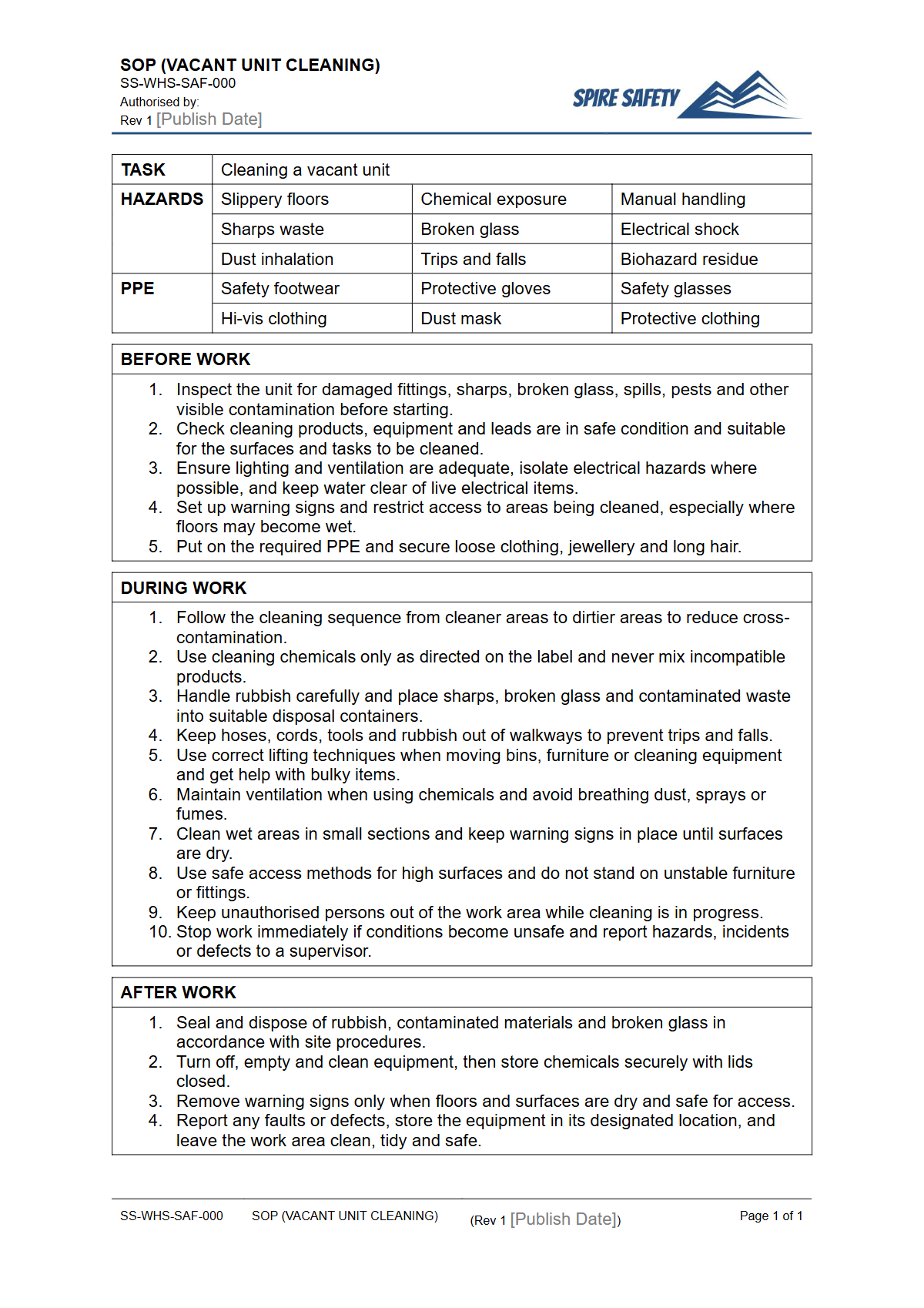
Download our free Safe Operating Procedure for vacant unit cleaning to standardise your processes. This template helps you outline hazards and controls.
Free Safe Operating Procedure (Vacant Unit Cleaning) Template
DOCX • 126 KB + PDF
Updated Oct 2026
No signup required
Purpose of the Free Safe Operating Procedure (Vacant Unit Cleaning) Template
This Free Safe Operating Procedure (Vacant Unit Cleaning) Template provides a structured starting point for organisations to document a safe system of work for cleaning empty residential, commercial, or industrial properties. Its primary purpose is to identify and control the specific risks associated with this task, ensuring worker health and safety.
The document guides you through outlining hazards such as chemical exposure from cleaning agents, manual handling risks from moving furniture or equipment, electrical hazards from appliances, and potential biological hazards.
By implementing a formal SOP, you standardise procedures, reduce the likelihood of incidents, and provide a clear basis for worker training and supervision. A well-defined SOP is a fundamental component of effective WHS management systems, demonstrating a proactive approach to risk management aligned with Australian WHS principles.
Video walkthrough
How to use the Free Safe Operating Procedure (Vacant Unit Cleaning) Template
Our Safe Operating Procedure for vacant unit cleaning is available in both DOCX and PDF formats for your convenience. The DOCX file is fully editable, allowing you to adapt it to your specific operational needs.
To use the template, simply download the file and begin filling in the sections with information relevant to your worksite, the chemicals you use, and the equipment your team operates.
Important: This template is a starting point and must be customised to your specific workplace, equipment, chemicals, and tasks. We have not been to your workplace and cannot know your unique risks.
You must conduct your own risk assessment and detail your specific control measures within the document before use.
Key sections to customise include the required Personal Protective Equipment (PPE), pre-start checks, step-by-step instructions for the cleaning process, waste disposal, and emergency procedures. For specialised cleaning within a larger project, such as in a commercial kitchen, you may need additional specific procedures like a deep fryer cleaning SOP.
When to use it
This Safe Operating Procedure should be developed and implemented before any work commences on a vacant property. It is designed for a range of scenarios, including post-tenancy 'bond cleans', preparing a property for sale or lease, and final clean-ups on a construction or renovation site.
The SOP should be used as a key document for training and inducting workers, and as a reference tool during pre-start meetings or toolbox talks to reinforce safe work practices.
When cleaning industrial units, the process might involve equipment for clearing widespread dust or debris. In such cases, your risk assessment may identify the need for a separate SOP covering specific plant, such as our Air Compressor SOP template.
In some cases, preparing a vacant unit goes beyond cleaning and includes minor repairs or 'make-good' provisions. If this involves tasks like cutting replacement fixtures or timber, a specific procedure like our FREE Circular Saw SOP Template would be required for that activity.
Who should use it
This template is designed for anyone responsible for the safety of workers involved in property cleaning. This includes property managers, real estate agencies, cleaning business owners, facilities managers, and other Persons Conducting a Business or Undertaking (PCBU).
Health and Safety Representatives (HSRs), supervisors, and team leaders will find it invaluable for drafting, reviewing, and implementing safe work methods on the ground.
Ultimately, the finalised SOP is for the workers carrying out the cleaning tasks. They must be consulted during the development of the procedure, thoroughly trained on its contents, and have easy access to it at the worksite.
Evidence of documented and implemented SOPs is a key focus area during any formal WHS compliance auditing process.
This document is one of many tools available to help you build a safer workplace. You can explore our entire free WHS resources library for more templates and guides to support your safety management system.
Common mistakes
Common mistakes to avoid
- Using a generic template without customising it for site-specific hazards and controls.
- Failing to adequately train workers on the finalised SOP and confirm their understanding.
- Not including procedures for managing unexpected discoveries like sharps, asbestos, or unlabelled chemicals.
- Forgetting to list the specific type and standard of Personal Protective Equipment (PPE) required for each task.
Legal references
Legal considerations
The following legal requirements may be relevant to this type of work.
- Work Health and Safety Act (Harmonised) — Provides the primary duties for protecting workers and other people from work health and safety risks.
- Work Health and Safety Regulations (Harmonised) — Sets out requirements supporting the management of workplace hazards and risks.
The following codes may be relevant to this type of work.
- Managing WHS Risks Code of Practice — Provides practical guidance on identifying hazards, assessing risks and applying effective controls.
- Work Health and Safety Consultation, Cooperation and Coordination Code of Practice — Provides practical guidance on consulting workers and coordinating with other duty holders.
- Managing the Work Environment and Facilities Code of Practice — Provides practical guidance on safe work environments, workplace facilities and related controls.
Did you know
Slips, Trips and Falls
Slips, trips and falls are a leading cause of serious, preventable workplace injuries in Australia, accounting for a significant portion of workers' compensation claims each year. Wet floors during cleaning are a primary contributor.
Chemical Safety
The model WHS Regulations include specific duties for managing the risks of hazardous chemicals, including requirements for labelling, safety data sheets (SDS), and providing information and training to workers.
FAQ
Frequently asked questions
01What hazards should be included in a vacant unit cleaning SOP?
02Is a Safe Operating Procedure a legal requirement for cleaning?
03How often should an SOP for vacant unit cleaning be reviewed?
04Can a generic cleaning SOP be used for vacant units?
Share this resource
Free Safe Operating Procedure (Vacant Unit Cleaning) Template
Browse Categories
How To Use It
- 1Download and open in Word or PDF.
- 2Replace the placeholders with your business details.
- 3Get it reviewed by a WHS specialist before rollout.
Need it customised?
Our WHS consultants can adapt this template to your site, run a gap analysis, or audit what you already have in place.
Book a Free Consultation WHS consulting servicesor call 1300 156 382
Related templates
- Free Safe Operating Procedure (Vacuum Excavation) Template
- Free Safe Operating Procedure (Vacuum Leak Test) Template
- Free Safe Operating Procedure (Vacuum Lifter) Template
- Free Safe Operating Procedure (Vacuum Lifting Beam) Template
- Free Safe Operating Procedure (Vacuum Packer) Template
- Free Safe Operating Procedure (Vacuum Pump) Template