
Free Safe Operating Procedure (Vacuum Excavation) Template
Download our free Safe Operating Procedure (Vacuum Excavation) Template. This structured document helps you define safe work practices for vacuum excavation.
Free Safe Operating Procedure (Vacuum Excavation) Template
DOCX • 126 KB + PDF
Updated Oct 2026
No signup required
Purpose of the Free Safe Operating Procedure (Vacuum Excavation) Template
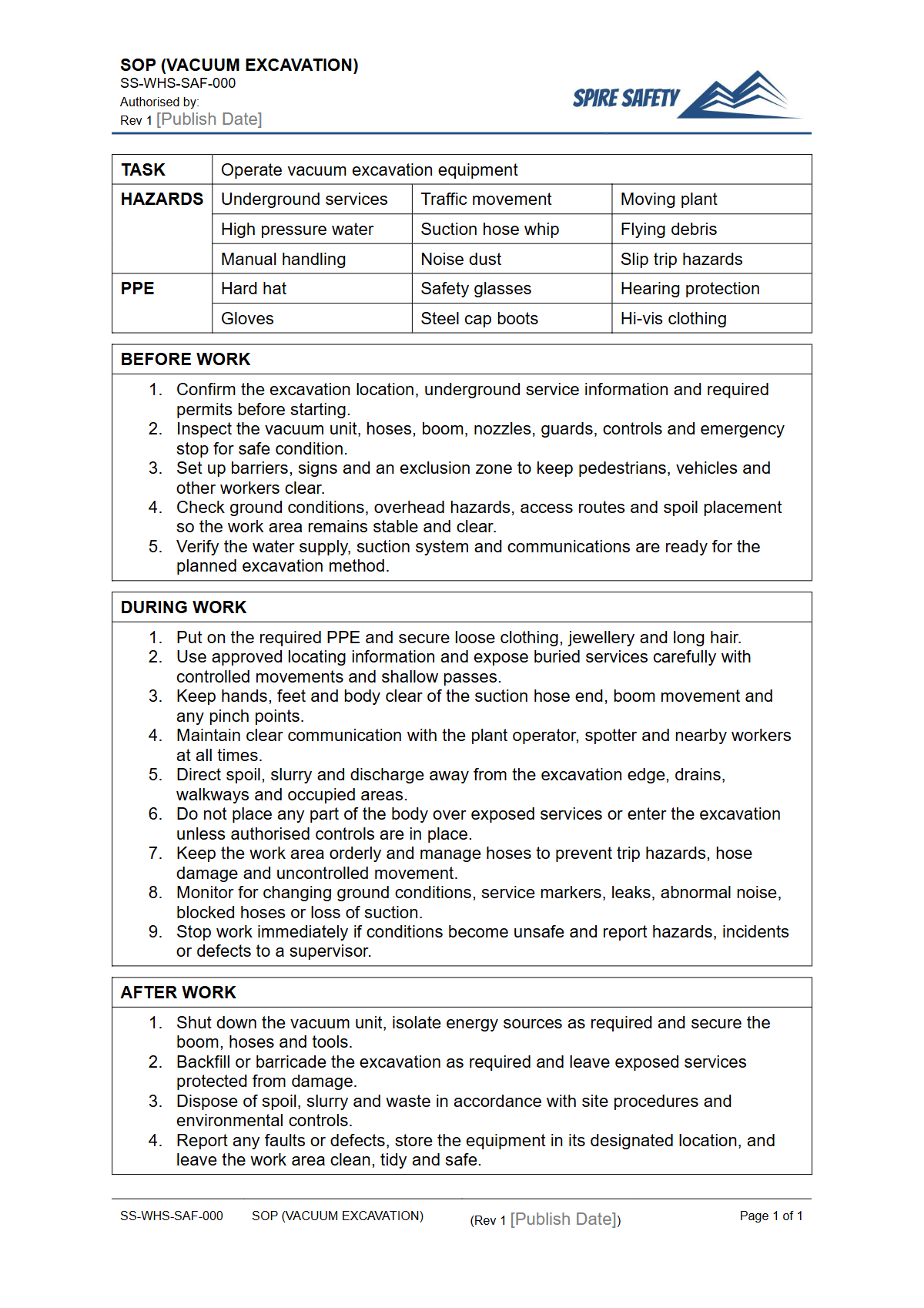
This Free Safe Operating Procedure (Vacuum Excavation) Template provides a structured framework for documenting the safe use of vacuum excavation units on your worksite. Using this SOP helps your organisation systematically identify hazards and detail the control measures required to manage risks associated with non-destructive digging.
It guides workers through a step-by-step process, covering everything from pre-start checks to operational procedures and shutdown protocols, forming a critical part of your site safety documentation.
By clearly outlining safe work methods, this SOP serves as a vital tool for operator training, competency verification, and risk management. It addresses key hazards such as striking underground utilities, soil instability, high-pressure water injection injuries, and exposure to noise and dust.
Adopting a thorough SOP helps ensure that all vacuum excavation tasks are planned and executed with safety as the top priority, aligning with Australian WHS best practices.
Video walkthrough
How to use the Free Safe Operating Procedure (Vacuum Excavation) Template
To effectively use this Free Safe Operating Procedure (Vacuum Excavation) Template, download the DOCX file and begin customising it to your specific operational context. The document is pre-formatted with sections for key information like PPE requirements, risk controls, and operational steps.
You must populate these sections with details relevant to your specific vacuum excavation equipment, the types of ground conditions encountered, and your company's established safety protocols.
This document is a template, not a finished product. We strongly advise that you customise this SOP to reflect the specific hazards, equipment models, and control measures relevant to your workplace and state/territory regulations.
For other excavation-related tasks, you might also find our FREE Trencher SOP Template a useful reference for building out your site-specific procedures.
When to Use a Vacuum Excavation SOP
A Safe Operating Procedure for vacuum excavation should be developed and implemented before any such work begins on a site. It is a fundamental component of the planning phase for any project involving non-destructive digging, particularly in areas with known or suspected underground services.
The SOP should be used as the primary reference document during pre-start meetings and toolbox talks to brief all involved personnel on the risks and required controls. It also serves as a benchmark for ongoing supervision and a reference for incident investigations, helping to identify any deviations from the established safe work method.
Integrating this SOP is a practical step towards building robust WHS management systems on your projects.
Who Should Use It
This template is designed for use by a range of personnel within an organisation. Persons Conducting a Business or Undertaking (PCBUs) and their management teams are responsible for ensuring that adequate safe work procedures are in place.
WHS managers and advisors will use the template to draft, review, and formalise the procedure. Site supervisors and foremen are responsible for implementing the SOP on the ground, ensuring workers adhere to it, and providing necessary instruction.
Finally, the equipment operators themselves must be trained in the SOP and follow it meticulously to ensure their own safety and the safety of others in the work area. A similar approach to operator responsibility is detailed in our FREE Telehandler SOP Template.
Key Elements of an Effective Vacuum Excavation SOP
A comprehensive SOP for vacuum excavation goes beyond basic operating instructions. It should be a holistic safety document that includes several critical components.
Pre-Operational Checks
This section must detail the visual inspections and functional tests the operator must perform before starting the unit. This includes checking fluid levels, hose conditions, safety guards, emergency stops, and the condition of the vacuum tank and filtration systems. Similar to plant like pressurised vessels, these checks are non-negotiable, a principle also found in resources like our Free Air Compressor SOP (Safe Operating Procedure) Template.
Hazard Identification and Risk Control
Your SOP must list all foreseeable hazards associated with the task. For vacuum excavation, this includes asset strikes, ground collapse, high-pressure fluid injection, manual handling injuries from hoses, noise, dust, and traffic interaction.
For each hazard, specific control measures must be documented, following the hierarchy of controls.
Review and Improvement
Safe Operating Procedures are not static documents. They should be reviewed regularly—typically annually or after any incident, near miss, or significant change in equipment or work practices.
This review process ensures the procedure remains relevant and effective. Engaging in periodic WHS compliance auditing can help verify that your documented procedures are being implemented correctly in practice and identify opportunities for improvement across all your site operations. For more templates and safety resources, explore our complete free WHS resources library.
Common mistakes
Common mistakes to avoid
- Failing to obtain and verify 'Dial Before You Dig' plans before starting work.
- Using excessive water pressure that could damage sensitive utilities like fibre optic cables.
- Neglecting to establish an exclusion zone around the work area to protect other workers and the public.
- Assuming operators are competent without formal training and verification on the specific model of equipment being used.
Legal references
Legal considerations
The following legal requirements may be relevant to this type of work.
- Work Health and Safety Act (Harmonised) — Provides the primary duties for protecting workers and other people from work health and safety risks.
- Work Health and Safety Regulations (Harmonised) — Sets out requirements supporting the management of workplace hazards and risks.
The following codes may be relevant to this type of work.
- Managing WHS Risks Code of Practice — Provides practical guidance on identifying hazards, assessing risks and applying effective controls.
- Work Health and Safety Consultation, Cooperation and Coordination Code of Practice — Provides practical guidance on consulting workers and coordinating with other duty holders.
- Managing the Work Environment and Facilities Code of Practice — Provides practical guidance on safe work environments, workplace facilities and related controls.
Did you know
Non-Destructive Benefits
Vacuum excavation is often called 'non-destructive digging' because it uses air or water to loosen soil, significantly reducing the risk of damaging underground utilities compared to mechanical excavators.
Water Pressure Risks
While safer than mechanical digging, the high-pressure water used in hydro-excavation can exceed 3,000 PSI. This pressure is easily capable of causing severe injection injuries if it makes contact with skin.
FAQ
Frequently asked questions
01What is a Safe Operating Procedure for vacuum excavation?
02Is a SOP legally required for vacuum excavation in Australia?
03What key hazards should be included in a vacuum excavation SOP?
04How often should a vacuum excavation SOP be reviewed?
Share this resource
Free Safe Operating Procedure (Vacuum Excavation) Template
Browse Categories
How To Use It
- 1Download and open in Word or PDF.
- 2Replace the placeholders with your business details.
- 3Get it reviewed by a WHS specialist before rollout.
Need it customised?
Our WHS consultants can adapt this template to your site, run a gap analysis, or audit what you already have in place.
Book a Free Consultation WHS consulting servicesor call 1300 156 382
Related templates
- Free Safe Operating Procedure (Vacuum Leak Test) Template
- Free Safe Operating Procedure (Vacuum Lifter) Template
- Free Safe Operating Procedure (Vacuum Lifting Beam) Template
- Free Safe Operating Procedure (Vacuum Packer) Template
- Free Safe Operating Procedure (Vacuum Pump) Template
- Free Safe Operating Procedure (Valve Actuator Test) Template