
Free Safe Operating Procedure (Urinal Descaling) Template
Download our free Safe Operating Procedure (Urinal Descaling) Template to formalise your cleaning processes and manage chemical hazards. Get started now.
Free Safe Operating Procedure (Urinal Descaling) Template
DOCX • 126 KB + PDF
Updated Oct 2026
No signup required
Purpose of the Free Safe Operating Procedure (Urinal Descaling) Template
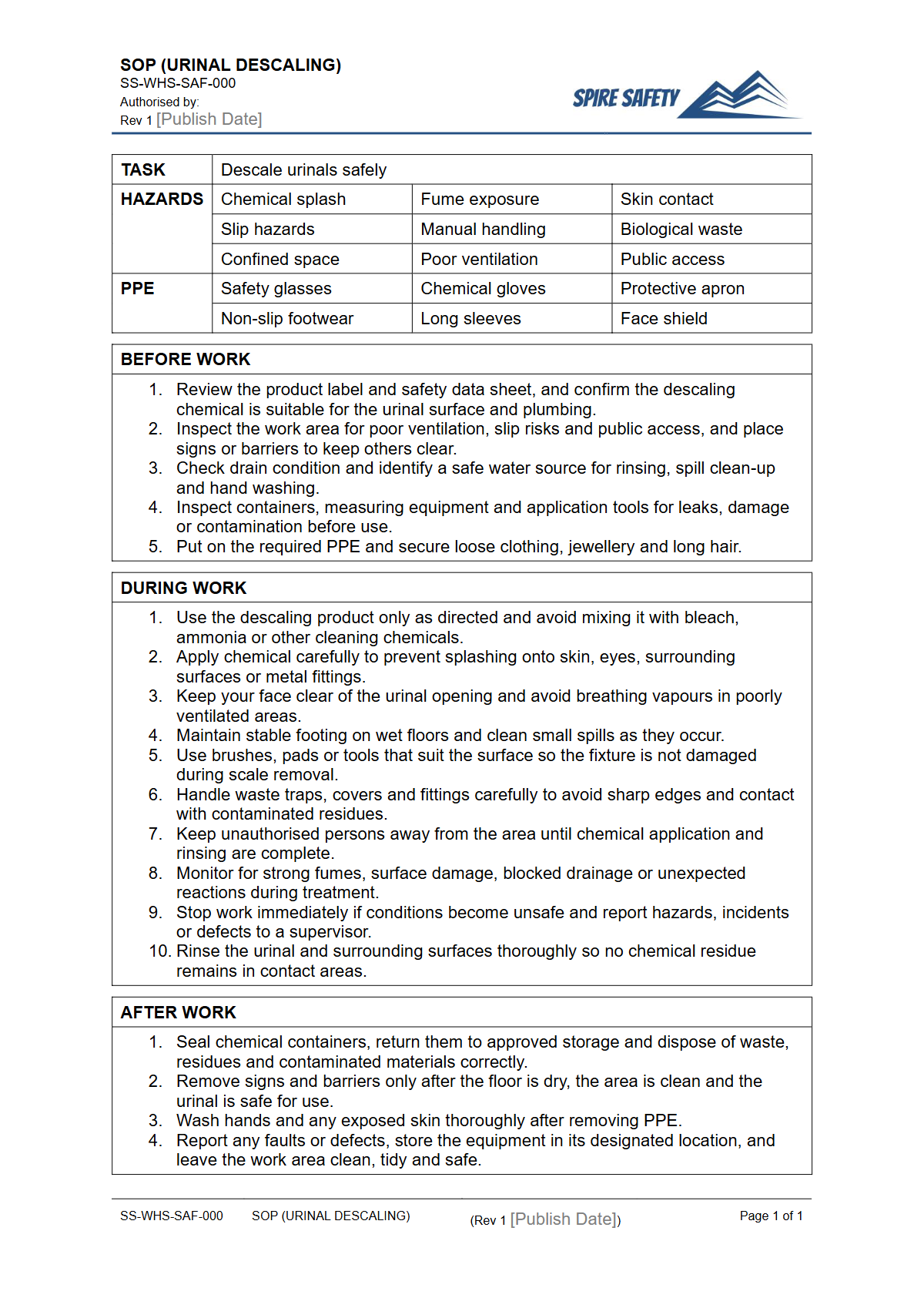
This Safe Operating Procedure (SOP) template provides a structured framework for safely performing urinal descaling tasks. Descaling involves using strong chemical agents to remove uric scale and mineral deposits, presenting significant risks if not managed correctly.
Our free Safe Operating Procedure (Urinal Descaling) Template helps your organisation document the required steps, personal protective equipment (PPE), hazard controls, and emergency procedures, aligning with Australian WHS best practices. A documented procedure is a critical component of ensuring workers are trained, competent, and protected from chemical exposure, splashes, and hazardous fumes.
A well-defined SOP demonstrates a commitment to health and safety and forms a key part of broader comprehensive WHS management systems. It standardises the task to ensure a consistent, safe outcome every time, regardless of which trained worker performs it. Using this template helps you meet your duty of care by systematically identifying hazards and implementing effective control measures.
Video walkthrough
How to use the Free Safe Operating Procedure (Urinal Descaling) Template
This document is provided in both DOCX and PDF formats for your convenience. The DOCX file is fully editable, allowing you to adapt it to the specific chemicals, equipment, and environment at your workplace.
To use the template effectively, you should review each section and modify it with site-specific information. This includes listing the exact brand and type of descaling agent used, referencing its Safety Data Sheet (SDS), and detailing the unique layout and ventilation characteristics of your facilities.
Important: This is a template only. You must customise this document to reflect the specific hazards and control measures relevant to your workplace.
We are not liable for any incidents arising from the use of this template. A generic procedure is not sufficient for compliance; it must be made specific to your operational context.
This includes adding your company branding, specific emergency contact details, and review dates.
When to use this Safe Operating Procedure
This Safe Operating Procedure should be used whenever a worker is required to perform chemical descaling of urinals or associated pipework. It is particularly important in environments with hard water, high usage, or recurring blockages where regular descaling is necessary.
The SOP should be a mandatory part of the pre-start process for the task. It also serves as a critical training tool for new employees and a refresher for existing staff, ensuring everyone understands the risks and required safety protocols before handling hazardous chemicals.
Furthermore, this procedure should be reviewed and referenced during incident investigations or when new chemicals or equipment are introduced. Regular reviews, often scheduled as part of routine WHS compliance audits, ensure the SOP remains current and effective against evolving workplace conditions.
This is just one of many procedures a business may need; our library of free WHS resources contains templates for a wide range of tasks and equipment.
Who should use this Safe Operating Procedure
This SOP is designed for use by any person conducting a business or undertaking (PCBU) where urinal descaling is performed. This includes facilities managers, cleaning supervisors, maintenance managers, and WHS advisors.
It is their responsibility to implement the procedure and ensure it is followed. The end-users of the SOP are the workers themselves—the cleaners, janitorial staff, or maintenance personnel who physically carry out the task.
The document must be readily accessible to them at the point of work, and they must be trained on its contents to a point of verifiable competency.
Documenting procedures for all high-risk tasks is crucial. Whether it's a chemical task like this one, or a maintenance task involving equipment covered by our circular saw SOP, the principles of risk assessment and documented control measures remain the same.
Engaging external expertise through WHS consulting services can also help ensure your procedures are robust and effectively implemented across your organisation.
Key Hazards in Urinal Descaling
Urinal descaling introduces several significant workplace hazards that must be controlled. The primary risk comes from the hazardous chemicals used, which are often corrosive acids. Specific hazards include:
- Chemical Burns: Direct contact with acidic descalers can cause severe burns to the skin and permanent damage to the eyes.
- Toxic Fumes: Acidic cleaners can release harmful vapours, leading to respiratory irritation or damage, especially in poorly ventilated areas. Mixing descalers with other chemicals, particularly those containing chlorine (bleach), can create highly toxic chlorine gas.
- Slips, Trips, and Falls: Spills of water or chemical solutions can create slippery surfaces, increasing the risk of falls in amenities blocks.
- Ergonomic Hazards: The task may involve awkward postures, such as bending or kneeling for extended periods, leading to musculoskeletal strain.
Properly documenting these hazards and their controls is a core function of this SOP. For other common cleaning tasks with different risk profiles, you might need separate procedures, such as a deep fryer SOP for kitchen environments.
Capturing the unique risks of each task is essential for a safe system of work.
Common mistakes
Common mistakes to avoid
- Mixing descaling agents with other cleaning chemicals, especially bleach, which can create toxic gas.
- Failing to ensure adequate ventilation in the work area, leading to a build-up of harmful fumes.
- Using incorrect or insufficient Personal Protective Equipment (PPE), such as not wearing a face shield over safety glasses.
- Neglecting to flush the urinal and pipes with water thoroughly before and after applying the descaling agent.
Legal references
Legal considerations
The following legal requirements may be relevant to this type of work.
- Work Health and Safety Act (Harmonised) — Provides the primary duties for protecting workers and other people from work health and safety risks.
- Work Health and Safety Regulations (Harmonised) — Sets out requirements supporting the management of workplace hazards and risks.
The following codes may be relevant to this type of work.
- Managing WHS Risks Code of Practice — Provides practical guidance on identifying hazards, assessing risks and applying effective controls.
- Work Health and Safety Consultation, Cooperation and Coordination Code of Practice — Provides practical guidance on consulting workers and coordinating with other duty holders.
- Managing the Work Environment and Facilities Code of Practice — Provides practical guidance on safe work environments, workplace facilities and related controls.
Did you know
The Science of Scale
Uric scale is a complex deposit formed from calcium phosphates, struvite, and other minerals that bind with organic matter. This creates a hard, insoluble deposit that is highly resistant to regular cleaning products, necessitating the use of strong acids.
Ventilation is Key
Descaling acids can release harmful vapours. Using mechanical ventilation or ensuring adequate natural airflow by opening windows and doors is a critical engineering control measure to prevent respiratory irritation and chemical inhalation.
FAQ
Frequently asked questions
01What PPE is essential for urinal descaling?
02How often should urinals be descaled?
03Can I use any strong acid for descaling urinals?
04What is the most important part of a urinal descaling SOP?
Share this resource
Free Safe Operating Procedure (Urinal Descaling) Template
Browse Categories
How To Use It
- 1Download and open in Word or PDF.
- 2Replace the placeholders with your business details.
- 3Get it reviewed by a WHS specialist before rollout.
Need it customised?
Our WHS consultants can adapt this template to your site, run a gap analysis, or audit what you already have in place.
Book a Free Consultation WHS consulting servicesor call 1300 156 382
Related templates
- Free Safe Operating Procedure (Used Oil Dropoff Intake) Template
- Free Safe Operating Procedure (Vacant Unit Cleaning) Template
- Free Safe Operating Procedure (Vacuum Excavation) Template
- Free Safe Operating Procedure (Vacuum Leak Test) Template
- Free Safe Operating Procedure (Vacuum Lifter) Template
- Free Safe Operating Procedure (Vacuum Lifting Beam) Template