
Free Safe Operating Procedure (UPS Battery Change) Template
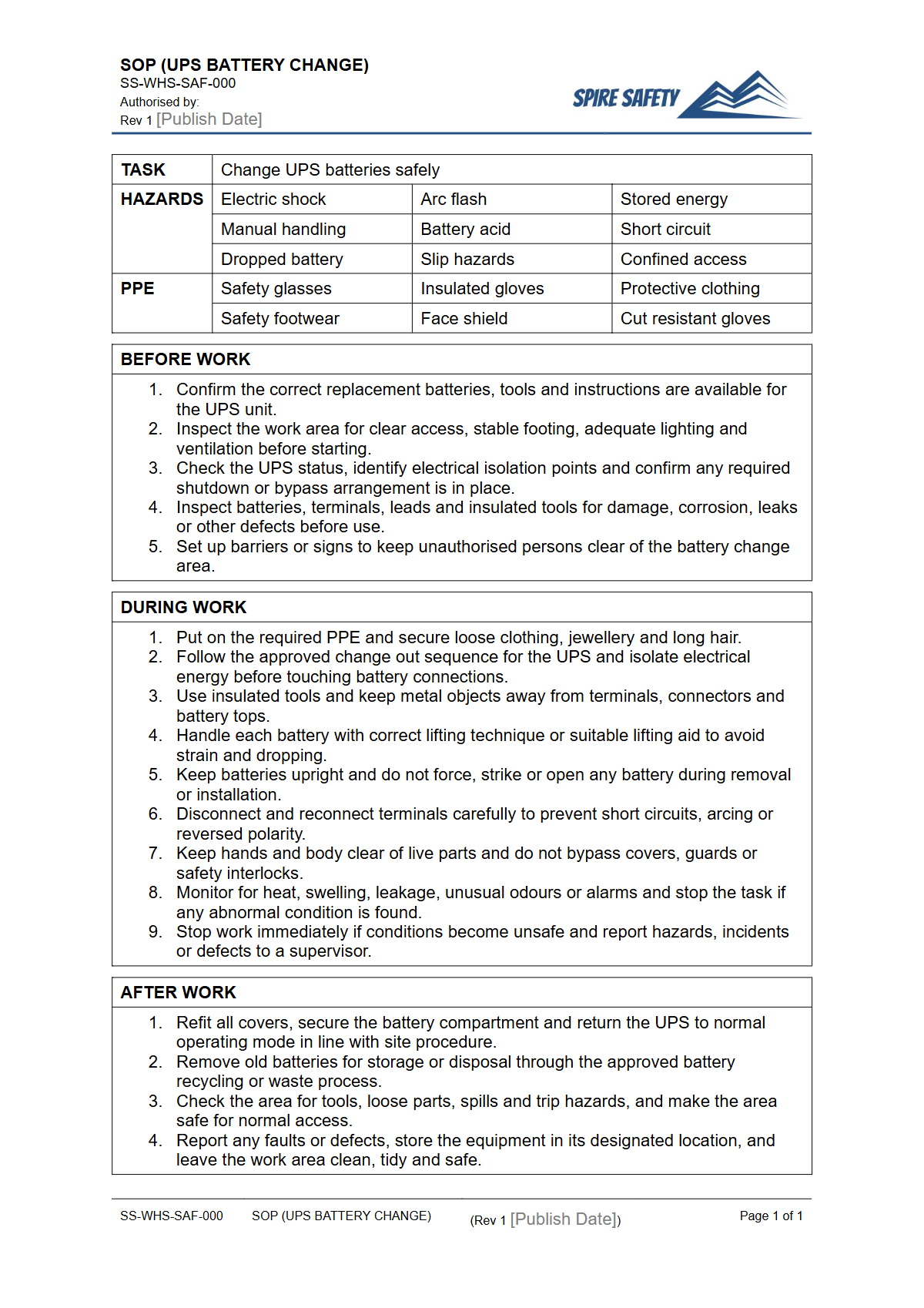
Download our free Safe Operating Procedure for UPS battery changes. This template provides a structured starting point for developing your own site-specific SOP.
Free Safe Operating Procedure (UPS Battery Change) Template
DOCX • 126 KB + PDF
Updated Oct 2026
No signup required
Purpose of the Free Safe Operating Procedure (UPS Battery Change) Template
Changing the batteries in an Uninterruptible Power Supply (UPS) system is a high-risk task that combines electrical, chemical, and manual handling hazards. A formalised procedure is essential for ensuring the safety of personnel and the integrity of your critical power systems.
This free Safe Operating Procedure (UPS Battery Change) template provides a structured framework for documenting the required steps, safety precautions, and control measures for this specific maintenance activity. Using an SOP helps organisations fulfil their duty of care by providing clear, step-by-step instructions that minimise the risk of electrical shock, arc flash, chemical burns from battery acid, or musculoskeletal injuries from lifting heavy components.
Developing robust procedures is a cornerstone of effective safety management. This template helps standardise the process, ensuring that every technician, whether experienced or new to the task, follows a consistent, pre-approved method.
Documenting the process is also crucial for training purposes and serves as a vital reference during incident investigations or safety audits. For more complex operational safety challenges, you may benefit from specialised WHS consulting to ensure all risks are adequately addressed.
Video walkthrough
How to use the Free Safe Operating Procedure (UPS Battery Change) Template
This resource is provided in both DOCX and PDF formats for your convenience. To implement it, download the DOCX file and adapt it to the specific context of your workplace.
The procedure should detail the exact models of UPS units in use, the types of batteries being replaced, and the specific tools and Personal Protective Equipment (PPE) required. It is vital to conduct a site-specific risk assessment and incorporate its findings into the final document.
Important: It is crucial to remember that this is a template, not a finished document. We have designed it as a starting point, and you must customise it to reflect the specific UPS models, battery types, tools, PPE, and environmental conditions at your worksite.
A generic procedure is not sufficient to control specific hazards. Once customised, the SOP should be reviewed and approved by a competent person, such as a maintenance supervisor or WHS manager.
When should you use this Safe Operating Procedure?
A Safe Operating Procedure for a UPS battery change should be used in several key situations. Its primary function is as a direct guide for technicians immediately before and during the maintenance task itself.
It ensures all safety checks, such as electrical isolation and verification, are completed in the correct sequence. The SOP is also an essential training tool for new employees or for refresher training for existing staff to ensure competency is maintained.
Furthermore, it should be reviewed as part of the planning process for scheduled maintenance and used as a benchmark during safety inspections or after any incident involving a UPS system. Regular reviews of SOPs are a key component of well-maintained WHS management systems.
Who should use this document?
This SOP is intended for use by competent and authorised personnel tasked with maintaining UPS systems. This typically includes qualified electricians, specialised data centre technicians, facilities maintenance staff, and IT personnel with appropriate electrical training and credentials.
Supervisors and managers responsible for overseeing these tasks should also use the document to verify that work is being conducted safely and in accordance with established procedures. It is not intended for untrained or unauthorised individuals; interacting with UPS internals without proper training presents a severe risk of injury or death. This is similar to the strict controls needed for other hazardous tasks, such as those detailed in our free Oxy Acetylene SOP template.
Implementing and Reviewing your SOP
After customising and approving the SOP, ensure it is readily accessible to all relevant workers at the point of work. The effectiveness of the procedure should be monitored and reviewed regularly, especially if new equipment is introduced or if an incident occurs.
Conducting periodic checks helps ensure the documented procedure remains effective and practical for controlling risks. You can formalise this process through a program of WHS compliance auditing to verify implementation and identify areas for improvement.
An SOP for one piece of equipment is often part of a much larger library of safety documents. For example, a facility might also require procedures for other electrically powered plant, which can be developed using resources like our free Air Compressor SOP template. Having a consistent format and approach across all procedures helps improve worker comprehension and compliance.
You can browse our entire free WHS resources library for more templates to support your safety system.
Common mistakes
Common mistakes to avoid
- Using non-insulated tools near live battery terminals or busbars.
- Failing to correctly isolate the UPS from both mains and load power before starting.
- Incorrectly connecting new batteries, particularly reversing polarity, which can cause catastrophic failure.
- Attempting to lift heavy battery strings or modules without mechanical aids or team lifting.
Legal references
Legal considerations
The following legal requirements may be relevant to this type of work.
- Work Health and Safety Act (Harmonised) — Provides the primary duties for protecting workers and other people from work health and safety risks.
- Work Health and Safety Regulations (Harmonised) — Sets out requirements supporting the management of workplace hazards and risks.
The following codes may be relevant to this type of work.
- Managing WHS Risks Code of Practice — Provides practical guidance on identifying hazards, assessing risks and applying effective controls.
- Work Health and Safety Consultation, Cooperation and Coordination Code of Practice — Provides practical guidance on consulting workers and coordinating with other duty holders.
- Managing the Work Environment and Facilities Code of Practice — Provides practical guidance on safe work environments, workplace facilities and related controls.
Did you know
Lead-Acid Lifespan
The sealed lead-acid (SLA) batteries common in UPS systems typically have a designed service life of 3-5 years, after which their capacity to hold a charge diminishes significantly.
Arc Flash Danger
An arc flash from a short-circuited high-current battery terminal can reach temperatures of up to 19,000°C, hotter than the surface of the sun, posing a severe burn and fire risk.
FAQ
Frequently asked questions
01What are the main hazards when changing UPS batteries?
02Is a Safe Operating Procedure legally required for changing UPS batteries in Australia?
03What Personal Protective Equipment (PPE) is needed for a UPS battery change?
04Can any IT technician change a UPS battery?
Share this resource
Free Safe Operating Procedure (UPS Battery Change) Template
Browse Categories
How To Use It
- 1Download and open in Word or PDF.
- 2Replace the placeholders with your business details.
- 3Get it reviewed by a WHS specialist before rollout.
Need it customised?
Our WHS consultants can adapt this template to your site, run a gap analysis, or audit what you already have in place.
Book a Free Consultation WHS consulting servicesor call 1300 156 382
Related templates
- Free Safe Operating Procedure (Urinal Bottle Cleaning) Template
- Free Safe Operating Procedure (Urinal Descaling) Template
- Free Safe Operating Procedure (Used Oil Dropoff Intake) Template
- Free Safe Operating Procedure (Vacant Unit Cleaning) Template
- Free Safe Operating Procedure (Vacuum Excavation) Template
- Free Safe Operating Procedure (Vacuum Leak Test) Template