
Free Safe Operating Procedure (Underground Service Scan) Template
Prevent costly service strikes and protect your workers with our structured SOP template. Download our free Safe Operating Procedure for underground service scanning today.
Free Safe Operating Procedure (Underground Service Scan) Template
DOCX • 126 KB + PDF
Updated Oct 2026
No signup required
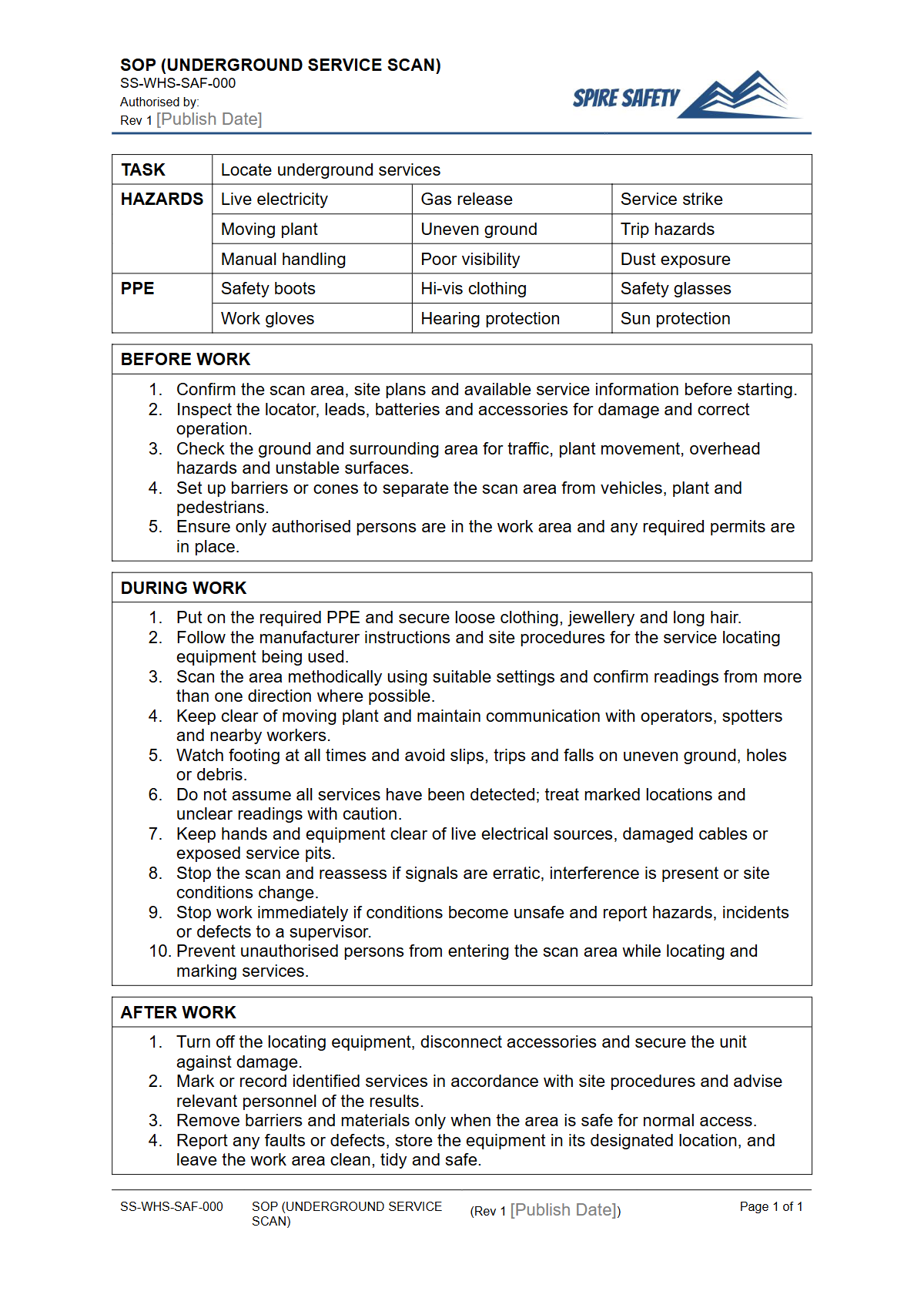
Purpose of the Free Safe Operating Procedure (Underground Service Scan) Template
Excavation and ground penetration activities carry a high risk of striking underground utilities such as electrical cables, gas lines, water pipes, and telecommunications conduits. A service strike can lead to severe injuries, costly project delays, and significant asset damage.
This Free Safe Operating Procedure (Underground Service Scan) Template provides a structured framework for identifying and locating these hidden services before any work begins. It outlines the essential steps for planning, scanning, marking, and documenting subsurface utilities, forming a critical part of a safe system of work.
Implementing a robust SOP helps organisations meet their duty of care and prevents catastrophic incidents on site.
By standardising the process, this SOP ensures that all personnel follow a consistent, safety-focused methodology. It serves as a vital tool for risk management, especially when used alongside task-specific procedures like a free Trencher SOP template, which details the safe use of excavation machinery.
The goal is to create a work environment where breaking ground is a predictable and controlled activity, not a gamble.
Video walkthrough
How to use the Free Safe Operating Procedure (Underground Service Scan) Template
This downloadable document is provided in both DOCX and PDF formats for your convenience. The DOCX file is fully editable, allowing you to adapt it to the specific requirements of your worksite.
It is crucial to recognise that this document is a template, not a finished procedure. Effective safety management requires site-specific customisation.
IMPORTANT: This is a template only. You must customise it to reflect the specific equipment (e.g., Ground Penetrating Radar, cable locators), environment, local regulations, and risks present in your workplace.
We recommend a competent person reviews and approves the final document before implementation. Ensure you insert your company name, specify the makes and models of scanning equipment used, and detail your site-specific emergency response procedures in the event of a service strike.
When to use an Underground Service Scan SOP
This Safe Operating Procedure should be implemented before any activity that involves disturbing the ground surface. It is not limited to large-scale excavation projects.
Even seemingly minor tasks can pose a significant risk if underground services are present. Use this SOP as a mandatory pre-work requirement for activities including:
- Mechanical excavation and trenching
- Drilling, boring, or piling
- Driving posts, stakes, or fencing
- Grading and earthmoving
- Any form of demolition that impacts ground slabs or footings
Integrating this procedure is a fundamental component of well-developed WHS management systems, ensuring that risk controls are systematically applied for all relevant high-risk construction work. It should be referenced in project plans, Safe Work Method Statements (SWMS), and pre-start meetings.
Who should use it
This SOP is intended for use by all personnel involved in planning and executing groundwork. This includes, but is not limited to:
- Equipment Operators: Individuals physically operating the scanning equipment must be trained and competent in its use and limitations.
- Site Supervisors & Forepersons: Responsible for ensuring the SOP is followed, permits are in place, and all workers understand the identified risks.
- Project Managers: For planning and allocating sufficient time and resources for thorough service locating activities.
- Safety Officers: For auditing compliance with the procedure and providing advice on risk controls.
Ultimately, any person with a responsibility to ensure safety during excavation work will benefit from this procedure. If you need assistance integrating this SOP or verifying its effectiveness on-site, consider seeking specialist WHS consulting support to ensure your processes are robust and practical.
Key Steps in an Underground Service Scan
A comprehensive scan involves more than just waving a device over the ground. A systematic approach is essential for accuracy and reliability.
Planning and Preparation
Before arriving on site, the process begins with a desktop review. This involves obtaining Dial Before You Dig (DBYD) plans and any other available service diagrams for the area.
These plans provide an initial indication of what utilities may be present but should never be solely relied upon. They are often not to scale and may not show all services, particularly private ones installed after the main infrastructure.
On-Site Scanning and Verification
Once on-site, a physical scan is conducted using appropriate equipment. This may involve a combination of radio detection (cable avoidance tools) and Ground Penetrating Radar (GPR) to locate a wider range of utility types, including non-metallic pipes.
The operator should conduct systematic sweeps of the entire work area in a grid pattern to ensure complete coverage. Cross-checking findings with DBYD plans is a critical verification step.
This process helps confirm the accuracy of plans and identify unrecorded services. For subsequent earthmoving, a procedure like our free Scraper SOP template should then be followed.
Marking, Reporting, and Handover
As services are located, they must be clearly marked on the ground surface using the standard colour codes (e.g., yellow for gas, orange for electrical, blue for water). The depth and alignment of each service should be recorded.
A site sketch or photographic record should be created and included in a formal report. This information must be communicated to all relevant personnel during a pre-start meeting or handover, ensuring everyone is aware of the location of hazards before any excavation starts.
Verifying these steps are consistently followed is a key part of any WHS compliance auditing program for high-risk work.
This document is one of many tools designed to help you build a safer workplace. For more templates and checklists, browse our free WHS resources library.
Common mistakes
Common mistakes to avoid
- Relying solely on 'Dial Before You Dig' plans without physical scanning.
- Using inappropriate or uncalibrated equipment for the site conditions.
- Failing to establish and maintain clearly marked exclusion zones around located services.
- Proceeding with mechanical excavation too close to marked utilities instead of using non-destructive methods to expose them first.
Legal references
Legal considerations
The following legal requirements may be relevant to this type of work.
- Work Health and Safety Act (Harmonised) — Provides the primary duties for protecting workers and other people from work health and safety risks.
- Work Health and Safety Regulations (Harmonised) — Sets out requirements supporting the management of workplace hazards and risks.
The following codes may be relevant to this type of work.
- Managing WHS Risks Code of Practice — Provides practical guidance on identifying hazards, assessing risks and applying effective controls.
- Work Health and Safety Consultation, Cooperation and Coordination Code of Practice — Provides practical guidance on consulting workers and coordinating with other duty holders.
- Managing the Work Environment and Facilities Code of Practice — Provides practical guidance on safe work environments, workplace facilities and related controls.
Did you know
The Cost of a Strike
Striking an underground asset can have enormous direct and indirect costs, including repair bills, project delays, regulatory fines, and reputational damage, far exceeding the initial cost of a professional service scan.
Standard Colour Codes
Australia uses a national standard (AS 5488) for marking underground utilities. For example, orange is used for electricity, yellow for gas, blue for water, and white for communications.
FAQ
Frequently asked questions
01What is Dial Before You Dig (DBYD)?
02What qualifications are needed to perform an underground service scan?
03How often should scanning equipment be calibrated?
04Does this SOP cover potholing or hydro-excavation?
Share this resource
Free Safe Operating Procedure (Underground Service Scan) Template
Browse Categories
How To Use It
- 1Download and open in Word or PDF.
- 2Replace the placeholders with your business details.
- 3Get it reviewed by a WHS specialist before rollout.
Need it customised?
Our WHS consultants can adapt this template to your site, run a gap analysis, or audit what you already have in place.
Book a Free Consultation WHS consulting servicesor call 1300 156 382
Related templates
- Free Safe Operating Procedure (Upholstery Cleaning) Template
- Free Safe Operating Procedure (UPS Battery Change) Template
- Free Safe Operating Procedure (Urinal Bottle Cleaning) Template
- Free Safe Operating Procedure (Urinal Descaling) Template
- Free Safe Operating Procedure (Used Oil Dropoff Intake) Template
- Free Safe Operating Procedure (Vacant Unit Cleaning) Template