
Free Safe Operating Procedure (Tyre Inflation) Template
Download our free Safe Operating Procedure (Tyre Inflation) Template to manage risks associated with tyre maintenance.
Free Safe Operating Procedure (Tyre Inflation) Template
DOCX • 126 KB + PDF
Updated Oct 2026
No signup required
Purpose of the Free Safe Operating Procedure (Tyre Inflation) Template
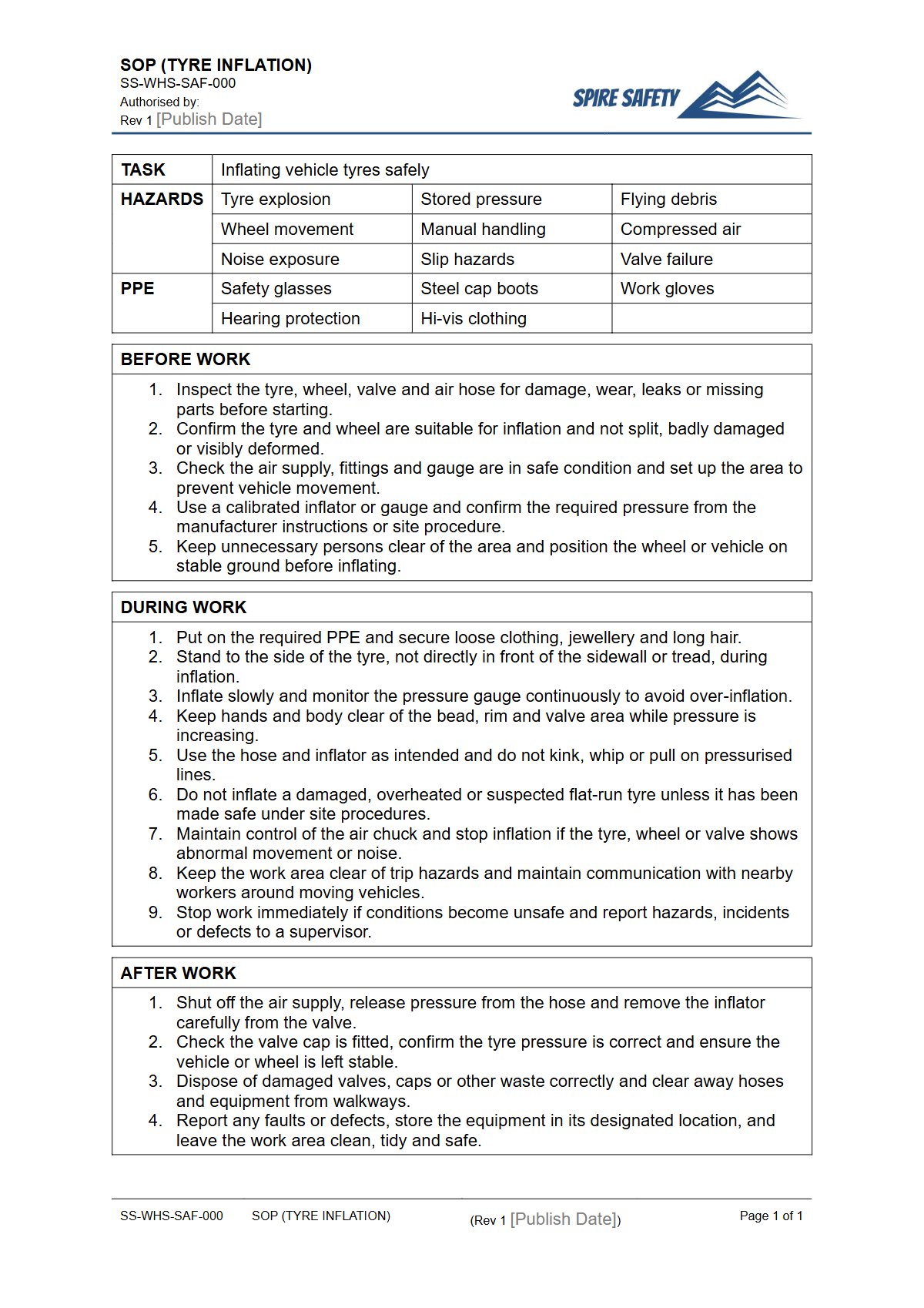
This free Safe Operating Procedure (Tyre Inflation) Template provides a structured framework for documenting the safety requirements for inflating tyres in your workplace. The task involves significant stored energy, presenting risks of over-pressurisation, catastrophic failure, and worker injury from projectiles or violent air release.
A formalised SOP helps to control these hazards by outlining a consistent, step-by-step method for all personnel to follow.
A well-developed SOP is a critical administrative control that supports your risk management process. It defines the required personal protective equipment (PPE), pre-operational checks for equipment like compressors and inflation gauges, and the specific actions needed to perform the job safely.
Because compressors are the power source for this task, it's vital that their operation is also managed; our Free Air Compressor SOP Template can help formalise those related procedures.
Video walkthrough
How to use the Free Safe Operating Procedure (Tyre Inflation) Template
To use this Safe Operating Procedure template, simply download the DOCX file and open it in your preferred word processor. The document is designed as a foundation, which you must then review and adapt to suit your specific operational context.
It is crucial to understand that this template is a starting point. We have provided a comprehensive framework, but you must adapt it to reflect the specific equipment, environment, and risks at your site.
This customisation process is essential for creating a document that is truly effective. Your final SOP should be integrated into your broader safety framework.
A robust procedure is a key element of effective WHS management systems, ensuring that safety is embedded in routine tasks. As you adapt this document, consider the specific types of plant used on your site, as procedures for inflating tyres on a small utility vehicle differ greatly from those for heavy machinery like a trencher; you may need separate SOPs for different equipment classes, referencing our FREE Trencher SOP Template as another example.
Key Sections to Customise
- Plant and Equipment: List the specific types of inflation gauges, hoses, connectors, and tyre cages used at your workplace.
- PPE Requirements: Adjust the personal protective equipment list to match your site's risk assessment findings (e.g., safety glasses, hearing protection, steel-capped boots).
- Step-by-Step Procedure: Modify the inflation steps to detail the process for the tyres your team handles, including light vehicles, trucks, or heavy earthmoving equipment. Include manufacturer-specified pressure limits.
- Emergency Procedures: Detail your site-specific emergency response, including contact numbers, first aid procedures, and incident reporting protocols.
When to use it
An SOP for tyre inflation should be used as a primary reference document for several key activities. It is an essential tool for training new employees and for conducting refresher courses for experienced workers, ensuring everyone understands the established safety standards. Workers should review the SOP before commencing work, especially for non-routine or high-risk inflation tasks, such as those involving multi-piece rims or large plant like telehandlers, which have their own operational risks that can be documented using resources like our FREE Telehandler SOP Template.
Supervisors and managers can use the SOP as a benchmark for workplace observations and to verify that correct procedures are being followed. The document also serves as a critical piece of evidence during safety reviews and incident investigations.
To ensure its ongoing relevance and effectiveness, the SOP should be reviewed periodically as part of a regular WHS compliance auditing program, or whenever there is a change in equipment, processes, or regulations.
Who should use it
This Safe Operating Procedure is intended for anyone involved in the tyre inflation process. This includes, but is not limited to, vehicle mechanics, tyre fitters, apprentices, mobile plant operators, and service technicians.
All personnel who perform or directly supervise this task must be trained and deemed competent in the procedure outlined in the finalised SOP.
WHS managers, safety advisors, and business owners should also use this template to establish and maintain consistent safety standards across the organisation. It provides a clear, documented process that helps demonstrate due diligence in managing a known workplace hazard. For those looking to build a comprehensive library of safety documents, you can find more templates in our free WHS resources library.
Common mistakes
Common mistakes to avoid
- Using damaged or incorrect inflation equipment, such as frayed hoses or mismatched connectors.
- Standing directly in front of the tyre during inflation, which is in the direct line of fire.
- Failing to use a tyre inflation cage for high-risk tyres like truck, bus, or earthmoving equipment wheels.
- Neglecting to inspect the tyre and rim for damage, defects, or corrosion before beginning inflation.
Legal references
Legal considerations
The following legal requirements may be relevant to this type of work.
- Work Health and Safety Act (Harmonised) — Provides the primary duties for protecting workers and other people from work health and safety risks.
- Work Health and Safety Regulations (Harmonised) — Sets out requirements supporting the management of workplace hazards and risks.
The following codes may be relevant to this type of work.
- Managing WHS Risks Code of Practice — Provides practical guidance on identifying hazards, assessing risks and applying effective controls.
- Work Health and Safety Consultation, Cooperation and Coordination Code of Practice — Provides practical guidance on consulting workers and coordinating with other duty holders.
- Managing the Work Environment and Facilities Code of Practice — Provides practical guidance on safe work environments, workplace facilities and related controls.
Did you know
Explosive Force
A truck tyre that fails catastrophically during inflation can explode with enough force to launch a 5kg bowling ball over 1.5 kilometres.
Pressure Accuracy
Using an uncalibrated or damaged pressure gauge is a leading cause of over-inflation. Gauges should be checked and calibrated regularly to ensure they provide accurate readings.
FAQ
Frequently asked questions
01What is a Safe Operating Procedure for tyre inflation?
02Why is a dedicated SOP for tyre inflation necessary?
03Does this template cover split rim and multi-piece wheels?
04How often should an SOP for tyre inflation be reviewed?
Share this resource
Free Safe Operating Procedure (Tyre Inflation) Template
Browse Categories
How To Use It
- 1Download and open in Word or PDF.
- 2Replace the placeholders with your business details.
- 3Get it reviewed by a WHS specialist before rollout.
Need it customised?
Our WHS consultants can adapt this template to your site, run a gap analysis, or audit what you already have in place.
Book a Free Consultation WHS consulting servicesor call 1300 156 382
Related templates
- Free Safe Operating Procedure (Tyre Recycling Intake) Template
- Free Safe Operating Procedure (ULD Handling) Template
- Free Safe Operating Procedure (Ultrasonic Cleaner) Template
- Free Safe Operating Procedure (Ultrasonic Weld Test) Template
- Free Safe Operating Procedure (Underground Service Scan) Template
- Free Safe Operating Procedure (Upholstery Cleaning) Template