
Free Safe Operating Procedure (ULD Handling) Template
Streamline your safety protocols for Unit Load Device operations. Download our free Safe Operating Procedure (ULD Handling) template to get started.
Free Safe Operating Procedure (ULD Handling) Template
DOCX • 126 KB + PDF
Updated Oct 2026
No signup required
Purpose of the Free Safe Operating Procedure (ULD Handling) Template
Unit Load Devices (ULDs) are essential for moving cargo and baggage in the aviation and logistics industries, but their handling presents significant safety risks. This Safe Operating Procedure (SOP) for ULD handling is designed to provide a structured framework for documenting the required steps to perform this task safely.
Its purpose is to help Persons Conducting a Business or Undertaking (PCBUs) control hazards like manual handling injuries, crush risks from moving equipment, and incidents caused by damaged or poorly loaded ULDs. By establishing a clear, step-by-step guide, you can standardise safe work practices, assist in worker training, and demonstrate a commitment to fulfilling your WHS duties.
Implementing a documented procedure helps ensure that all workers, from ground crew to warehouse staff, understand the expected safety standards and controls. A well-defined SOP is a cornerstone of an effective safety management system.
For comprehensive oversight, this can be supported by regular WHS compliance audits to verify that documented procedures are being followed correctly in practice.
Video walkthrough
How to use the Free Safe Operating Procedure (ULD Handling) Template
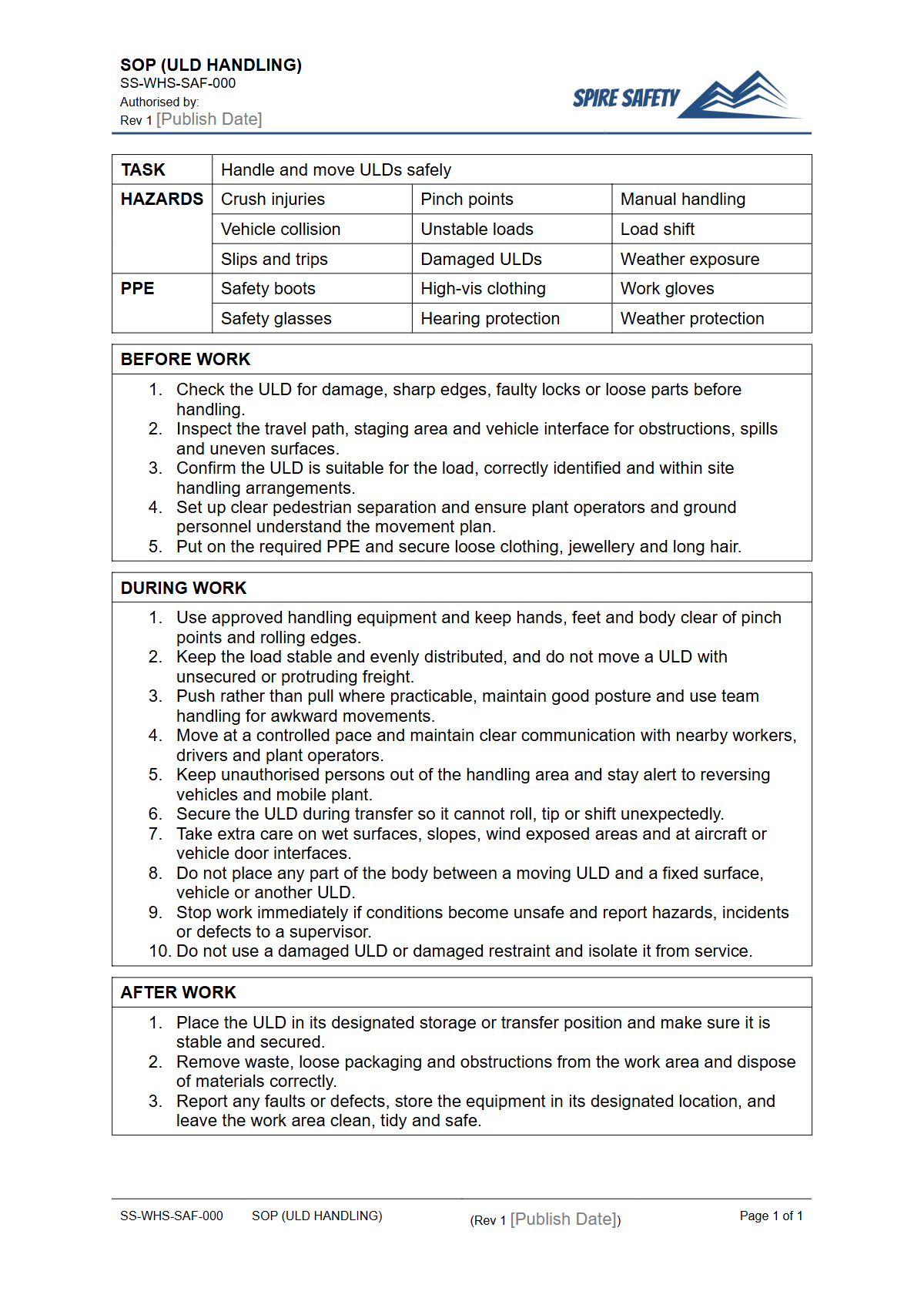
This template is available for download as a fully editable DOCX file, with a PDF version also provided for easy printing and distribution. It is structured to align with Australian WHS best practices, covering key areas such as pre-operational checks, operational steps, and post-task clean-up.
The procedure also includes sections for identifying required Personal Protective Equipment (PPE) and detailing potential hazards and their control measures.
Important: This document is a template, not a finished product. To make it effective, we strongly recommend you customise it to reflect the specific ULDs (e.g., pallets, containers), handling equipment (dollies, forklifts, loaders), and unique environmental conditions of your workplace.
Consult with your workers during this customisation process to ensure the SOP is practical and addresses the real-world risks they face. For tasks involving related machinery, consider using our free Conveyer System SOP to build out a complete set of procedures.
When to use a ULD Handling SOP
A Safe Operating Procedure for ULD handling should be a living document integrated into your daily operations. It is not a file to be written once and forgotten. It should be used consistently as a primary reference for:
- Worker Training and Induction: Use the SOP to train new employees on the correct, safe methods for handling ULDs before they begin the task.
- Pre-Task Planning: Workers should review the SOP as a refresher before commencing ULD handling operations, especially for non-routine tasks.
- Supervision and Monitoring: Supervisors can use the SOP as a benchmark to monitor work practices and ensure tasks are performed as required.
- Incident Investigation: If an incident or near-miss occurs, the SOP provides a baseline to help determine if procedural gaps or non-compliance contributed to the event.
- Refresher Training: The procedure should form the basis of periodic refresher training to reinforce safe behaviours and introduce any updated processes.
Who should use this SOP
This Safe Operating Procedure is intended for use by a wide range of personnel involved in the lifecycle of ULD handling. This includes:
- Ground Crew and Baggage Handlers: The primary operators who physically move, load, and unload ULDs.
- Warehouse and Logistics Staff: Workers responsible for building up, breaking down, and storing ULDs.
- Forklift and Telehandler Operators: Personnel using powered mobile plant to transport ULDs. If your operations involve specialised equipment, our free Telehandler SOP may also be a useful resource.
- Supervisors and Team Leaders: Those responsible for overseeing work and ensuring procedures are followed.
- WHS Managers and Advisors: Professionals who develop, implement, and review safety documentation as part of broader WHS management systems.
Key Hazards in ULD Handling
Handling ULDs involves several significant hazards that must be controlled. Common risks include:
- Manual Handling: Pushing, pulling, and lifting ULDs or their contents can lead to musculoskeletal injuries if not managed with mechanical aids and proper techniques.
- Struck-by Incidents: Workers can be struck by moving ULDs, dollies, forklifts, or aircraft service vehicles in a busy operational environment.
- Crush Injuries: Body parts can be crushed between a ULD and another object, such as a vehicle, storage rack, or conveyer system.
- Damaged Equipment: Using ULDs with structural damage, faulty locks, or torn nets can lead to load instability and failure.
- Falls: Items falling from improperly secured or over-stacked ULDs pose a risk to people below.
Regular maintenance and inspection of all associated equipment is vital for safety. For instance, if your facility uses compressed air for cleaning or maintenance tasks, having a clear Air Compressor SOP ensures that machinery is also operated safely.
You can find more templates like this in our complete free WHS resources library to support your different operational needs.
Common mistakes
Common mistakes to avoid
- Using ULDs that are visibly damaged, such as cracked frames or faulty locking mechanisms.
- Attempting to manually push or move heavy ULDs without using appropriate mechanical aids like dollies or forklifts.
- Failing to properly inspect nets, straps, and locks for wear and tear before securing a load.
- Exceeding the maximum gross weight limit specified for the ULD.
Legal references
Legal considerations
The following legal requirements may be relevant to this type of work.
- Work Health and Safety Act (Harmonised) — Provides the primary duties for protecting workers and other people from work health and safety risks.
- Work Health and Safety Regulations (Harmonised) — Sets out requirements supporting the management of workplace hazards and risks.
The following codes may be relevant to this type of work.
- Managing WHS Risks Code of Practice — Provides practical guidance on identifying hazards, assessing risks and applying effective controls.
- Work Health and Safety Consultation, Cooperation and Coordination Code of Practice — Provides practical guidance on consulting workers and coordinating with other duty holders.
- Managing the Work Environment and Facilities Code of Practice — Provides practical guidance on safe work environments, workplace facilities and related controls.
Did you know
Standardised Efficiency
The International Air Transport Association (IATA) regulates the design, specifications, and maintenance of ULDs to ensure they are compatible with the loading systems of various wide-body aircraft, promoting global efficiency and safety.
Heavy Lifting
A fully loaded main deck cargo container, such as an AMA container, can weigh over 6,800 kilograms. This immense weight highlights why relying on mechanical aids and safe procedures is non-negotiable.
FAQ
Frequently asked questions
01What is a ULD in aviation and logistics?
02What are the main WHS risks when handling ULDs?
03How often should a Safe Operating Procedure for ULD handling be reviewed?
04Is specific training required to handle ULDs?
Share this resource
Free Safe Operating Procedure (ULD Handling) Template
Browse Categories
How To Use It
- 1Download and open in Word or PDF.
- 2Replace the placeholders with your business details.
- 3Get it reviewed by a WHS specialist before rollout.
Need it customised?
Our WHS consultants can adapt this template to your site, run a gap analysis, or audit what you already have in place.
Book a Free Consultation WHS consulting servicesor call 1300 156 382
Related templates
- Free Safe Operating Procedure (Ultrasonic Cleaner) Template
- Free Safe Operating Procedure (Ultrasonic Weld Test) Template
- Free Safe Operating Procedure (Underground Service Scan) Template
- Free Safe Operating Procedure (Upholstery Cleaning) Template
- Free Safe Operating Procedure (UPS Battery Change) Template
- Free Safe Operating Procedure (Urinal Bottle Cleaning) Template