
Free Safe Operating Procedure (Ultrasonic Cleaner) Template
Streamline your workshop safety with our free Safe Operating Procedure (Ultrasonic Cleaner) template. Download your customisable DOCX and PDF now.
Free Safe Operating Procedure (Ultrasonic Cleaner) Template
DOCX • 126 KB + PDF
Updated Oct 2026
No signup required
Purpose of the Free Safe Operating Procedure (Ultrasonic Cleaner) Template
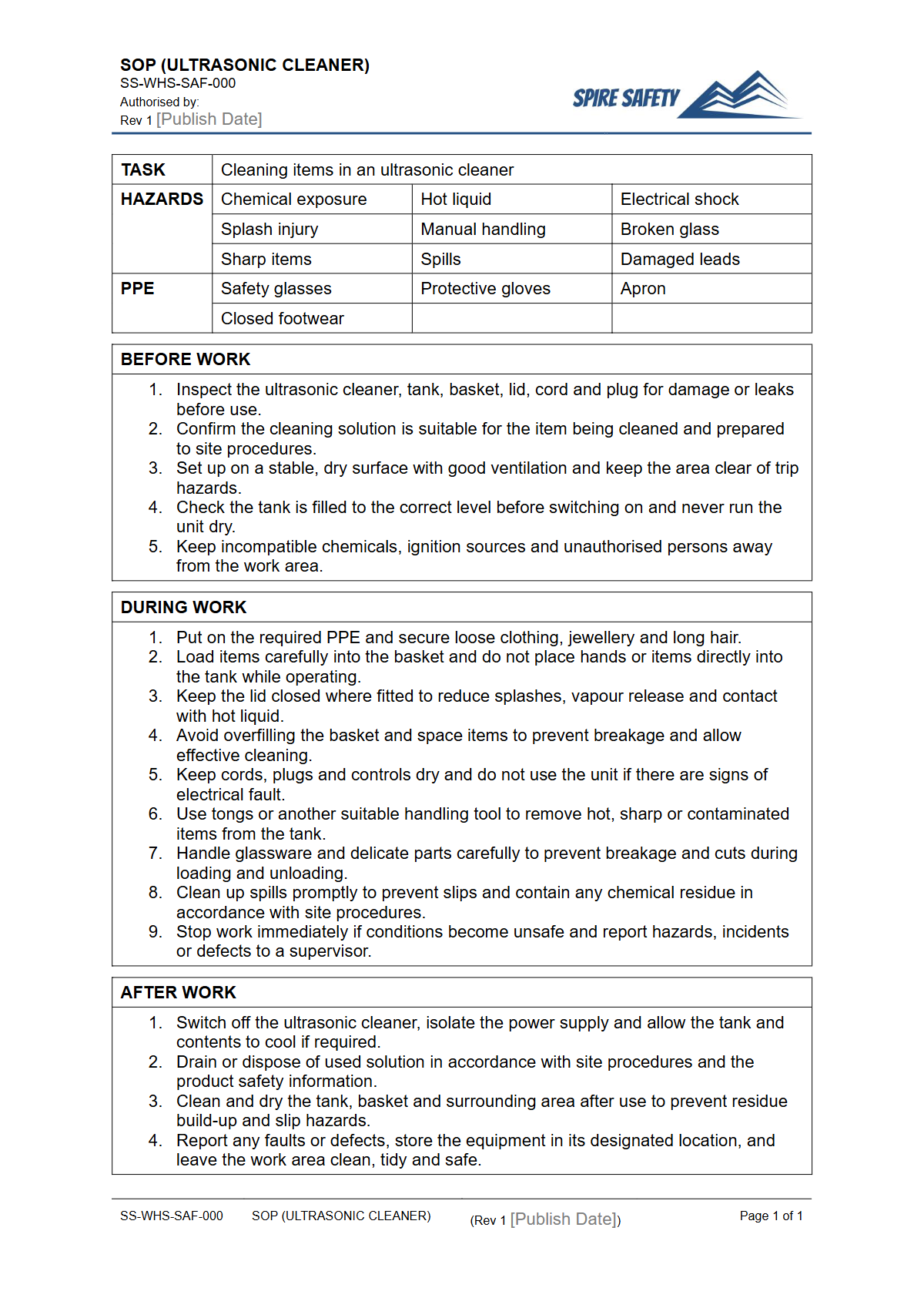
This Free Safe Operating Procedure (Ultrasonic Cleaner) Template provides a structured framework for documenting the safe use of ultrasonic cleaning equipment in your workplace. Ultrasonic cleaners, while highly effective, introduce several hazards that must be managed.
These include exposure to hazardous chemicals, high-frequency noise, hot surfaces, and electrical risks. A formal SOP ensures all operators are aware of the correct procedures, from pre-operational checks to shutdown, minimising the risk of injury or equipment damage. Implementing robust procedures like this is a key component of effective WHS management systems.
Video walkthrough
How to use the Free Safe Operating Procedure (Ultrasonic Cleaner) Template
Our template is designed as a comprehensive starting point, not a finished document. You must customise it to reflect your specific workplace environment, the exact model of ultrasonic cleaner you use, the types of cleaning solutions handled, and your existing risk assessments.
Download the DOCX file and edit the sections to align with your operational context, adding or removing steps as necessary.
Customisation is Essential
We have created this template to be a helpful guide, but we cannot know the specific hazards of your workplace. It is your responsibility as the PCBU (or delegate) to conduct a thorough risk assessment and adapt this document to ensure it is suitable for your business.
This SOP should be a practical tool that reflects how work is actually done safely on-site. Similar to our Free Air Compressor SOP (Safe Operating Procedure) Template, this document becomes truly effective only after site-specific customisation.
When to use a Safe Operating Procedure
An SOP for an ultrasonic cleaner should be a central part of your safety processes. It is used during the induction and training of new operators to establish a baseline of safe behaviour.
Experienced workers should use it as a reference to refresh their knowledge, particularly for non-routine cleaning tasks. It is also an essential document for supervisors to refer to when conducting observations or safety checks, ensuring that agreed-upon procedures are consistently followed.
Using SOPs for all workshop equipment, including tools covered in our FREE Circular Saw SOP (Safe Operating Procedure) Template, creates a consistent and reliable safety culture.
Who should use this Safe Operating Procedure
This document is intended for several key roles within an organisation:
- Persons Conducting a Business or Undertaking (PCBUs): To meet their primary duty of care by providing safe systems of work.
- Managers and Supervisors: To train workers, enforce safe practices, and conduct safety monitoring. Regular checks against the SOP can form part of a broader WHS compliance auditing program.
- Workers and Operators: As a clear, step-by-step guide for performing their tasks safely and consistently.
Only workers who have been properly trained and deemed competent should be authorised to operate an ultrasonic cleaner. This SOP should form the basis of that training and competency assessment.
Key Steps for Safe Operation
While your customised SOP will contain specific details, it should always cover these fundamental stages:
- Pre-Operational Checks: Inspecting the unit for damage, checking power cords, ensuring proper ventilation, and confirming the cleaning solution is appropriate and at the correct level.
- Personal Protective Equipment (PPE): Defining the mandatory PPE, which typically includes safety glasses or a face shield, chemical-resistant gloves, and potentially hearing protection depending on the machine's noise output.
- Operation: Procedures for loading parts, setting temperature and time controls, and the critical instruction to never place hands in an active cleaning bath. The use of a lid to reduce noise and vapour exposure should be mandatory. This mirrors the process-driven safety needed for other specialised equipment detailed in resources like our FREE Oxy Acetylene SOP (Safe Operating Procedure) Template.
- Shutdown and Cleaning: Safe methods for draining solutions (following hazardous waste protocols), cleaning the tank, and storing the unit correctly.
By thoroughly documenting these steps, you create a reliable and repeatable process that protects your team. You can find more templates and checklists across a range of equipment and tasks in our free WHS resources library.
Common mistakes
Common mistakes to avoid
- Using flammable or unapproved cleaning solvents, creating a fire or explosion risk.
- Placing hands directly into the cleaning solution while the machine is operating.
- Operating the unit without sufficient liquid, which can damage the transducers.
- Neglecting to use a lid, leading to increased noise exposure and chemical vapour inhalation.
Legal references
Legal considerations
The following legal requirements may be relevant to this type of work.
- Work Health and Safety Act (Harmonised) — Provides the primary duties for protecting workers and other people from work health and safety risks.
- Work Health and Safety Regulations (Harmonised) — Sets out requirements supporting the management of workplace hazards and risks.
The following codes may be relevant to this type of work.
- Managing WHS Risks Code of Practice — Provides practical guidance on identifying hazards, assessing risks and applying effective controls.
- Work Health and Safety Consultation, Cooperation and Coordination Code of Practice — Provides practical guidance on consulting workers and coordinating with other duty holders.
- Managing the Work Environment and Facilities Code of Practice — Provides practical guidance on safe work environments, workplace facilities and related controls.
Did you know
Invisible Bubbles
Ultrasonic cleaning works through a process called cavitation, where millions of microscopic bubbles form and implode due to high-frequency sound waves. This implosion creates a tiny but powerful scrubbing action that dislodges contaminants.
Beyond Human Hearing
The sound waves used are 'ultrasonic' because their frequency (typically 20–40 kHz) is above the range of normal human hearing. However, the cavitation process itself can create audible, high-pitched noise that may require hearing protection.
FAQ
Frequently asked questions
01What are the main hazards of using an ultrasonic cleaner?
02Is special PPE required for operating an ultrasonic cleaner?
03How often should an ultrasonic cleaner SOP be reviewed?
04Can any cleaning solution be used in an ultrasonic cleaner?
Share this resource
Free Safe Operating Procedure (Ultrasonic Cleaner) Template
Browse Categories
How To Use It
- 1Download and open in Word or PDF.
- 2Replace the placeholders with your business details.
- 3Get it reviewed by a WHS specialist before rollout.
Need it customised?
Our WHS consultants can adapt this template to your site, run a gap analysis, or audit what you already have in place.
Book a Free Consultation WHS consulting servicesor call 1300 156 382
Related templates
- Free Safe Operating Procedure (Ultrasonic Weld Test) Template
- Free Safe Operating Procedure (Underground Service Scan) Template
- Free Safe Operating Procedure (Upholstery Cleaning) Template
- Free Safe Operating Procedure (UPS Battery Change) Template
- Free Safe Operating Procedure (Urinal Bottle Cleaning) Template
- Free Safe Operating Procedure (Urinal Descaling) Template