
Free Safe Operating Procedure (Tyre Recycling Intake) Template
Clearly define the hazards and control measures for receiving and processing end-of-life tyres at your recycling facility. Download our free template to start.
Free Safe Operating Procedure (Tyre Recycling Intake) Template
DOCX • 126 KB + PDF
Updated Oct 2026
No signup required
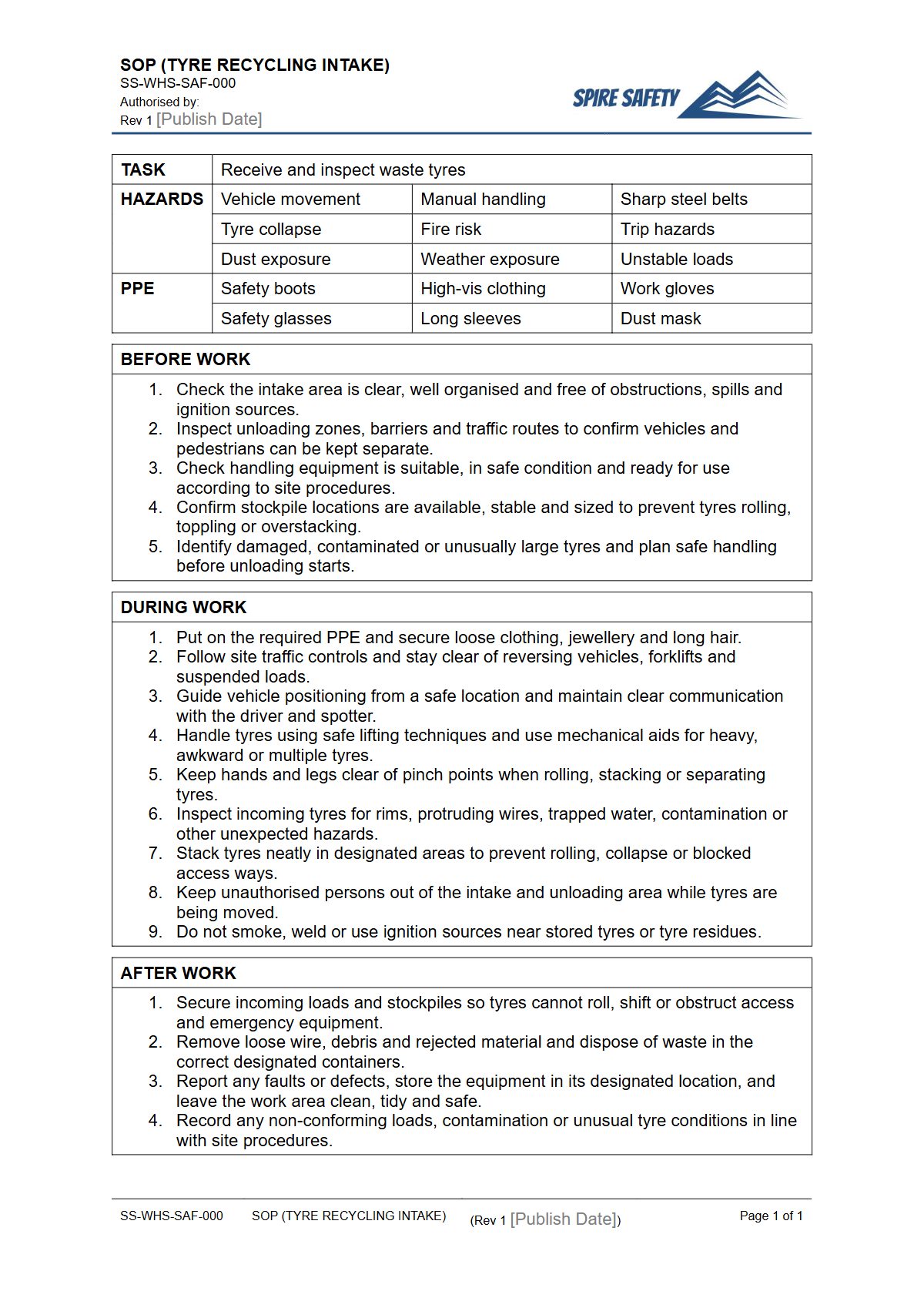
Purpose of the Free Safe Operating Procedure (Tyre Recycling Intake) Template
Managing the intake process at a tyre recycling facility involves significant work health and safety risks. This Free Safe Operating Procedure (Tyre Recycling Intake) Template provides a structured starting point for your organisation to document the required steps for safely receiving, inspecting, and handling end-of-life tyres.
Using a documented procedure helps control hazards such as manual handling injuries, fire risks, vehicle interaction, and exposure to contaminants. A clear SOP is a critical component of a safe system of work, helping you meet your duties under Australian WHS legislation.
This template is designed to guide you in establishing controls for key tasks, including unloading delivery vehicles, initial tyre sorting, identifying non-conforming materials, and moving tyres to the initial storage or processing area. A well-developed SOP forms a fundamental part of a robust WHS management system, providing consistency in training and operational performance.
It helps ensure every worker understands the expected safety standards and procedural requirements for their role in the intake process.
Video walkthrough
How to use the Free Safe Operating Procedure (Tyre Recycling Intake) Template
This document is a template and not a complete Safe Operating Procedure. To make it effective for your workplace, you must customise it to reflect your specific site, equipment, materials, and processes.
We strongly recommend a consultation process involving workers who perform the tasks, as their direct experience is invaluable for identifying hazards and developing practical controls. You will need to add details specific to your machinery (e.g., forklifts, loaders), site layout, types of tyres accepted, and emergency procedures.
Follow these steps to effectively implement this SOP:
- Risk Assessment: Conduct a thorough risk assessment for all tyre recycling intake activities to identify all potential hazards.
- Customisation: Fill in the template with specific details including site-specific rules, types of machinery used, PPE requirements, and emergency contacts. If your process involves specialised machinery like telehandlers, you may want to cross-reference with our FREE Telehandler SOP Template.
- Consultation: Review the draft SOP with workers, supervisors, and health and safety representatives.
- Training: Provide training to all relevant personnel on the finalised SOP, ensuring they understand the procedures and can apply them correctly.
- Review: Schedule regular reviews of the SOP (e.g., annually, or after an incident) to ensure it remains current and effective.
When to use this Safe Operating Procedure
A Safe Operating Procedure for tyre recycling intake should be used consistently as a reference and training tool. It is essential during the induction and training of new employees to ensure they understand the risks and control measures from day one.
It should also be readily available in the work area for workers to reference before and during operations. Furthermore, the SOP is a key document during safety audits and incident investigations, helping to verify that established procedures were followed and to identify areas for improvement.
Regular WHS compliance auditing can help confirm that the practices outlined in your SOP are being consistently applied on the ground.
The SOP should be formally reviewed whenever there are changes to the work environment, such as the introduction of new machinery, a change in the types of tyres being accepted, or an alteration to the workflow. If conveyors are part of your intake process, it's wise to have a dedicated procedure for them, and you might find our free Conveyer System SOP a useful starting point.
Who should use this Safe Operating Procedure
This SOP is intended for use by all individuals involved in the tyre recycling intake process. This includes:
- Workers and Operators: The primary users, who must follow the procedure to perform their tasks safely.
- Supervisors and Managers: Responsible for ensuring workers are trained on and adhere to the SOP, as well as for conducting reviews and updates.
- Health and Safety Representatives (HSRs): To assist in the consultation, development, and review process, representing the safety interests of their work group.
- Persons Conducting a Business or Undertaking (PCBUs): To help meet their primary duty of care to provide and maintain a safe system of work.
For other procedural documents, you can explore our broader free WHS resources library to find templates relevant to your operations.
Common mistakes
Common mistakes to avoid
- Using the generic template without customising it for site-specific machinery and layout.
- Failing to adequately train all workers on the finalised SOP and confirm their understanding.
- Neglecting fire prevention controls, such as limits on stockpile size and separation distances.
- Providing inadequate or poorly maintained Personal Protective Equipment (PPE) for tasks.
Legal references
Legal considerations
The following legal requirements may be relevant to this type of work.
- Work Health and Safety Act (Harmonised) — Provides the primary duties for protecting workers and other people from work health and safety risks.
- Work Health and Safety Regulations (Harmonised) — Sets out requirements supporting the management of workplace hazards and risks.
The following codes may be relevant to this type of work.
- Managing WHS Risks Code of Practice — Provides practical guidance on identifying hazards, assessing risks and applying effective controls.
- Work Health and Safety Consultation, Cooperation and Coordination Code of Practice — Provides practical guidance on consulting workers and coordinating with other duty holders.
- Managing the Work Environment and Facilities Code of Practice — Provides practical guidance on safe work environments, workplace facilities and related controls.
Did you know
Tyre Fire Risk
Waste tyres contain a high level of stored energy, similar to that of coal. Once ignited, a tyre fire is extremely difficult to extinguish and can release toxic smoke and oils that contaminate the surrounding air, soil, and water.
A Growing Waste Stream
Australia generates around 56 million end-of-life tyres each year, equivalent to over 450,000 tonnes. Effective and safe recycling processes are critical to managing this vast and growing waste stream responsibly.
FAQ
Frequently asked questions
01What is a Safe Operating Procedure for tyre recycling intake?
02Why is a specific SOP needed for tyre intake?
03Does this SOP template cover tyre shredding and baling?
04How often should a tyre recycling SOP be reviewed?
Share this resource
Free Safe Operating Procedure (Tyre Recycling Intake) Template
Browse Categories
How To Use It
- 1Download and open in Word or PDF.
- 2Replace the placeholders with your business details.
- 3Get it reviewed by a WHS specialist before rollout.
Need it customised?
Our WHS consultants can adapt this template to your site, run a gap analysis, or audit what you already have in place.
Book a Free Consultation WHS consulting servicesor call 1300 156 382
Related templates
- Free Safe Operating Procedure (ULD Handling) Template
- Free Safe Operating Procedure (Ultrasonic Cleaner) Template
- Free Safe Operating Procedure (Ultrasonic Weld Test) Template
- Free Safe Operating Procedure (Underground Service Scan) Template
- Free Safe Operating Procedure (Upholstery Cleaning) Template
- Free Safe Operating Procedure (UPS Battery Change) Template