
Free Safe Operating Procedure (Turnstile Cleaning) Template
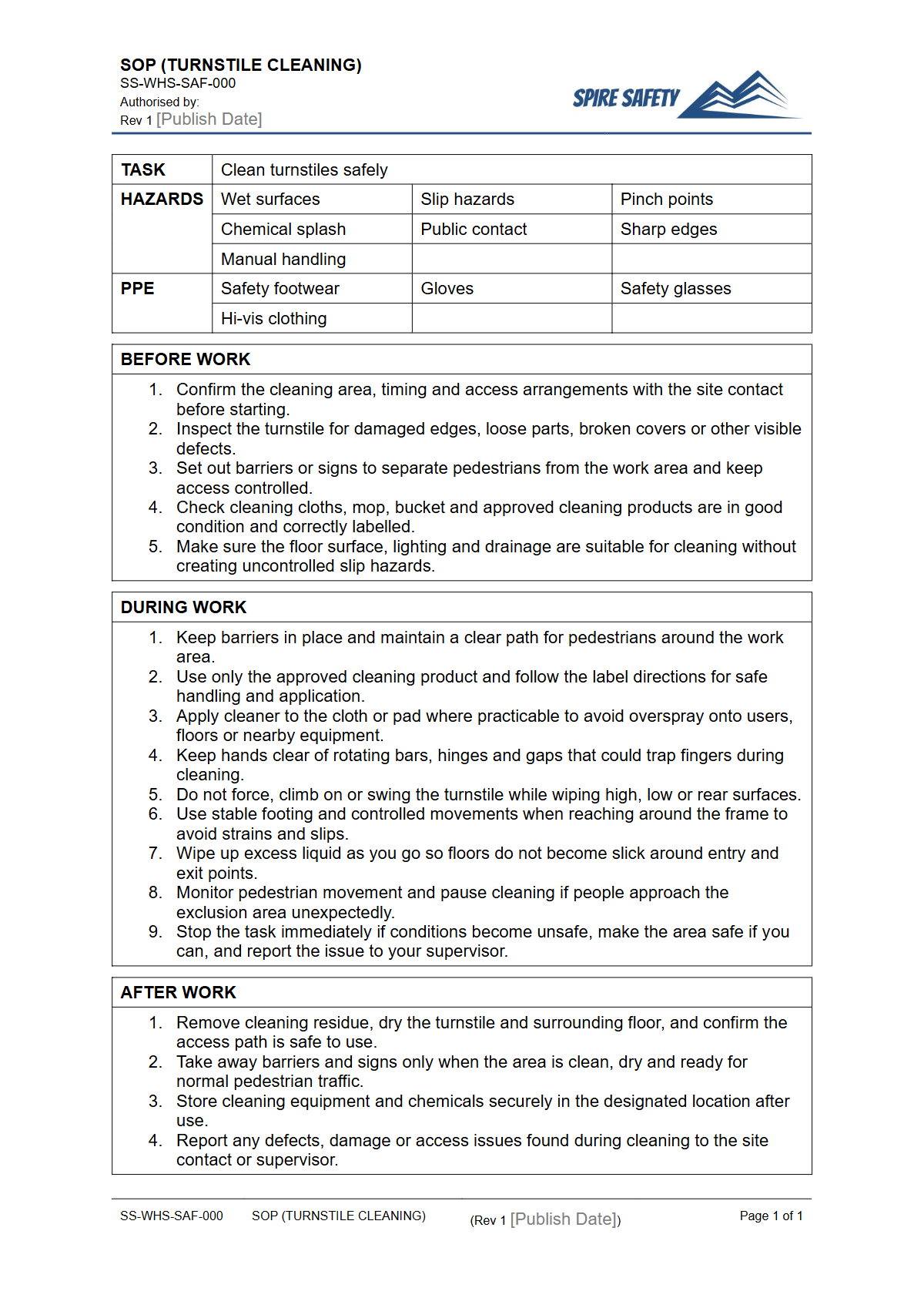
Download our free Safe Operating Procedure for Turnstile Cleaning. This template helps you document safety controls for a common but often overlooked task.
Free Safe Operating Procedure (Turnstile Cleaning) Template
DOCX • 126 KB + PDF
Updated Oct 2026
No signup required
Purpose of the Free Safe Operating Procedure (Turnstile Cleaning) Template
Establishing clear, safe work methods for routine tasks is a cornerstone of effective workplace safety. This free Safe Operating Procedure (Turnstile Cleaning) Template provides a structured framework for documenting the specific steps, hazards, and controls required to clean and maintain turnstile access systems safely.
Its purpose is to minimise risks to workers, such as electrical shock, chemical exposure, and musculoskeletal injuries, by outlining a repeatable, best-practice process. Using a standardised SOP ensures that all personnel follow the same approved procedure, reducing variability and the potential for incidents.
A well-drafted SOP is a critical control measure derived from a thorough risk assessment. It serves as an essential training tool for new employees and a reference for experienced staff, reinforcing safe behaviour and demonstrating the organisation's commitment to a safe working environment.
This document helps formalise procedures that might otherwise be passed down informally, ensuring that safety-critical information, like electrical isolation or correct chemical handling, is never missed. It forms a key part of your broader WHS management systems, providing auditable evidence of your processes.
Video walkthrough
How to use the Free Safe Operating Procedure (Turnstile Cleaning) Template
This template is provided in both DOCX and PDF formats for your convenience. To implement it effectively, you must customise it to reflect the specific circumstances of your workplace.
Generic procedures are not sufficient; your SOP must detail your equipment, your chemicals, and your environment.
Follow these steps to adapt the template:
- Step 1: Consultation. Discuss the cleaning task with the workers who perform it. Their direct experience is invaluable for identifying practical hazards and effective controls.
- Step 2: Customisation. Insert site-specific information, including the make and model of the turnstiles, the exact names of the cleaning chemicals used, and the required Personal Protective Equipment (PPE) such as gloves and safety glasses.
- Step 3: Detail Procedures. Clearly document pre-start checks, electrical isolation (Lockout-Tagout) steps, the cleaning sequence, and post-cleaning checks. Reference the location of Safety Data Sheets (SDS) for all chemicals.
- Step 4: Review and Approve. Have a competent person, such as a supervisor or WHS manager, review and approve the final document before it is issued for use.
- Step 5: Train and Implement. Train all relevant workers on the finalised SOP. Ensure they understand every step and have an opportunity to ask questions. Keep the SOP in a readily accessible location near the work area.
Important: We have developed this document as a starting point based on Australian WHS principles. You are responsible for ensuring the final, customised document is suitable for your specific operations and meets your legal obligations.
When to use it
A Safe Operating Procedure for turnstile cleaning should be used every time the task is performed. It is not just a document for emergencies; it is a guide for routine work.
It is particularly important during worker induction and refresher training to ensure consistent and safe practices. The SOP should also be a key reference document during safety meetings or toolbox talks, especially when discussing hazardous chemicals or electrical safety. Similar principles apply when documenting procedures for other powered equipment, such as those outlined in our conveyer system SOP.
Furthermore, the SOP must be reviewed and updated whenever there is a change in the workplace. This includes the introduction of new turnstile models, a change in cleaning chemicals, or following an incident or near-miss.
Regular reviews, typically annually, are also recommended as part of a scheduled WHS compliance auditing program to ensure the procedure remains current and effective.
Who should use it
This SOP is intended for use by several groups within an organisation. Primarily, the workers and contractors assigned to clean the turnstiles must be trained in and follow the procedure.
Supervisors and team leaders are responsible for ensuring their teams adhere to the SOP and for providing the necessary resources, such as correct PPE and tools. Facility managers and WHS personnel should use the template to develop and formalise the procedure as part of their risk management responsibilities. This process of identifying task-specific hazards is common across many types of equipment maintenance, as seen in procedures like a Safe Operating Procedure for deep fryer cleaning.
Developing robust SOPs is crucial whether you're cleaning with simple cloths or using equipment like compressed air for detailing. When tools are involved, their own safe operating procedures must also be considered, much like you would for an air compressor SOP. Ultimately, anyone involved in the lifecycle of the task—from planning and supervision to execution—should be familiar with the contents of the SOP. You can find more templates to build out your safety systems in our free WHS resources library.
Common mistakes
Common mistakes to avoid
- Failing to include specific Lockout-Tagout (LOTO) steps for electrical isolation before cleaning.
- Using generic instructions that don't match the specific turnstile model or cleaning chemicals.
- Forgetting to consult with cleaning staff, who have practical insights into the task's real-world hazards.
- Not referencing the specific Safety Data Sheets (SDS) for the chemicals required in the SOP.
Legal references
Legal considerations
The following legal requirements may be relevant to this type of work.
- Work Health and Safety Act (Harmonised) — Provides the primary duties for protecting workers and other people from work health and safety risks.
- Work Health and Safety Regulations (Harmonised) — Sets out requirements supporting the management of workplace hazards and risks.
The following codes may be relevant to this type of work.
- Managing WHS Risks Code of Practice — Provides practical guidance on identifying hazards, assessing risks and applying effective controls.
- Work Health and Safety Consultation, Cooperation and Coordination Code of Practice — Provides practical guidance on consulting workers and coordinating with other duty holders.
- Managing the Work Environment and Facilities Code of Practice — Provides practical guidance on safe work environments, workplace facilities and related controls.
Did you know
Slips and Trips
Slips, trips, and falls are a leading cause of serious, preventable injuries in Australian workplaces, accounting for thousands of workers' compensation claims each year. Cleaning activities are a major contributing factor.
Sensitive Electronics
Modern turnstiles contain complex electronics, sensors, and logic boards. Using incorrect cleaning fluids or methods, such as spraying liquid directly into seams, can cause short circuits and costly damage.
FAQ
Frequently asked questions
01What are the main hazards when cleaning turnstiles?
02Do I need a Safety Data Sheet (SDS) for my cleaning chemicals?
03Is a Safe Operating Procedure the same as a risk assessment?
04How often should an SOP for turnstile cleaning be reviewed?
Share this resource
Free Safe Operating Procedure (Turnstile Cleaning) Template
Browse Categories
How To Use It
- 1Download and open in Word or PDF.
- 2Replace the placeholders with your business details.
- 3Get it reviewed by a WHS specialist before rollout.
Need it customised?
Our WHS consultants can adapt this template to your site, run a gap analysis, or audit what you already have in place.
Book a Free Consultation WHS consulting servicesor call 1300 156 382
Related templates
- Free Safe Operating Procedure (Turnstile Operation) Template
- Free Safe Operating Procedure (Turret Punch) Template
- Free Safe Operating Procedure (Tyre Changer) Template
- Free Safe Operating Procedure (Tyre Inflation) Template
- Free Safe Operating Procedure (Tyre Recycling Intake) Template
- Free Safe Operating Procedure (ULD Handling) Template