
Free Safe Operating Procedure (Turbidity Meter) Template
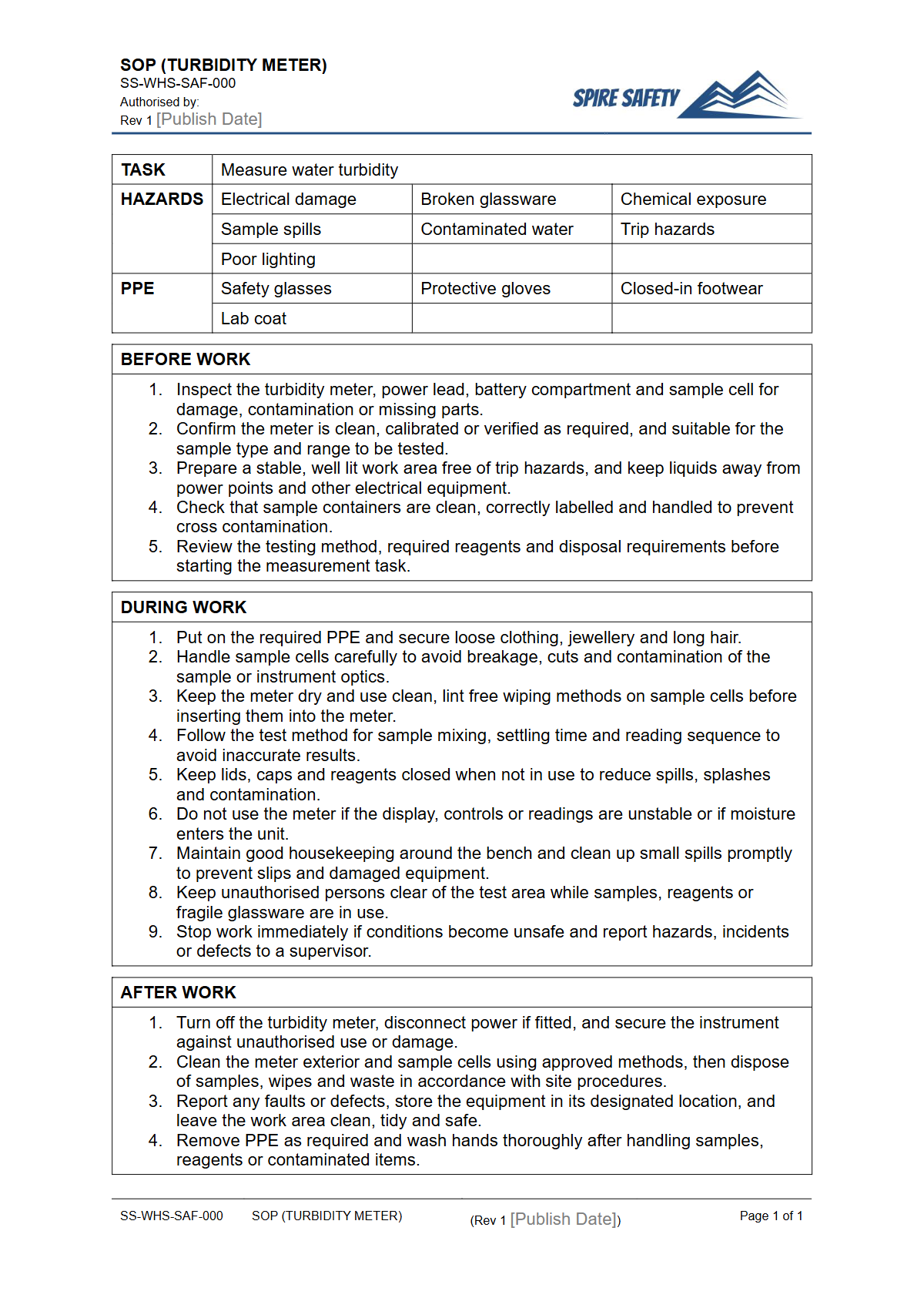
Our free Safe Operating Procedure (Turbidity Meter) template provides a solid foundation for documenting safe work methods. Download your DOCX to get started.
Free Safe Operating Procedure (Turbidity Meter) Template
DOCX • 126 KB + PDF
Updated Oct 2026
No signup required
Purpose of the Free Safe Operating Procedure (Turbidity Meter) Template
Using a turbidity meter is a common task in industries ranging from environmental monitoring and construction to food and beverage production. While generally a low-risk activity, it involves potential hazards from electricity, chemical reagents, and glassware.
This Free Safe Operating Procedure (Turbidity Meter) Template provides a structured framework for documenting the required steps to perform the task safely and consistently. A well-defined SOP ensures that every operator follows the same validated process, minimising errors and promoting a safe work environment.
Documenting these procedures is a fundamental part of creating robust WHS management systems. It serves as a critical training tool for new employees, a reference for experienced staff, and evidence of your organisation’s commitment to managing risks. By clearly outlining pre-start checks, calibration, operation, cleaning, and maintenance, you create a clear standard for safe and accurate work.
Video walkthrough
How to use the Free Safe Operating Procedure (Turbidity Meter) Template
This template is a comprehensive starting point designed to be adapted to your specific operational context. To implement it effectively, you should first download the DOCX file and consult with the workers who actually use the turbidity meters.
Their direct input is essential for identifying unique workplace hazards and practical control measures.
Note: We have created this document as a guide. You must customise it to reflect the specific equipment, chemical safety data sheets (SDS), and operational risks present in your workplace.
Once customised, the SOP forms a key part of your safety system. The effectiveness of your procedures can be verified during a WHS compliance auditing process, which will check that documented steps are being followed in practice.
Customisation Steps:
- Review and Edit: Go through each section and replace the generic placeholder text with details specific to your turbidity meter model(s) and workplace.
- Incorporate Chemical Safety: Add specific details from the Safety Data Sheets (SDS) for any calibration standards or cleaning solutions used.
- Specify PPE: Detail the mandatory Personal Protective Equipment (PPE) required, such as safety glasses and gloves.
- Consult and Train: Review the finalised draft with all relevant personnel to ensure it is clear and practical. Use the SOP as the basis for all future training on the equipment.
- Approve and Publish: Have the document formally approved by a manager or WHS representative and make it easily accessible to all operators.
When to use it
A Safe Operating Procedure for a turbidity meter should be used whenever the equipment is operated. It is particularly important during tasks that require precision and adherence to safety protocols.
This includes routine water quality analysis on a construction site, where runoff needs to be monitored to prevent environmental contamination. For tasks involving heavy machinery on such sites, our free Trencher SOP template provides a similar procedural guide.
This SOP is also vital for environmental compliance testing, process control in manufacturing, and for any scientific or laboratory work where consistency and accuracy are paramount.
Who should use it
This SOP is intended for all personnel who are required to operate, calibrate, or maintain a turbidity meter. This typically includes environmental scientists, field technicians, laboratory assistants, water treatment plant operators, and quality control staff in the food and beverage industry.
Supervisors and managers should also use the document to ensure they understand the correct procedures for training and supervision. Having clear SOPs for all key equipment, such as a Conveyer System SOP in a processing plant, ensures a consistent approach to safety across the entire organisation.
By establishing a clear, documented procedure, you not only manage risk but also improve the quality and reliability of your data. A robust SOP is a sign of a mature safety culture.
Like our Air Compressor SOP, this document helps standardise the safe use of common workplace equipment. You can explore more templates like this one in our free WHS resources library to build out your safety documentation.
Common mistakes
Common mistakes to avoid
- Failing to properly calibrate the meter before taking measurements, leading to inaccurate results.
- Using sample vials (cuvettes) that are scratched, smudged with fingerprints, or dirty, which interferes with light transmission.
- Not allowing the sample to de-gas, resulting in microscopic air bubbles that can be incorrectly measured as turbidity.
- Neglecting to record calibration data, measurement results, and maintenance activities in a dedicated logbook.
Legal references
Legal considerations
The following legal requirements may be relevant to this type of work.
- Work Health and Safety Act (Harmonised) — Provides the primary duties for protecting workers and other people from work health and safety risks.
- Work Health and Safety Regulations (Harmonised) — Sets out requirements supporting the management of workplace hazards and risks.
The following codes may be relevant to this type of work.
- Managing WHS Risks Code of Practice — Provides practical guidance on identifying hazards, assessing risks and applying effective controls.
- Work Health and Safety Consultation, Cooperation and Coordination Code of Practice — Provides practical guidance on consulting workers and coordinating with other duty holders.
- Managing the Work Environment and Facilities Code of Practice — Provides practical guidance on safe work environments, workplace facilities and related controls.
Did you know
The Unit of Measurement
The standard unit of measurement for turbidity is the Nephelometric Turbidity Unit (NTU). It measures the amount of light scattered at a 90-degree angle by suspended particles in a water sample.
Historical Method
One of the earliest methods for measuring turbidity was the Jackson Candle Turbidimeter, where a user would pour a water sample into a calibrated glass tube until the flame of a candle underneath was no longer visible.
FAQ
Frequently asked questions
01What is a Safe Operating Procedure for a turbidity meter?
02Who is responsible for writing a Turbidity Meter SOP?
03How often should a Turbidity Meter SOP be reviewed?
04Does this template cover calibration and maintenance procedures?
Share this resource
Free Safe Operating Procedure (Turbidity Meter) Template
Browse Categories
How To Use It
- 1Download and open in Word or PDF.
- 2Replace the placeholders with your business details.
- 3Get it reviewed by a WHS specialist before rollout.
Need it customised?
Our WHS consultants can adapt this template to your site, run a gap analysis, or audit what you already have in place.
Book a Free Consultation WHS consulting servicesor call 1300 156 382
Related templates
- Free Safe Operating Procedure (Turf Divot Repair) Template
- Free Safe Operating Procedure (Turf Moisture Check) Template
- Free Safe Operating Procedure (Turf Roll Handling) Template
- Free Safe Operating Procedure (Turnstile Cleaning) Template
- Free Safe Operating Procedure (Turnstile Operation) Template
- Free Safe Operating Procedure (Turret Punch) Template